Showing posts sorted by date for query malhotra. Sort by relevance Show all posts

Friday, 19 September 2025

The lifestyle medicine of Aseem Malhotra


Taking a rare break from trying to free Lucy Letby, Private Eye's Phil Hammond has written a justified excoriation of the star turn at Reform UK's recent conference, Aseem Malhotra. I agree with most of it and I have said same much the same myself, but I was struck by this sentence...
 

Malhotra is particularly dangerous because he talks sense in some areas (eg. lifestyle medicine) while spouting scaremongering conspiracies with no credible evidence base.

 
When, exactly, did Malhotra ever talk sense about "lifestyle medicine" or anything else? When he said that saturated fat was good for you? When he said that exercising won't help you lose weight? When he said that Italians have a low carb diet? 
 
Perhaps Hammond is thinking about the time when he claimed that sugar was the new tobacco, but that's not really based on "credible evidence", is it? 
 
Or perhaps he's thinking about when he claimed - in a journal article that had to be corrected - that the food industry has been “buying the loyalty of bent scientists". Doesn't that sound like a scaremongering conspiracy theory?
 
Maybe he's thinking about the time he said that people who have high cholesterol live longer than people who don't, and that Big Pharma doesn't want you to know that? Again, that sounds like a bit of a scaremongering conspiracy with no credible evidence base to me.
 
You can go back as far as you want but you will not find Malhotra "talking sense" about anything. All that has happened is that he has swapped high status conspiracy theories for low status conspiracy theories. 
 
What makes Malhotra dangerous is not that he talks sense but that he abuses the trust that people have in doctors by cherry-picking evidence to suit a particular narrative. He's been doing it from the start. That is why he was able to hide in plain sight among 'public health' campaigners for so long.


Tuesday, 16 September 2025

RIP Graham "mad dog" MacGregor

I was sadder than you might expect to read that Graham MacGregor has died, aged 84. The Telegraph focuses on his anti-salt advocacy, but you probably know him better for setting up Action on Sugar.

We sparred on TV and radio many times and I was always happy to let him talk because he was so zealous in his campaigning and so extreme in his demands that it could only put the median voter off. He was a fanatic and he didn't try to hide it. I don't mind that. I prefer a sincere crank to a fanatic who pretends to be a moderate. You knew where you were with Graham. Most of what he said was deranged and he told some outright lies, but he was upfront about his longterm goals, such as plain packaging for chocolate and halving the amount of sugar in all foods.

He was also, I think, an eccentric, and at least eccentrics are colourful. He said something to me once that gave me the strong impression that he was right-wing, which would certainly make him an eccentric in 'public health' circles. His accent and appearance were more military than medical, but he was a proper medical doctor and, as far I can tell, he never profited personally from Action on Sugar. 

In 2014, we both appeared on 'Alan's Ding Dong', a Partridge-esque feature of the Alan Titchmarsh Show, to debate the merits of a sugar tax in front of an audience of pensioners who had been bussed in from middle England. It went to a public vote in which the audience were invited to hold up a yellow paddle if they were opposed to the idea. As you can see from the photo below, you should never get between OAPs and their sugar.

I also remember MacGregor and fellow nanny statist Susan Jebb shouting at each other at the 2015 Sugar Summit. I couldn't hear exactly what was being said but it started after Jebb accused him of using "loose words" and "factual inaccuracies" on stage.


I only had a private conversation with him a couple of times, but when we were chatting before doing the Spectator podcast in 2017, he told me with some reluctance that he had agreed with every word of an article I had recently written (unfortunately I can't remember which one). When I asked him about the departure of Aseem Malhotra from Action on Sugar, MacGregor called him "bonkers" and was just getting into his stride when he stopped himself said "Anyway, I'm not going to talk about Aseem - especially to you!"

I met him again at a small conference held by the sugar industry in a London hotel. MacGregor was only required for a panel on public health late in the afternoon but he turned up for the whole thing and ended up listening to industry folk talking about things like fertilisers, the climate and other issues that affect sugar farmers. After a dry and detailed discussion of the global sugar market from an American speaker via videolink, MacGregor raised his hand to talk about how sugar taxes and food reformulation were sweeping the world and asked how the industry was going to cope with the inevitable downturn in sales. The American looked rather baffled and said that he was not projecting any decline in sugar consumption.

His legacy was mostly malign and a lot of what he said was objectively wrong, but I could never bring myself to hate the old boy. At least he was a character. RIP.


Monday, 3 April 2023

High status conspiracy theories

I recently wrote about high status conspiracy theories for Quillette, featuring James O'Brien, George Monbiot, Carole Cadwalladr, Philip Hammond, Aseem Malhotra, Peter Jukes, Andrew Adonis, Tom Watson, Jeremy Corbyn and Naomi Klein. 

Who can forget Lord Andrew Adonis, once considered the blandest of centrists, demanding answers from the BBC about what he called “the fake vicar scandal”? Perhaps you have forgotten, so let me remind you. It was a minor conspiracy theory of Adonis’s own invention that stemmed from his mind erupting at seeing a female vicar on a Newsnight panel praising Theresa May’s Brexit deal. With a little digging, Adonis discovered that she had appeared as an extra in a number of films, including a villager in Macbeth and a funfair attendant in Pudsey the Dog: The Movie. Rather than accept that she was a vicar who did a bit of acting, Adonis concluded that she was an actor hired by the BBC to pretend to be a Leave voter.

Replying to one of Adonis’s many tweets about “Vicargate,” Newsnight presenter Emily Maitlis wrote: “To have got to a place where you could chose to believe that enough to write it—is deeply worrying.” There are, as Donald Trump would say, many such cases. If COVID-19 instigated a wave of conspiracy theories on the Right, Boris Johnson’s election victory had the same effect on the Left and Brexit caused many centrists to have a meltdown. Everybody’s had something to break their brains in recent years and some people may never recover.

Many of the classic conspiracy theories arise from a sense of disbelief. A simple car crash seemed to be an inadequate ending to the Princess Diana soap opera. JFK was too important to have been killed by someone as insignificant as Lee Harvey Oswald. 9/11 was too enormous to have been mere terrorism. The logistics of putting a man on the Moon were too mind-blowing to have been achieved in 1969.

COVID-19 and lockdown delivered a psychic shock on a greater scale than any of these events. That fallible politicians were grappling with the extraordinary problem of dealing with a deadly new virus seemed an inadequate explanation when one could instead believe that it was a false flag to sell vaccines and install a world government (or, from the opposite perspective, that the government had a policy of culling the elderly).

The election of Donald Trump and the vote to leave the EU were similarly shocking to those who had previously regarded those developments as unthinkable. As we retreat into our echo chambers, there is a growing inability to even acknowledge the existence of opposing views, let alone consider them valid. When everyone you know agrees with you, it comes as a shock when the votes are counted and you realise that your side is outnumbered by a basket of deplorables. When something seems unbelievable, the temptation is to simply disbelieve it and reach for alternative explanations.


Saturday, 25 March 2023

Lessons from my fat belly

The meniscus is the cartilage in the middle of the knee that stabilises the knee joint. In October, I bust both of them in a mishap at a friend’s wedding. I won’t go into details but it involved a dance floor, ten hours of drinking and Whitesnake’s Here I Go Again.

It was very painful indeed. I couldn’t really move my knees at all. I developed a silly walk. I would have to straddle stairs, wobbling from side to side. Going upstairs wasn’t too bad, but going down again was agonising.

Fortunately, I didn’t need surgery so all I could do was rest my legs and keep them as straight as posssible. So that’s what I did. It took three months before they got anything close to normal again. They are still slightly sore.

A week before the wedding I happened to buy a new suit. Putting it on again in February I noticed that the trousers no longer fitted me. I had got larger. For the first time in my life I weighed more than 13 stone.

I am not particularly weight conscious but 13 stone is too much. 12 stone would be perfectly OK. 11 stone would be ideal. 13 stone is officially overweight and it showed. I had, undeniably, a fat gut.

In retrospect, it is obvious what happened. My diet hadn’t changed, but for several months I had ceased to do any form of physical activity. I don’t mean exercise, in the organised, sporty sense of the word. I don’t really do that. Essentially, I mean walking.

When I got a phone with a FitBit-style app, I was surprised by how much I move around. Yesterday, for example, I walked 7.1 miles. That’s more than average, but I generally clock up at least two miles just walking into town at lunchtime to get some bread. If I go to London I will walk at least five miles.

This all adds up. According to the app, the 7.1 miles I walked yesterday burned 561 calories. Admittedly, I consumed more calories than that in red wine while in London, but then I would have done that if I was sat at home.

I don’t know about you, but I don’t eat more on days when I walk more. By the same token, I didn’t eat less when I was barely walking at all. The result was a fat belly, as the first law of thermodynamics would predict.

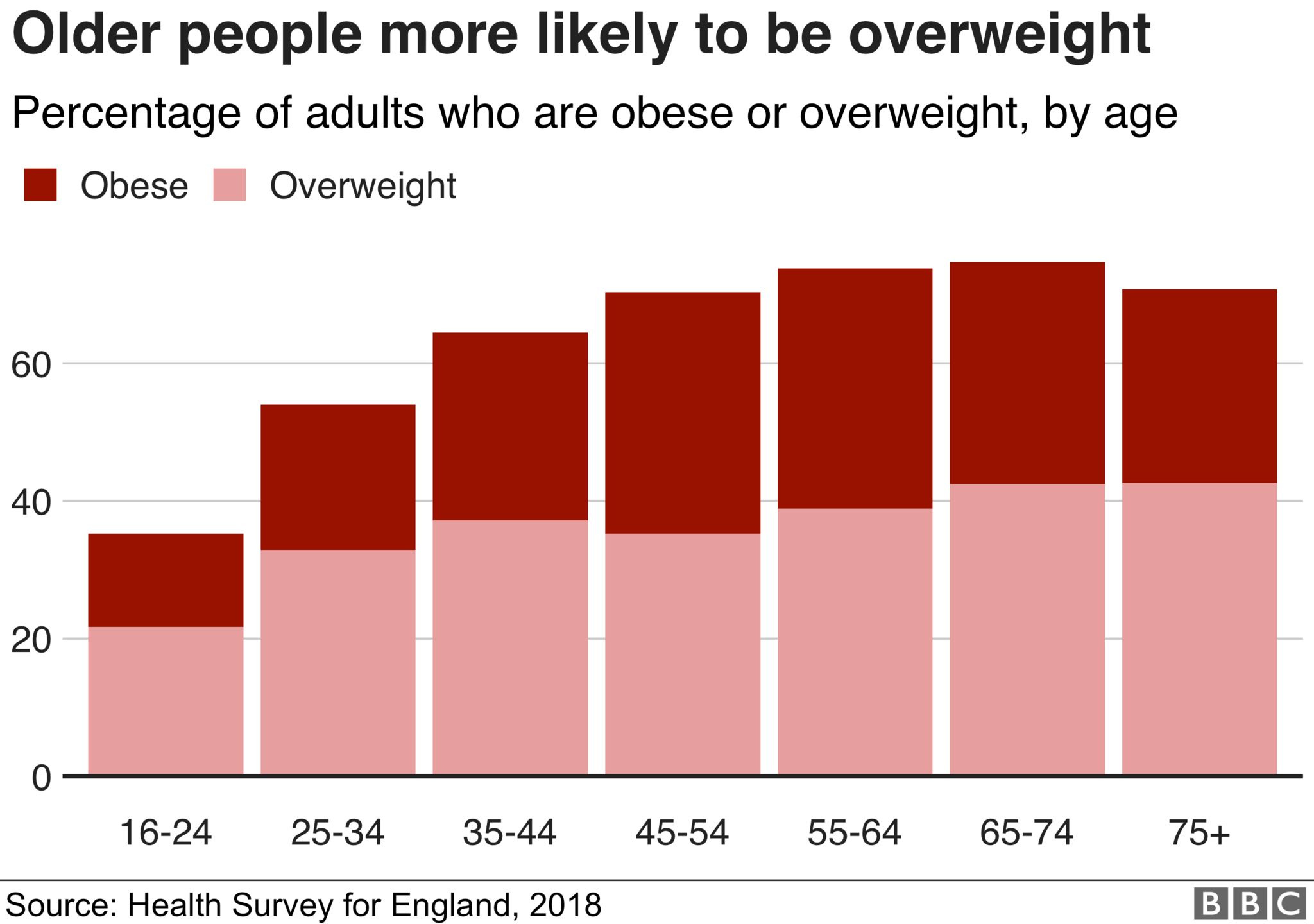
This is how people get obese. It happens gradually. They put on a bit of weight on holiday or at Christmas and never lose it. They just accept that they get bigger as they get older. They just accept that their old clothes will never fit them again. It is why rates of obesity rise with age.
 

You will doubtless be relieved to hear that I am no longer in the 13 Stone Club. I now make a conscious effort to do a bit of walking, I don’t eat cheese and crackers in the evening (as I am sometimes tempted to do) and I have lost more than half a stone.

The reason I mention this rather dull anecdote is that it demonstrates something obvious that is weirdly denied by people such as Henry Dimbleby, whose new book I reviewed this week, namely that physical activity has a major role in regulating body weight. One chapter of his book is titled ‘You can’t outrun a bad diet’ (a line nicked from the full-blown crank Aseem Malhotra). In it, Dimbleby asserts:
 

The idea that exercise is a good way to lose weight is not just incorrect it is actively harmful.

 
He accepts that Britons are more sedentary now than in the 1970s and even accepts that exercise is effective in preventing weight gain among people who have lost weight. But he thinks that everybody else who exercises just gets hungrier and eats more. All I can say is that this is not my experience. Perhaps it is true of people who work out in the gym. The evidence he cites is based on people who exercise, in the sporty sense of the word, whereas I am talking about physical activity - moving around - which, as Dimbleby acknowledges, has been engineered out of most people’s lives by labour saving devices and the decline of manual labour.
 
Now, you could argue that it is abstaining from cheese, rather than walking a few miles a day, that has reversed my weight gain, but that implies willpower, something that Dimbleby also thinks doesn’t work.
 

Libertarians always fall back on that same tired refrain - Education! Exercise! Willpower! - which we know to be utterly ineffective.

 
To which one can only reply, ‘Speak for yourself, Henry’. They are, in fact, the only things that have ever been effective.
 
 
Cross-posted from my Substack.


Tuesday, 21 February 2023

Accolades for Aseem

Book early to ensure disappointment

Aseem Malhotra has gone all the way down the rabbit hole in the last year and is off the South Africa to spread his anti-vax messsage, having done likewise in India recently. The GMC say they won't investigate him because the vast majority of the British public have already been vaccinated and so the damage he can do to public health is limited. This is surely less convincing as an excuse for inaction when it comes to less vaccinated parts of the world. In any case, Malhotra is deliberately undermining confidence in mRNA technology in general, not just Covid vaccines.

Be that as it may, it is grimly amusing to see the flyer above using adoring quotes from people who fell for his low carb schtick back in the day. I wonder how anti-vaping fanatic Simon Capewell, anti-sugar zealot Robert Lustig and government-loving libertarian Shami Chakrabarti feel about their names being used to promote Malhotra's latest quackery?

It's a shame that there was no room on the flyer to quote Action on Sugar who worked out seven years ago that Malhotra was "completely mad", albeit only in relation to his views on statins and fat. Getting kicked out of Action on Sugar for being mad is like being kicked out of the KKK for being bigoted. But even they could see the signs.  

The signs were there from the very start. People in 'public health' didn't see them for the same reason they didn't spot that David Miller was a wrong 'un - they told them what they wanted to hear and so many cranks and conspiracy theorists work in 'public health' that it is easy for such people to hide in plain sight.


Thursday, 29 December 2022

2022 in review


At Spiked, I started and ended the year by talking about how useless the COVID-19 models were. Having got that of my chest, it is now time for peace and reconciliation. Incredibly, some people were still calling for more restrictions as late as April 2022. They just couldn't let it go.

If you wanted to follow the evidence on smoking and COVID-19, this blog was almost the only place to go. I stopped counting studies when I got to 100. The great majority found smokers to be less likely to be infected, but when I discussed this at SpikedI got the Facebook red flag treatment again.

In January, more evidence emerged of vaping's extraordinary ability to get smokers off cigarettes even when they don't want to quit. This was followed by a compelling Cochrane Review later in the year. Australians, however, were drip-fed a diet of lies about e-cigarettes in a country where the tobacco black market has grown to an absurd extent, and the Netherlands decided it wasn't even able to tolerate something as harmless as nicotine pouches. One Aussie doctor became so misinformed he started giving his son cigarettes to wean him off the vapes!

Gamblers, the gambling industry and their foes awaited a White Paper that was never published. The anti-gambling coalition, which wrongly presented the issue as one of public health, touted a claim about the number of gambling-related suicides which Public Health England had made up in its last days. It didn't stack up. In November, the Times also made a claim about problem gambling that was obviously untrue. 

With regards to tobacco, fifteen years after the smoking ban began and a decade after I stopped smoking, I still thought it was a terrible mistake. I also argued that Theresa May should have consulted smokers before she promised that most of them would quit by 2030. Some of the ideas put forward by a member of the Blob to achieve this target were frankly insane.

On food, the government struggled to cope with the commitments made by a delirious Boris Johnson in 2020. A ban on placing tasty food in prominent positions in supermarkets came into effect in October (predictably, nanny statists immediately complained about imaginary 'loopholes'), but bans on BOGOFs and advertising were pushed back to 2023 and 2024 respectively. Unpopular though they were, the Conservatives could see that charging people more for food wasn't the smartest thing to during an inflation-driven cost of living crisis. Meanwhile, the Mayor of London made ridiculous claims about his ban on junk food advertising.

By July, the evidence that minimum pricing had died on its arse in Scotland had become overwhelming. Expect much high jinx when the SNP is required to prove it worked to bypass the sunset clause next year. And expect more junk science about alcohol advertising now that it is in the cross-hairs of the Scottish Government.

In crank's corner, George Monbiot was hoist by his own 'who funds you?' petard and James O'Brien worked on yet another conspiracy theory for his listeners at LBC. Aseem Malhotra continued his downward spiral and anti-vaxxers wilfully misunderstood every piece of Covid data.

In the summer, I wrote a series of columns for the Times in which I discussed the perils of low interest ratesthe risks of hiking corporation tax and why the energy price guarantee should be means tested. To no avail, clearly.

It was a busy year in politics with three Prime Ministers and goodness knows how many Chancellors. Liz Truss's brief tenure was a disaster for the Conservative Party and, briefly, for the pound, but the economy was broken before she got her hands on it and it is a myth that Trussonomics cost the country £30 billion. When Rishi Sunak took over, Jeremy Hunt preached austerity while borrowing like there was no tomorrow and doing nothing about inflation.

On a happier note, my pal Ronnie O'Sullivan won his seventh snooker World Championship and I wrote about how lucky we are to share a planet with him. I also reviewed the deluxe edition of the Beatles' Revolver and the solo career of Paul McCartney. On a less happy note, I reviewed a documentary about Russia (1985-1999).

I also reviewed some excellent books about The New Puritans and interest rates, plus a contrarian take on Prohibition.

And I interviewed lots of people for The Swift Half with Snowdon. Some of the most interesting discussions were with some of the less well known people, including Angela Knight (on energy), David Zaruk (on anti-science NGOs), Bill Hanage (on Covid), Marewa Glover (New Zealand authoritarianism) and Edward Chancellor (interest rates).

Thanks for all your comments, shares and visits in 2022. Have a great New Year's Eve and I'll see you on the other side.


Friday, 16 December 2022

Take no one's word for it

I take it as a slight badge of honour that an article I wrote in the early days of Covid was flagged as fake news on Facebook. I wrote a follow up to the offending article for Spiked two weeks ago titled 'The great Covid and fags cover up'. Regular readers will know what I'm talking about. If you don't, hit the link.

An organisation called Logically is Facebook's official fact-checking partner.
 

When Logically rates a piece of content as false, Facebook will significantly reduce its distribution so that fewer people see it, apply a warning label to let people know that the content has been rated false, and notify people who try to share it.

 
They have now rated my new Spiked article as 'misleading' which is a rung above 'false' in their ladder of truthiness. Why is it misleading? According to the accompanying blog post...

The article includes links to Snowdon's blog, where he has compiled a list of studies (including those published by reputed medical journals such as Lancet and Nature), and claims that an overwhelming “87 percent” of the studies acknowledge that smokers are typically less likely to catch the virus and be hospitalized.

On reviewing the exhaustive list of studies that Snowdon refers to, Logically found that several of them are pre-prints rather than peer-reviewed published papers.

You don't need to dig too deeply to see that. I explicitly say a study is a pre-print in the few cases where that is the case. There are only four of them, two of which use the same UK Biobank data. Excluding them makes no difference to the overall picture. The vast majority of studies have found smokers at less risk of getting COVID-19 and hardly any of them have found the opposite.
 
The author himself says that he has not done a "systematic review" of all the studies that have been listed.
 
Quite true. It is a compilation of every relevant study that crosses my radar, although I have some expert help.
 

In his article, Snowdon argued that search results for COVID-19 and tobacco/smoking lead to WHO briefs and articles in publications such as the British Medical Journal (BMJ). He claims that these studies merely state that smokers are at greater risk without addressing the actual findings of the studies that suggest smokers had a reduced risk of contracting COVID-19.

 
Indeed I do. Anyone who does a casual search would come away thinking that there was little to no evidence of a protective effect. Worryingly, this is all the fact-checker seems to have done. He focuses on those very same out-of-date and inaccurate websites that come up at the top of the listings - in particular, a short opinion piece by Jonathan Grigg (or 'John Griggs', as the fact-checker calls him):
 

In an article published in The Lancet on August 16, 2022, Professor John Griggs, a respiratory and environmental medicine specialist, acknowledged that there were studies in the early stages of the pandemic that appeared to provide evidence that smoking might protect against COVID-19. However, he also noted that during those early stages of the pandemic, "scientific journals rightly responded to the SARS-CoV-2 pandemic by more rapidly publishing their COVID-19 research”.

 
Yes, but the point is that these studies kept coming out long after the early days of the pandemic and have been remarkably consistent. 

Prof. Griggs also cited a more detailed article published in The Lancet, which examined epidemiological studies of tobacco use and COVID-19, and found that the studies have produced conflicting results, meaning further research is needed before one can claim that smoking affects susceptibility to the virus. The article nonetheless concludes that "the evidence indicates that smokers are at greater risk of poor outcomes from COVID-19, including hospital admission and progression to severe disease than are non-smokers."

This is a reference to an article by the renowned anti-smoking academic Neal Benowitz and his colleagues. It looked at 51 relevant studies, none published after August 2021, and found the evidence to be 'conflicting'.
 
Firstly, given what the fact-checker says about systematic reviews above, let's bear in mind that Grigg notes that Benowitz's article is...
 
...not a formal systematic review and based largely on searches up to August 2021
 
So how does this collection of studies differ from mine, apart from being half the size (and also smaller than the meta-analysis I mentioned in the article but which the fact-checker does not address)?
 
We identified conflicting evidence for the effects of cigarette smoking on the incidence of SARS-CoV-2 infection (appendix pp 3–6). Specifically, we identified 12 multivariable and eight univariate or frequency-reporting studies that found a positive effect of cigarette smoking on SARS-CoV-2 infection rates, and 14 multivariable and 12 univariate or frequency-reporting studies that found a negative effect.

That does indeed sound like a highly conflicting literature, but is it? Dip into the appendix and you will see that many of the studies are either irrelevant or don't say what Benowitz claims. The criteria for my list is that the study must be an epidemiological study showing the relative risk for SARS-CoV-2 infection among current smokers. Benowitz reckons he found twelve studies using multivariate models which show that smokers are more likely to get COVID-19, but he is clearly using far more generous criteria because they include the following... 
 
Li et al. - an ecological study about vaping, not smoking.  
 
Yoshikawa et al. - an ecological looking at smoking rates in Japanese districts. 
 
Liu et al. - another weak ecological study.

Wang et al. - a study of hospitalisations, not infections.

Gaiha et al. is a new one to me. It found, rather implausibly, that smokers were more likely to get COVID-19 but only if they vaped as well. Past use of e-cigarettes - but not current use - was strongly associated with COVID-19 risk. Make of that what you will.

McQueenie et al. is another study using Biobank data (two pre-prints using this data are in my list). It found that current/former smokers (the study didn't distinguish between the two) were 26% more likely to test positive. 

Colaneri et al. clearly states that 'being a current smoker was negatively associated' with COVID-19 infection. Presumably, Benowitz's excuse for including in his list was that it found that former smokers (like other nonsmokers) were more likely to get it.
 
Chen et al., which is in my list, didn't find an association between smoking or vaping and Covid infection but did find an association between vaping and smoking (i.e. dual use). 
 
Didikoglu et al. is another Biobank study. This one found that people whose mothers smoked in pregnancy were more likely to test positive. It is unclear from the study whether the same was true of people who smoked themselves.
 
Ho et al. is yet another Biobank study. This one found that current/former smokers were 45% more likely to test positive for SARS-CoV-2 (1.45 (95% CI 1.19 to 1.79)).
 
How many times was the Biobank data dredged during the pandemic?! Prats-Uribe et al. is yet another study using this dataset. This one separated current smokers from former smokers and found that current smokers were 42% more likely to test positive (1.42 (95% CI, 1.21–1.66)).
 
Of these twelve studies, only two fit my criteria and one is already on it so I've amended the list to include Prats-Urbine et al.
 
Benowitz also claims to have four studies using univariate models which find smokers to be at greater risk of infection. They are...

Albiges et al. didn't look at infections, it looked at mortality risk. 

Li et al. is the same study mentioned above; an ecological study about vaping, not smoking.

Dev et al. found an association between smoking and infection but this disappeared after adjustment. I'm happy to include this study in the list as supporting the null hypothesis.

Similarly, Mostafa et al. found associations with both former and current smoking which disappeared after adjustment for confounding factors. I'll add this one as a null finding too.

Unless we think epidemiological findings are more robust before they are adjusted for exogenous variables, none of these studies support Benowitz's argument. And none of the 'frequency-reporting studies' are relevant at all (I won't list them but feel free to check them yourself).

Benowitz also cites five studies which, he says, support the null hypothesis, i.e. they find no association either way. They are...

Liu et al. did not look at infection although it did find that smoking was not associated with Covid mortality risk.

Zhu et al. looked at hospitalisations, not infections. 

Dadgari et al. is a study from Iran which does indeed support the null hypothesis. I'll add it to the list.

Dayem et al. is a study from England which doesn't give relative risks for smoking but does say that 'current smoking status appeared to have a protective effect in our cohort after adjusting for comorbidities, as has been observed by others'.

Finally, Benowitz lists 14 studies using multivariate analyysis which show a protective effect from smoking, plus six using univariate analysis. Some of them are on my list already and a few of them don't meet my criteria, but there are eight studies that I've missed. They are...

Ghinai et al. is a study of homeless people in Chicago which found that smokers were less likely to be infected (0.71; 95% CI, 0.60-0.85).

Gu et al. is a US study which found: 'Being a current smoker (self-reported in the latest EHR encounter) was associated with a reduced chance of having positive test results (OR, 0.31 [95% CI, 0.20-0.48]; P < .001).'

Vila-Córcoles et al. is a study from Spain which found smokers 57% less likely to be infected (0.43 (0.25-0.74)).

Fernandez-Fuertes et al., is a study from Spain involving HIV patients. It found that 'active tobacco smoking was the only factor independently associated with lower risk of SARS-Cov-2 infection [Incidence rate ratio: 0.29 (95% CI 0.16–0.55)'.

Green et al. is a study from Israel involving patients with bronchial asthma which found: 'A significantly higher proportion of smokers was observed in the COVID-19–negative group than in the COVID-19–positive group (4734 [13.45%] vs 103 [4.55%]; P < .001).'

Gu et al. is a study from Michigan which found that smokers were much less likely to test positive for COVID-19 (0.31 (0.20-0.48)).

Lombardi et al. is a seroprevalence survey of Italian healthcare workers which found smokers were 59% less likely to test positive (0.41 (0.27-0.61)).

Holuka et al. is a study from Luxembourg which found smokers half as likely to test positive for COVID-19 (0.50 (0.30–0.83)).

These eight, plus the four studies that reached different conclusions, mean that we have an extra twelve studies to add. So let's get rid of the four pre-prints, two of which use the Biobank data. If they were going to be published in journals, they probably would have been by now. I've also taken a couple of studies out of the list, like this one, which are interesting but don't quite fit my criteria. I kept the Mendelian Randomisation studies even though they don't really fit the criteria because they're virtually the only studies that find an increased infection risk from smoking.

The new list is here. It has a grand total of 105 epidemiological studies looking at the relative risk of SARS-CoV-2 infection among current smokers. 

Of the 105 studies, 90 find a statistically significant reduction in risk of infection from SARS-C0V-2 among current smokers.

Eight of them find no statistically significant association either way (although theyy are nearly all below 1.0).

Four of them find an increase in risk.

Three of them found mixed results.

I mean, I guess you could say that these studies are 'conflicting' but there's a pretty clear tendency in one direction, isn't there?

The fact-checker then goes to the next link in the search results and finds the WHO... 
 

The WHO, in an updated 2020 review, which excluded the non-peer-reviewed reports and pre-prints, found that smoking is associated with increased severity of disease and death in hospitalized COVID-19 patients. However, it could not quantify the risk to smokers of infection by SARS-CoV-2 or hospitalization for COVID-19. The brief said that more population studies are needed to address these questions


Even if we ignore the fact that the WHO is corrupt and incompetent, the important thing to note is that this was a '2020 review'. More population studies have been conducted in the last two and half years and they overwhelmingly point to a protective effect. Perhaps this explains why the WHO haven't updated their webpage?

The fact-check ends with the thoughts of some random doctor in India... 
 

Logically also contacted Dr. Satyanarayana Mysore, head of the pulmonology department at Manipal Hospitals in Bengaluru, to get more clarity on the matter. Dr Mysore dismissed the claim that smokers are less likely to catch COVID-19, and said that there are major limitations in the studies associating smoking with with reduced risk of getting COVID-19. He noted that WHO has listed smoking and chronic obstructive pulmonary disease (COPD) as major risk factors for COVID-19. He added that smoking does not protect anyone from COVID-19 and has the potential to harm.


I've never heard of this guy and I doubt you have either. He could be as reliable as Aseem Malhotra for all I know. What are the 'major limitations in the studies'? Are they any more serious than in other epidemiological studies? The fact-check asserts that the early studies in this area were 'riddled with various problems' and had 'several biases' but it doesn't say what they are. It doesn't include a single link, even to the article it is fact-checking.

There are some very good fact-checking websites out there. The good ones lay out the facts, link to the data and explain why the claim is right or wrong. They don't appeal to authority or expect you to take their word for it just because they've declared themselves to be fact-checkers. Nullius in verba and all that. 
 
But I suppose if you are only accountable to Facebook, you can say what you like.


Friday, 1 July 2022

Meet the British Medical Association

Aseem Malhotra, Croydon's part-time cardiologist, was given an award this week by the Chair of the British Medical Association (BMA). Malhotra, whose Twitter feed has been teeming with anti-vax dogwhistles for months, was - incredibly - honoured as a champion of preventive health.

Despite being handed the gong by the Chair of the BMA in front of the BMA logo, it turned to have nothing to do with the BMA, as the BMA was eager to point out.


Dr Nagpaul also released a statement distancing him from Malhotra.
 
 
The event seems to have been at a curry house in Hove.

I'm not sure why this group decided to honour Malhotra or how Dr Nagpaul got caught up in it, but it's not a good look for the BMA's chairman to be seen with this grifting narcissist

In any case, it was virtually his last act in the job. The BMA has since made changes at the top that do not bode well for Britain.

This week it appointed Dr Phil Banfield as the Chair of the BMA. Dr Banfield first came to my attention in 2016 when he compared e-cigarettes to Thalidomide. As Chair of the BMA's Welsh Council, he was furious when the plan to ban vaping indoors fell apart.

Banfield's views on e-cigarettes are shared by the anti-vaping dinosaur and obese windbag Martin McKee who recently became President of the BMA's President. Irreconcilably opposed to tobacco harm reduction, Brexit and 'neoliberalism', McKee is wheeled out by the media whenever they need someone to go against the UK consensus on vaping. His far-left political views make it more likely that we will see medics going on strike this year.

The BMA is instinctively authoritarian, but it largely dropped its resistance to vaping in 2017. With these two clowns in charge, there is a real danger of the organisation going backwards.


Wednesday, 18 May 2022

Trying to find common ground on food policy

Sky News have a show presented by Trevor Phillips which tries to find common ground between people who disagree. It is called, reasonably enough, Common Ground and I like the format. It's half an hour long so there is time to get deeper into issues than you get in a standard TV interview. 

Yesterday I was on the show with Thomasina Miers, a restaurateur and food campaigner, to discuss the BOGOF ban and obesity policy in general. She is not a fanatic like Graham 'Mad Dog' MacGregor nor is she a grifter like Aseem Malhotra. She's mostly interested in improving the nutritional quality of school meals, but she also supports things like the BOGOF ban, so we naturally disagreed.

I'm not sure how much common ground we found. Watch it and decide for yourself.


Wednesday, 16 March 2022

The further decline of Aseem Malhotra

"I'm with stupid"

This blog is proud to be the first place where the dubious claims of Aseem Malhotra were picked apart. It is nearly a decade since I wrote a post with the prescient title Dr Aseem Malhotra doesn't know what he's talking about. Back then the Croydon cardiologist was all about 'demonising' junk food (his word) and he was already displaying a relaxed attitude towards facts.

He then transformed into an anti-sugar campaigner before being kicked out of Action on Sugar (where a former colleague described him as "completely mad"). His next move was to jump aboard the low carb gravy train where he was involved in a hostile takeover of the National Obesity Forum which soon led to the organisation's destruction

Meanwhile, he became a regular at Retraction Watch after filing a series of dodgy articles to academic journals. Editors had their hands full retrospectively correcting his errors and slurs. 
 
He has written several books, including the execrable Pioppi Diet and the hastily written 21 Day Immunity Plan to cash in on COVID-19 in 2020 ("a cheap, shoddily produced work, written by a cheap, shoddy man" - Anthony Warner). In 2017, the British Dietetic Association named his Pioppi Diet as one of the 'Top 5 Celeb Diets to Avoid in 2018'.
 
Malhotra does not take criticism well. He denounced the British Dietetic Association as Big Food puppets after they dissed his diet book. He then added the British Heart Foundation and the American Heart Association to his list. He claimed that Public Health England was in the pocket of the food industry.
 
As far I can tell, he no longer practises in the NHS, although he seems to do a bit of work for private healthcare companies and, inevitably, he now has a Patreon. Frankly, it's a wonder he's allowed to practise anywhere. His main contribution to the field of cardiology has been to tell people that exercise won't help them lose weight, they shouldn't take statins and they should eat more saturated fat (he was described as "irresponsible" by Public Health England for the latter advice.)
 
I have often asked what it would take for Malhotra to get struck off. That question has become more urgent in the last six months as he has become the Pied Piper of the anti-vaxxers. In November he went on GB News to misrepresent the findings of unpublished study abstract, pandering to those who think the Covid vaccines have created an epidemic of heart attacks. 
 
 
It is at this point that Malhotra stopped being a grifting buffoon and became a dangerous grifting buffoon. His Twitter account has become a sewer of anti-vax dogwhistles and yesterday he appeared on GB News to give his worthless opinion about the death of the great Shane Warne.
 
 
Being an arrogant sociopath, he couldn't resist starting his answer with a reference to what a great cricketer he was in his youth and how he could have played at the same level as Warne if he hadn't been attracted by the glamour of being a cardiologist in Croydon hospital. He goes on say, with zero evidence, that "the [Covid] vaccine may well have played a part" in Warne's death.

Shane Warne died in Thailand of a heart attack at the age of 52. His love of junk food and his yo-yo dieting were legendary. His obituary in the Economist begins as follows... 

If someone invited him to a fancy restaurant, Shane Warne could tell them there wasn’t much point. A white-bread cheese sandwich or a bag of chips was just as good for him. Spaghetti bolognese was as far as he went in the gourmet department. And there wasn’t much to beat those warm pies you could buy at stalls, the ones he could demolish in about 30 seconds, with that sauce that inevitably ran down his chin and dribbled all over his jacket.

He drank, too. Not only Castlemaine, Foster’s and other patriotic brews, but the pints he downed in England in his winter seasons, when he discovered pubs. Those really put the weight on. He smoked like a chimney, lighting up a fag as soon as the dawn broke. His credo was “Eat. Go. Party!”, and there were plenty of high jinks to keep the tabloids happy. “Two drinks and two girls later,” began a sentence in his autobiography, and it could have started dozens.

 
Warne was a prolific smoker and had suffered from COVID-19 twice, being seriously ill on the first occasion. At the time of his death, he was on an extreme two week liquid diet.

I'm not going to speculate on what, exactly, caused his heart attack, but there is no doubt that if Malhotra had been talking about this two years ago, he would have blamed his diet. Malhotra even blamed his own mother's death on "her regular consumption of starchy carbohydrates and ultra-processed snack foods of biscuits, crisps and chocolate" (everything is a media opportunity for him).

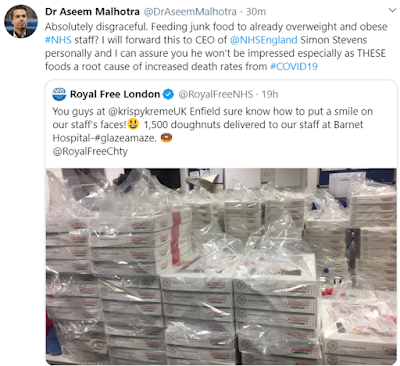
This is a guy who, in that article which first grabbed my attention ten years ago, claimed (falsely) that "diet-related diseases are responsible for 35 million deaths worldwide". A guy who made himself a laughing stock early in the pandemic with his infamous attack on doughnuts.


But when it comes to Shane Warne, all the lifestyle factors go out the window because he's found a new grift. "He had no risk factors," he says. And so - wink, wink - it may have been the vaccine.

Despicable.
 

UPDATE
 
Some details on Malhotra's school cricketing career.