Thursday, 30 April 2026

The "stickiness" of betting shop customers

It was only six months ago that Carsten Jung from the Institute for Public Policy Research (IPPR) was telling the Treasury Select Committee not to listen to those silly gambling industry lobbyists who were warning about hundreds of betting shops closing if gambling duty was hiked up. I wrote at the time...
 

The IPPR claims that its tax rises would bring in an extra £3.2 billion a year which former Prime Minister Gordon Brown says should be used to “solve” the child poverty “crisis”. The government currently spends the thick end of £400 billion a year on social security and yet relative child poverty persists, so it is far from certain that an extra £3 billion would solve anything, but despite the Treasury’s notorious resistance to hypothecation, anti-gambling campaigners have craftily made the two issues of gambling taxation and child poverty synonymous. Whose side are you on? Hungry children or online casinos? And what kind of monster are you anyway?

Cunning though it may be, this plan does rather depend on the onshore gambling industry not being a smoldering ruin after these duties have been hiked sky high.

 
Reassured by the IPPR and the Social Market Foundation that any claims about shop closures and job losses were "scaremongering" and that betting shop customers were "sticky" (i.e. loyal with inelastic demand), the government did pretty much everything the IPPR wanted in the last budget. And lo and behold...
 
Gambling giant blames UK tax rises as they close hundreds of stores
 
  • Evoke, the owner of William Hill and 888, has confirmed the closure of approximately 270 betting shops across the UK.
  • This decision aims to offset the financial impact of higher gambling taxes and mounting debts faced by the company.
  • Evoke reported pre-tax losses more than doubled to £549.1 million in 2025, largely attributed to increased UK duty costs.
  • The shop closures are expected to result in hundreds of job losses, although the precise number has not yet been confirmed.
  •  
    It would appear that the anti-gambling lobby have outwitted the politicians once again. 


    Democratically Deficient Organizations

    With Julian Morris and Roger Bate, I have written a short paper about Democratically Deficient Organizations (DoDOs). We focus on the World Health Organisation and the massive NGOs that fund it.
     

    In tobacco control and pandemic governance, foundation funding, WHO authority, NGO advocacy, and academic research reinforce one another to produce policy consensus insulated from scrutiny. Law & economics frameworks help explain the result: incentives favor persistence over performance. The WHO’s Framework Convention on Tobacco Control (FCTC) has not accelerated global declines in smoking, while discouraging harm-reduction approaches that have succeeded in countries such as Sweden. Proposals to expand WHO authority in pandemic preparedness risk replicating the same institutional failures revealed during COVID-19.

    The problem is not insufficient resources, but weak accountability. The brief proposes reforms to restore it: rebalance WHO funding toward assessed contributions, strengthen transparency and conflict-of-interest rules, open governance processes, embrace harm reduction, and return policymaking authority to domestic democratic institutions. Without such changes, the continued expansion of the DoDO model will deepen existing failures—with consequences measured in human lives.

     
    You can read the whole thing for free. I also interviewed Roger for the IEA podcast last week...


    Tuesday, 28 April 2026

    Drinking on the job

    ALCOHOL
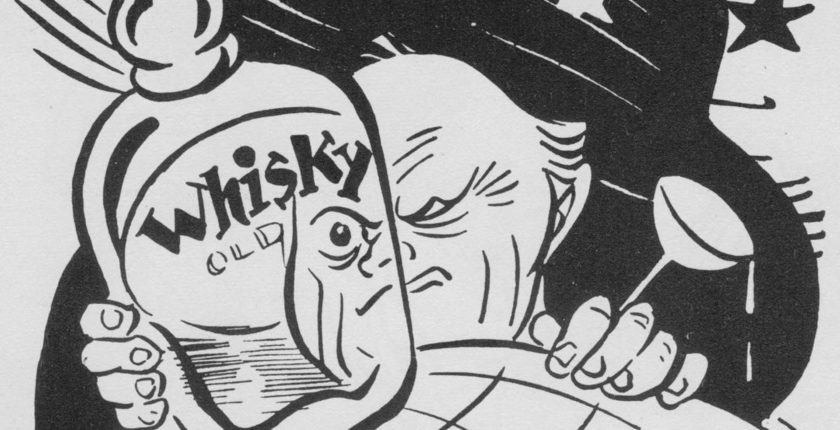
     “Churchill tries to find luck in drink, but the bottle distorts the view.” - Nazi propaganda, 1942
     
    The online British public are having one of their fits of moral outrage because they have discovered, seemingly for the first time, that there are bars in the parliamentary estate and MPs use them. I have written about it for The Critic
     

    After the latest attempt to assassinate the President of the United States on Saturday, an attendee at the White House correspondents’ dinner was spotted making off with a couple of bottles of wine. As several people noticed, many Americans seemed to think that this was a greater outrage than the shooting itself, whereas British observers were firmly on the side of the minesweeper. 

    Perhaps the difference is that Americans can afford to turn away free booze, but it seems more like another manifestation of the USA’s strangely prudish attitude towards alcohol. It is still less than a hundred years since Prohibition ended. The Anti-Saloon League is no more, but its place has been taken by “sober influencers”, gym bros and longevity-obsessed billionaires who preach the gospel of total abstinence. Last year, the number of drinkers in America fell to an all-time low, with barely half of the adult population touching a drop. 

    We Brits cannot afford to be complacent. As another viral video released over the weekend showed, the American culture of puritanism has spread to these shores. Hannah Spencer, the recently elected Green MP for Gorton and Denton, has exclusively revealed that members of Parliament can be a bibulous bunch. In an interview with Politics Joe, she said: “Like, there’s a room where I walked past and I doubled back and looked in because people are just sat having a drink.” That room, I fancy, is what is known as a “bar” and there are nine of them on the parliamentary estate. There are also several pubs within walking distance which, rather wonderfully, have a bell that rings when MPs need to stagger back and vote. 

     
    Read the rest. (NB. The Critic has put up a paywall for magazine articles and old articles, but you can continue to read mine for free when they come out. Although I do recommend getting a subscription.) 


    Friday, 24 April 2026

    The EU Tobacco Tax Directive

    The European Commission is pressing on with its plans to have an EU-wide tax on nicotine pouches and e-cigarette fluid, in addition to a sharp increase in the minimum tax rate on tobacco. Epicenter's experts at the EU Regulatory Observatory have been assessing the proposals and are unimpressed. 

    I've written a short briefing with Constantinos Saravakos outlining their views and discussing some of the main dangers.

    The main findings are:

    • The TTD’s extension of minimum taxes to low-risk nicotine products conflicts with the EU’s goal of reducing smoking prevalence.
    • Taxing safer alternatives will likely increase consumption of more harmful cigarettes.
    • Higher minimum tobacco taxes will stimulate the illicit market, particularly in Eastern Europe.
    • The proposal is highly regressive and fails to account for income differences across member states.
    • The principle of differentiating taxes by relative risk is sound and should be strengthened, not diluted.
    • A risk-proportionate reform would impose minimal or zero EU-level taxes on e-cigarettes and nicotine pouches to maximise substitution away from smoking.


    Thursday, 23 April 2026

    Why 'public health' hates the public

    I was in Brussels for the World Nicotine Congress last month and had a chat with my pal Peter Beckett from Clearing the Air about vaping. Video below.


    Wednesday, 22 April 2026

    The least conservative Conservatives

    The Tobacco and Vapes Bill will very soon become the Tobacco and Vapes Act. I've written about it for Spiked.
     

    The Tobacco and Vapes Bill, which is soon to receive royal assent, is the most empty-headed and illiberal piece of legislation passed in my lifetime. It is a pathetic epitaph for a vacuous political class, a sad fart from the rotting corpse of Blairism, and a new low for the nanny state. Waved through by the political pygmies in the House of Commons and cheered on by the freedom-hating gibbons in the House of Lords, it has given a quick dopamine rush to self-righteous windbags as the British state crumbles around them.

    Most people have been only vaguely aware of what the new law says, but the media coverage yesterday alerted millions to the fact that the so-called generational smoking ban has nothing to do with smoking in pubs (which was banned in 2007) or selling cigarettes to children (which was banned in 1908). Instead, it will create an almost surreal two-tier society in which people born after 2008 become permanent children in the eyes of the law. 


    Tory leader Kemi Badenoch has described the generational tobacco sales ban as the least conservative policy of the last 14 years (it was put into motion, lest we forget, by Rishi Sunak). Most of the 41 MPs who voted against it yesterday were Conservatives (all the Reform MPs voted agin and there were four liberal Lib Dems), but there were quite a few Tories who didn't, including Sunak himself and a few obvious ones like Bob Blackman (ASH's man in parliament) and Caroline Johnson (horrendous nanny statist). Former ministers such as Jeremy Hunt and Steve Barclay did the walk of shame to join Labour MPs in voting for prohibition and a two-tier society (no Labour MPs voted against). 
     
    The rest of the alleged conservatives were: 
     
    John Glen
    Geoffrey Clifton-Browne
    Peter Fortune
    Helen Grant
    Damian Hinds
    Neil Hudson
    Alicia Kearns
    John Lamont
    Robbie Moore
    Andrew Murrison
    Joe Robertson
    Neil Shastri-Hunt
    David Simmonds
    Graham Stuart
    Martin Vickers
    Mike Wood
     
    They all voted for a policy which their leader says, correctly, is profoundly unconservative. None of them had to do it - the Bill was bound to pass. They did it because they wanted to. This is the kind of thing that really gets them going.
     
    I'm not necessarily saying that all these freedom hating authoritarians should be kicked out of the party, but how is Caroline Johnson - who is not only an anti-smoking zealot but also a crank about vaping - the shadow health secretary?! So much for the party being under new management.  


    Audit the Gambling Commission

    It has been nearly six years since the Social Market Foundation, a leftish think tank, came up with the brilliant wheeze of banning people from spending more money on gambling than they can afford. They proposed a £23 a week cap on gambling expenditure and said that anyone who wanted to exceed this “socially acceptable gambling budget” would have to prove that they were good for it. They did not explain how this would work in practice, but in a submission to the Gambling Commission in 2021, their gambling regulation spokesman, Dr James Noyes, said that the checks should be “non-intrusive” and “based on the data already held” by the company. 

    The idea of “frictionless affordability checks” was supported by the the Gambling Commission, the All-Party Parliamentary Group for Gambling Related Harm, the House of Lords’ Select Committee on the Social and Economic Impact of the Gambling Industry and every anti-gambling group worth its salt, but it was a mirage. Background checks for County Court Judgements and past bankruptcies are insufficient to show whether a person is spending beyond their means. Customers can be phoned up and asked if they have an adequate income, but nothing compels them to tell the truth. When push comes to shove, you need bank statements and pay slips, but two-thirds of punters are unwilling to show these to a bookmaker

    And why should they? Gambling companies use all sorts of methods to identify problematic patterns of play and intervene with questions and advice, but they cannot look into their customers’ souls. If they ask too many questions, there are plenty of unregulated and offshore websites for punters to bet on. And since those websites do not pay tax, they often offer better odds. When General Betting Duty rises from 15 per cent to 25 per cent next year, “black market” sites will gain a further competitive advantage over the companies that are regulated by the Gambling Commission.


    Read the rest at The Critic


    Tuesday, 21 April 2026

    Sheffield modellers join temperance group

    Two of the leading Sheffield alcohol modellers, John Holmes and Colin Angus, have joined the Institute of Alcohol Studies' Expert Panel. The Institute of Alcohol Studies is almost entirely funded by the Alliance House Foundation whose key objective is "to promote alcoholic abstinence" and bring about "an alcohol free society". They set up the IAS in 1987 when they closed down the UK Temperance Alliance. All these groups are direct descendents of the prohibitionist United Kingdom Alliance for the Suppression of the Traffic in all Intoxicating Liquor. When the IAS went whining to the press regulator about The Times describing them as part of the "anti-drink" lobby they lost, because they obviously are.
     
    By contrast, the Sheffield Addictions Research Group (SARG), as it now calls itself, is supposed to be an impartial group of egghead mathematicians doing careful modelling for governments. 
     
    But that conceit has never been very persuasive... 
     

    SARG has worked closely with the Institute for many years – our researchers have been involved in a wide range of IAS outputs, while senior colleagues from the IAS have sat on Steering Groups for SARG research projects. 

     
    Fancy that. 
     

    Reflecting on the appointment, Professor John Holmes said:

    "Having worked closely with the IAS for many years, providing informal advice and supporting their research, I am delighted to take up a formal role on the panel. The IAS plays a vital role in ensuring that public debate on alcohol is informed by the best available evidence, and I look forward to supporting their mission over the next three years."

     
    It's nice to finally make it official. I'm sure they'll be very happy there. 


    Monday, 20 April 2026

    "Through donations to NGOs and bribes, Bloomberg interferes in politics"

    The Mexican newspaper El Universal has reported allegations that Bloomberg Philanthropies have used donations and bribes to influence policy. Bloomberg's pet policies are sugar taxes and e-cigarette flavour bans.

    The article says that Bloomberg Philanthropies have funnelled nearly 300 million pesos (£12.8 million) to the NGO El Poder del Consumidor which is supposed to be a consumer's right group but has ended up lobbying for anti-consumer policies.
     

    The documents indicate that Bloomberg Philanthropies uses its multimillion-dollar financial support to influence and promote regulatory and fiscal changes in Mexico and other countries, focusing on imposing restrictions, high taxes, and strict regulations that directly affect large U.S. companies.

    To achieve this, it funds public institutions —such as health research institutes—and civil society organizations, mainly those dedicated to consumer protection and public health , creating a coordinated ecosystem that includes the production of “scientific” studies, media campaigns, political pressure, and strategic dissemination.

    To carry out these irregular acts, the documents reveal that the Bloomberg Philanthropies foundation triangulates funds through intermediaries such as Fernwood Group Fund. 

     
    It is no secret that Bloomberg has used his billions to take over NGOs, create media outlets from scratch and influence the WHO, but the claims made in Mexico seem to go beyond that.
     

    ... Bloomberg's funding of El Poder del Consumidor is so extensive that it ends up paying million-dollar salaries to those close to Alejandro Calvillo, the leader of this NGO.

    For example, his brother Jorge Luis Calvillo Unna received a total of 7 million 800 thousand pesos from 2020 to October 2025; while Suzanne Elaine Kemp, wife of Alejandro Calvillo, received more than 4 million 285 thousand pesos in the same period.

     
     Moreover...
     

    Several payments were also found to former federal government officials, such as Alfonso Guati Rojo, who served as Director General of Standards at the Ministry of Economy (SE), leading the design, defense and legal strengthening of the new [food] labeling system in the face of business injunctions.

    Five months after leaving office in 2022, payments began for “consulting” and “monitoring of injunctions” from El Poder del Consumidor (The Power of the Consumer), coinciding with the review of key cases in the Supreme Court of Justice of the Nation ( SCJN). These payments totaled more than one million pesos for the former federal official.

    Based on public documents, the dates and concepts indicate that the consulting functioned as a piece of parallel strategy: while the government legally defended the regulation in courts, Alfonso Guati Rojo transferred technical knowledge to El Poder del Consumidor to strengthen its political, communicational and public pressure action in support of the defense against the injunctions before the Court.

     
    Curiouser and curiouser. This seems like the kind of story that The Investigative Desk and the School for Moral Ambition would be interested in...
     
    You can read the English translation here


    Thursday, 16 April 2026

    Illiberal liberalism

    I've written about Adrian Wooldridge's new book, Centrists of the World Unite!: The Lost Genius of Liberalism, for The CriticI agree with much of it and it's very good as a history of liberal thought, but when he offers a prescription for change, he is more centrist than liberal. A lot of it doesn't offer change at all...
     

    Under the heading “The case for liberal paternalism”, he makes such a shallow and uninformed case for lifestyle regulation that one starts to doubt whether he has read On Liberty. In addition to making a number of factual errors, he puts forward a series of hoary old chestnuts that he seems to think are argument-winning zingers. So you think you like freedom, eh? What about the drunk driver that kills someone? (Drink driving is banned.) Why should thin people have to pay for the healthcare of fat people? (The obese take less out of the welfare state than the thin because they don’t live as long.) He cites Richard Thaler’s work on behavioural economics to justify “nudging” and “soft paternalism” and then lists a slew of anti-smoking policies that Thaler would consider to be unacceptable because they impose costs and cannot be opted out of. 

    He rejoices in people being banned from smoking not only inside but outside and then says that similar tactics need to be used against people who eat “fattening foods”. He celebrates governments that put “comprehensive taxes on unhealthy food” and cheers on Japanese companies that “measure the waistlines of employees to make sure that they are not getting too fat”. “We should go further”, he says. “Why not use the proceeds of food taxes to subsidize healthy foods?” (Because the government doesn’t control the price of food.)

    The problem with this is not so much that the policies he proposes are ineffective, though they are (Britain’s sugar tax, which Wooldridge thinks is wonderful, did absolutely nothing to reduce obesity and nor did the warning labels put on “unhealthy” food in Chile.) The real problem is twofold. Firstly, whatever else they might be, policies that “demonise” (his word) consumers of tobacco, cast them out from private buildings, extort money from them through sin taxes and restrict where they can buy the product are not liberal; a word that, as the author helpfully reminds us, is derived from the Latin word libertas, meaning liberty. Wooldridge is right to say that John Stuart Mill was comfortable with more state intervention than some libertarians care to admit, but when it came to state-sponsored paternalism he was crystal clear. “To tax stimulants for the sole purpose of making them more difficult to be obtained,” he wrote, “is a measure differing only in degree from their entire prohibition; and would be justifiable only if that were justifiable. Every increase of cost is a prohibition, to those whose means do not come up to the augmented price; and to those who do, it is a penalty laid on them for gratifying a particular taste.” Laws restricting where alcohol can be sold, said Mill, are “suited only to a state of society in which the labouring classes are avowedly treated as children or savages.” If banning people from smoking outdoors and having the government define and prohibit “misinformation” is Wooldridge’s idea of liberalism, we can only be thankful that he never developed an interest in fascism.

    The second problem is that if Wooldridge wants a government that will take on populism by hassling smokers, meddling with the food supply and censoring the internet, he has already got it. Under Boris Johnson — the supposed populist “strongman” — the UK put into legislation the most stringent restrictions on “junk food” marketing and promotion in the world. His successor, Rishi Sunk, announced the total prohibition of tobacco, albeit over a timeframe that is almost surreal. Both policies were eagerly pursued by Keir Starmer when he became Prime Minister, as was the Online Safety Act. The House of Lords recently tried to ban social media for under-16s, Kemi Badenoch has already said that the Conservatives will enact such a ban, and it is only a matter of time before it becomes official Labour policy. Is it any wonder that populists talk about the Uniparty?


    Tuesday, 14 April 2026

    A discussion about Anti-Capitalism and "Public Health"

    I spoke to my friends at the Sloavkian think tank INESS (the Institute of Economic and Social Studies) recently. We talked about my 2025 paper Anti-Capitalism and Public Health and you can watch the video below.  


    Monday, 13 April 2026

    Chris Whitty, the man who broke Britain

    The newspaper asked me to write about someone who broke Britain so I wrote this about the joyless Chief Medical Officer, Chris Whitty. Here's a sample...

    Flattening the curve – i.e. allowing the virus to circulate while suppressing it enough to stop the health service being overwhelmed – was as much Whitty’s plan as it was anyone’s, but when he pivoted to supporting full lockdown in March 2020 he essentially never looked back. By May, the curve was flat but the country would remain in lockdown for another two months. The belief that everything is more important than the economy and nothing is more important than “public health” had taken hold.

    Whitty seemed to become obsessed with the idea that epidemics are always halving or doubling. Since the only time the infection rate (the infamous R number) went down in the first 18 months of the pandemic was during lockdowns, this meant that he could always foresee the Tiber foaming with blood. The only solution was more lockdowns. Longer lockdowns. Lockdowns to prevent lockdowns. For the rest of the pandemic, every piece of advice from Sage, which was co-chaired by Whitty, was nudging the government towards that end.

    Politicians decide, but their decisions are based on the advice and evidence given to them by experts. During Covid, the evidence presented appeared partial and excessively pessimistic and the advice seemed relentlessly illiberal. A few examples should suffice.

    In October 2020, the NHS was nowhere near being overwhelmed. There were more empty hospital beds than there had been a year earlier. Things were worse in parts of northern England but local restrictions seemed to be working in the northwest and infection rates were falling in the northeast. Nevertheless, Chris Whitty appeared on television at Halloween with some graphs and Boris Johnson capitulated with a four-week lockdown. When that ended, Sage used out-of-date infection data to justify putting nearly every English county into the top two tiers, thereby extending lockdown in all but name and crushing the hospitality sector.

    In December 2021, the Omicron variant was causing renewed panic around the world despite all the evidence showing that it was significantly milder than its predecessors and that hospitalisation rates in South Africa, where it had originated, were a small fraction of what they had been before. On 15 December, more than a fortnight after the chair of the South African Medical Association told us that we were “panicking unnecessarily” about an “extremely mild” variant, Whitty appeared on television to warn about the “misinterpretation” of the South African data and saying: “I want to be clear, this is going to be a problem.” He argued that South Africans benefited from high levels of immunity, seemingly forgetting that the British had been repeatedly vaccinated for the last year. “There are several things we don’t know [about Omicron]” he said, before adding inaccurately, “but what we do know is bad”. It seemed like every effort was made to bounce Boris Johnson into a fourth lockdown that Christmas. It is to his credit that he resisted. It was not until 23 December that Sage finally admitted that Omicron was indeed much milder. In February, Whitty conceded that Omicron’s impact on mortality had been “much more muted” and was “essentially not visible”. The government spent £9.3bn on lateral flow tests that winter.

    Whitty was not alone in pushing lockdowns at the drop of a hat. It took a team effort to lay waste to Britain’s economy and inflict an injury to the nation’s psyche from which it has yet to recover. Weak politicians, flawed modellers and hysterical journalists should all be held accountable. But if the finger has to be pointed at a single individual, it is the man who has never apologised and who was knighted when in my view he should have been sacked. Chris Whitty, the softly spoken boffin, the unassuming technocrat, broke Britain with Powerpoint. 

     
    We used to think that Whitty never smiled because he is a serious man. It turned out that he is just a misery-guts who hates the idea of people enjoying themselves, as he has proved by whispering terrible, illiberal ideas into the ears of politicians ever since. A pox on him.