|
Promises, promises
|
Minimum pricing of alcohol in Scotland is not going well. Self-styled public health advocates are baffled.
Now
in its fifth year and facing a subset clause next year, the Scottish
government’s own evaluation has made grim reading for those who claimed
that setting a floor price of 50p on a unit of alcohol would be a
game-changer in Scotland’s relationship with The Drink.
..
no changes in the trend direction or statistically significant changes
in the level of all alcohol-related crime and disorder
(Except in one local authority where alcohol-related crime went up.)
The
odds ratio for an alcohol-related emergency department attendance
following minimum unit pricing was 1.14 (95% confidence interval 0.90 to
1.44; p = 0.272). In absolute terms, we estimated
that minimum unit pricing was associated with 258 more alcohol-related
emergency department visits (95% confidence interval –191 to 707) across
Scotland than would have been the case had minimum unit pricing not
been implemented.
In June 2022, the evaluation looked at the heavy drinkers who were supposed to benefit most from minimum pricing. Its conclusions were unflinching:
There
is no clear evidence that MUP led to an overall reduction in alcohol
consumption among people drinking at harmful levels or those with
alcohol dependence, although some individuals did report reducing their
consumption.
People drinking at harmful
levels who struggled to afford the higher prices arising from MUP coped
by using, and often intensifying, strategies they were familiar with
from previous periods when alcohol was unaffordable for them. These
strategies typically included obtaining extra money, while reducing
alcohol consumption was a last resort.
MUP
led to increased financial strain for a substantial minority of those
with alcohol dependence as they obtained extra money via methods
including reduced spending on food and utility bills, increased
borrowing from family, friends or pawnbrokers, running down savings or
other capital, and using foodbanks or other forms of charity.
Some
people with alcohol dependence and their family members reported
concerns about increased intoxication after they switched to consuming
spirits rather than cider. In some of these cases, people also expressed
concerns about increased violence.
Alcohol-related hospital admissions refused to decline
after the policy was introduced and alcohol-related deaths are at a
nine-year high, although lockdowns doubtless had an affect on the
latter. The policy cost Scottish drinkers £270 million
in its first four years and all the SNP have to cling to is a modest
drop in alcohol consumption, much of which is due to COVID-19.
Last month, a new piece of research was published in BMJ Open
looking at alcohol consumption. It was not part of the official
evaluation and was produced by academics who are very sympathetic to
minimum pricing. They nevertheless struggled to make the policy look
like a success.
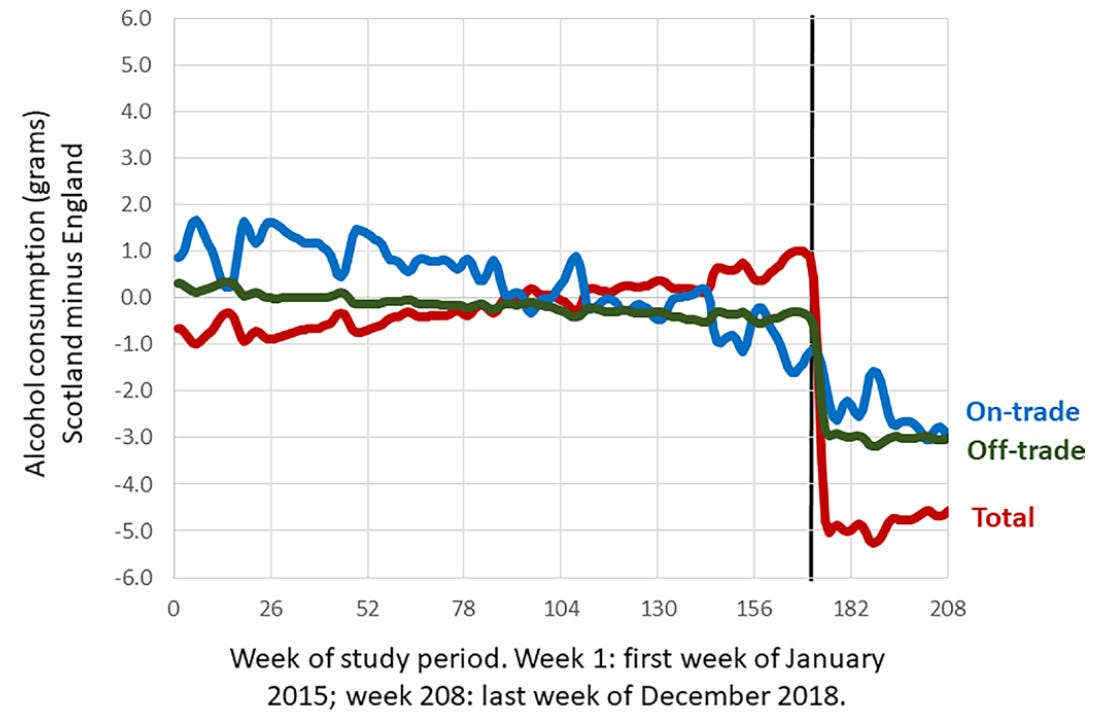
Using Kantar survey data and comparing
Scotland to northern England, they found that the introduction of
minimum pricing was followed by a drop in consumption, as shown below.
It looks like an impressively steep decline until you realise that 5 grams of alcohol is barely half a unit. Per week.
And the reduction in consumption from the off-trade, which is the only
place minimum pricing makes any difference, was just 3 grams.
Moreover,
the reduction in consumption was not evenly spread across the
population. It was weighted towards women who tend to drink less anyway.
The reductions in consumption are largely driven by
women (a reduction of 8.6 g per week, 95% CI 2.9 to 14.3) rather than by
men (a reduction of 3.3 g per week, 95% CI –3.6 to 10.4)
And among men who were the heaviest drinkers, consumption actually increased.
For
the 95th percentile the introduction of MUP was associated with an
increase in consumption for men of 13.8 g (95% CI 5.8 to 21.5), but not
for women (4.8 g, 95% CI −4.0 to 13.7).
The study
also contains bad news for the pub industry which, in classic Baptists
and bootleggers fashion, supported minimum pricing for nakedly
self-interested reasons.
For younger men there was an
increase in off-trade consumption, which was offset by decreases in
on-trade consumption in the same group.
None
of these findings are terribly surprising to people who are more
worldly than your average ‘public health’ academic. Raising the price of
cheap booze was always more likely to change the behaviour of moderate
tipplers than heavy drinkers. Hardcore drinkers were always going to
find money to keep drinking and minimum pricing was never going to help
the pub trade. It was only likely to make the poor poorer.
The authors of the study seem flabbergasted that a policy that had so much (naive and flawed) modelling behind it could turn out like it has.
When
the Minister for Public Health, Sport and Wellbeing introduced the 2018
alcohol policy framework, he emphasised that the implementation of the
MUP [minimum unit price] was strongly motivated by an interest in
decreasing health inequalities through a reduction in alcohol
consumption among the heaviest and most vulnerable drinkers. Our results
indicate that this goal may not be fully realised…
You can say that again.
…
first, we found that women, who are less heavy drinkers in our data and
in almost all surveys worldwide to date, reduced their consumption more
than men; second, the 5% of heaviest drinking men had an increase in
consumption associated with MUP; and, third, younger men and men living
in more deprived areas had no decrease in consumption associated with
MUP. These results are surprising as modelling studies would have
suggested otherwise.
It takes a heart of stone not to laugh at the best laid plans of philosopher kings falling apart at the seams.
We
do not know why, for both younger men (those aged <32 years) and for
those living in residential areas in the bottom two-fifths of
deprivation, there was no decrease in consumption associated with MUP
compared with older men and those living in less deprived areas.
One wonders if the authors have ever met any men aged under 32 or anyone in the bottom two-fifths of the income distribution.
Several
studies have found that overall, heavier drinkers— including people
with alcohol use disorders—react less to price than the general
population (ie, they react more price inelastic and their consumption is
determined by other factors). However, while this may explain lower
reductions, it cannot explain an increase in consumption.
Yes, that is a particularly awkward finding. Even I didn’t see that coming.
The
results may also imply a diminished impact on alcohol-attributable
hospitalisations and mortality, which have been shown to be strongly
associated with heavy drinking in men and in those of lower
socioeconomic status. Indeed, a large controlled study on emergency
department visits following the introduction of MUP did not show any
reduction in alcohol-related emergency department visits.
It’s
fair to say that minimum pricing hasn’t gone the way that the likes of
Dr Nick Sheron, a blowhard anti-alcohol campaigner, expected. In 2014,
he insisted
that minimum pricing was an ‘almost perfect alcohol policy because it
targets cheap booze bought by very heavy drinkers and leaves moderate
drinkers completely unaffected’. In the same year, Sir Ian Gilmore,
chair of the Alcohol Health Alliance, described
minimum pricing as an ‘evidence-based policy exquisitely targeted at
those, and those around them, who are currently suffering harm’. In a sensational act of hubris, three activist-academics published an article
in 2017 claiming that the evidence-base for minimum pricing, a policy
that had never been tried anywhere, fulfilled the great epidemiologist Austin Bradford Hill’s criteria for causality. It seemed absurd at the time and it seems almost grotesque now.
Still, this being ‘public health’, the answer to the medicine failing is to demand more of the same medicine.
If
indeed the findings of our study are corroborated, then additional
and/or different pricing mechanisms may need to be considered to reduce
alcohol-attributable hospitalisations and mortality.
‘Tis but a flesh wound!
Postscript
While I was writing this post, I came across this new study
which finds evidence of another unintended consequence which seems
obvious to the man on the Clapham omnibus but never occurred to those
who have qualifications in public health.
Following
the introduction of MUP, total household food expenditure in Scotland
declined by 1.0%, 95%CI [-1.9%, − 0.0%], and total food volume declined
by 0.8%, 95%CI [-1.7%, 0.2%] compared to the north of England.
That might not necessarily be a bad thing. Scotland has an obesity problem, after all.
There
is variation in response between product categories, with less spending
on fruit and vegetables and increased spending on crisps and snacks.
Oh.