Showing posts sorted by date for query mckee vaping. Sort by relevance Show all posts

Thursday, 17 July 2025

Just rejoice at this news

Some good news for consumers and taxpayers in the Politico newsletter...
 
EU funding cuts force health NGOs to slash staff

Health NGOs are making staff redundant and leaving Brussels after the European Commission failed to pay out expected grants, leaving some without most of their funding for the rest of the year.

Get in!

The European Public Health Association (EUPHA), based in Utrecht, the Netherlands, said it would file a complaint to the European ombudsman over the missing grants, which forced it to close its Brussels office and make its head of advocacy in the Belgian capital redundant in June.

“It’s a huge issue when the Commission agrees to fund us, sign [agreements] with us, but withholds it without explanation. Not only it betrays trust, it also probably breaches its own legal obligations,” said Charlotte Marchandise, executive director of EUPHA. 

In the unlikely event that you are feeling sorry for the EUPHA, bear in mind that the appalling Martin McKee used to be its president and it has long had a reprehensible anti-vaping stance.

EUPHA is one of 30 health NGOs that signed agreements with the European Commission outlining their planned activities last year, in anticipation of operating grants for the following financial year. Operating grants go toward daily overhead costs like staff salaries and without which many NGOs say they cannot survive. 

They're not really NGOs then, are they?

The call to apply for those grants never arrived, however, while Commission officials have informally told NGOs to expect no funding.
 
Based. 

Other health NGOs have had to take similarly dramatic cost-cutting measures after learning no grants from the Commission would arrive this year. Last week, the European Public Health Alliance (EPHA), one of the biggest health NGO networks in Brussels, confirmed it would cut five of its 13 staff. 

Haha! YES!!

Incredibly, it gets even better...
 
The European Alcohol Policy Alliance (Eurocare) is also in danger of losing two of its four staff, Anamaria Suciu, policy and advocacy manager, told POLITICO. The Commission’s operating grant typically accounts for 60 percent of Eurocare’s funding in a given year, she said. 
 
Why on earth is the EU giving fat sums of money to a temperance group? And yes, it is a temperance group. Even if you believe the specious reasoning that the EU needs to fund 'civil society' lobbying as a counterweight to industry lobbying, why have they picked a bunch of teetotal Methodists to represent civil society? Make it make sense.
 
Politico is firmly on the side of the Brussels blob for some reason...
 

Brussels is an increasingly inhospitable environment for NGOs since the European election last year.

 
Cry me a river.
 

Under a right-wing majority led by the European People’s Party, lawmakers such as the European People’s Party’s Dirk Gotink — appointed to head a probe into NGO funding on Wednesday — claim NGOs have used European money to “shadow lobby” for green policies. A POLITICO fact-check found little evidence for shadowy lobbying, however. EU funding is publicly disclosed and allows NGOs to counter the lobbying activities of better-resourced private interests.

 
This is what the self-serving activists of the sockpuppet state claim. In fact, these NGOs usually either have a vast amount of money from big foundations or are heavily reliant on the EU. If they have foundation money, they don't need more and if they can't raise money from the public then why should anyone care what they think?
 
There's a good interview with Dirk Gotink in which you can see what he actually means by 'shadow lobbying'. Keep up the good work, sir!


Friday, 3 March 2023

Martin McKee: still wrong about vaping after all these years

When a man points at the stars, McKee stares at his finger

 
The heavily overweight Zero Covid crank Martin McKee had a letter published in The Times yesterday in response to an op-ed from the paper's resident puritan Alice Thomson (whom we have come across before). Thomson has spotted a real problem - the sharp rise in vaping among teenagers, especially those using Elf bars - but characteristically comes up with the wrong solutions: banning flavours, banning colours and getting Public Health England (which she thinks still exists) to "treat vaping in the same way as cigarettes".
 
This is music to the ears of Fatty McKee who is claiming that his ignorant and dishonest campaign against e-cigarettes has been vindicated.
 

Sir, Sadly, the massive growth in e-cigarette use among adolescents comes as no surprise to those of us who warned that this would happen (“ ‘Harmless’ vapes are creating teenage addicts”, Mar 1). Unlike public health organisations worldwide, Public Health England (now the Office for Health Improvement and Disparities) has been promoting these products heavily, arguing that restricting the features that make them most attractive to young people, especially flavouring, would deter the adults they wanted to switch from cigarettes. Although no longer using the discredited “95 per cent safer than cigarettes” claim, it at least accepts that e-cigarettes are not risk-free but seem oblivious to the evidence linking their use to heart disease. We always knew that it would be a struggle to counter the efforts of the tobacco industry to get a new generation addicted to nicotine but, sadly, in England, those who should have been protecting these young people did not even try.
Professor Martin McKee

London School of Hygiene & Tropical Medicine

 
What is this "evidence linking their use to heart disease" to which McKee refers? Presumably he isn't referring to this study from last year which said...
 
We did not find a significant difference in the cardiovascular risk of exclusive e-cigarette use compared with nonuse of cigarettes and e-cigarettes

Nor can he have been referring to this study which found a "positive cardiovascular impact" among vapers who had quit smoking, with e-cigarettes being no worse for the heart than nicotine patches.
 
I can only assume that he is talking about cross-sectional studies which find that people who have been smoking for many years have a higher risk of heart disease even after they've switched to vaping. Disingenuous activist-academics present such findings as evidence that vaping, rather than prior smoking, increases the risk. Control for past smoking, however, and the association disappears
 
McKee's anti-vaping wingman Stanton Glantz had a paper retracted after it turned out that the heart attacks among vapers occurred before they started vaping. Perhaps that's the study he's thinking of?
 
As for the Office for Health Improvement and Disparities no longer using the '95% safer than cigarettes' claim, let's see what they have to say about that: 
 
We are aware that summarising the relative risks of vaping versus smoking across a range of different products and behaviours and assessed across multiple biomarkers can be simplistic and misinterpreted. Based on the reviewed evidence, we believe that the “at least 95% less harmful” estimate remains broadly accurate, at least over short term and medium term periods. However, it might now be more appropriate and unifying to summarise our findings using our other firm statement: that vaping poses only a small fraction of the risks of smoking. 
 
This is arguably a better way of putting it, since it is vanishingly unlikely that vaping carries five per cent of the risk of smoking.
 
John Britton replied today...

Sir, Martin McKee (letter, Mar 2) is right that the recent increase in vaping by young people is a cause for concern but I disagree that this represents a failure of public health policy. Between 2011, when vaping entered the mainstream, and 2021 (the most recent available national data), UK smoking prevalence has fallen from 20.2 per cent to 13.3 per cent — a fall roughly 50 per cent larger than in either of the preceding two decades, and equivalent to about three million smokers. While many of these former smokers are still vaping, the facts that smoking kills half of all long-term smokers and that vaping is unquestionably far less harmful than smoking make this a massive public health gain. We need to ensure that existing laws protecting children from e-cigarette promotion and under-age sale are observed and enforced, but ought not lose sight of the reality that vaping has contributed to a record reduction in the UK’s biggest avoidable cause of premature death and disability.
John Britton

Emeritus professor of epidemiology, Nottingham University

 
Britton is right about the solution. The law needs to be enforced. Notwithstanding the black market, which is the consequence of nanny state policies, it is generally very difficult for people under the age of 18 to buy cigarettes (and alcohol) these days. There is no reason why it should be any easier for them to buy e-cigarettes. 
 
There will be more media hysteria about Elf bars this year, I'm sure, but we already have the laws needed to limit underage vaping.


Wednesday, 20 July 2022

Delusional anti-vaping ignoramuses

Australia is a basket case when it comes to vaping. Reading newspaper op-eds from Down Under, you would think the country had been completely cut off from the rest of the world. Its health establishment is so detached from reality that all you can do is laugh at it.

So let's do that, starting with this amazing editorial from a chap called Dr Sukhwinder Singh Sohal and a lady called Dr. Kathryn Barnsley. The former is a medic. The latter is best known for working for various anti-smoking pressure groups in Tasmania and recently did a PhD in Tasmanian tobacco control.

They begin by noticing that the prohibition of e-cigarettes in Australia has been accompanied by a black market in e-cigarettes. This is a stupefyingly predictable outcome of prohibition, but as far as the two doctors are concerned, the ban would have worked fine had it not been for a shadowy force at work…
 

"The advocates for unregulated e-cigarette sales, say that it is causing a black market".

It is almost certainly the industry itself which is fuelling the black market.

The tobacco industry use smuggling to open new markets. This is what they are doing with e-cigarettes.

 
I don’t know why the first line is in speech marks (or why there’s a comma in it). As far as I can see, nobody has ever said this. Nobody is arguing for unregulated e-cigarette sales and the only countries that have unregulated e-cigarettes are countries that have banned them.

The claim that the tobacco industry is smuggling e-cigarettes into Australia desperately needs a citation or some shred of evidence. It seems rather unlikely as it would require blue chip, listed companies who have to publish their accounts to have extensive contacts in the criminal underworld. On the face of it, this is an unnecessarily high risk strategy for the sake of the nickel-and-dime rewards of flogging a few vapes in Australia when they make so much money operating in the legal market.

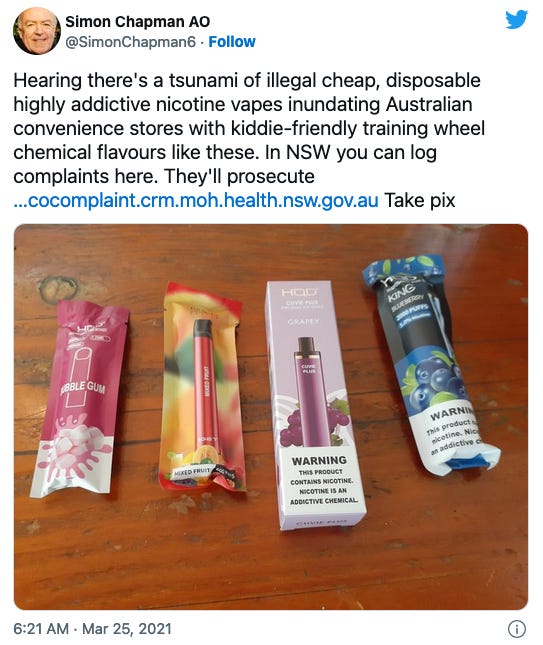
In any case, most vapes are not made by the tobacco industry. All the products shown in the tweet below by the outraged prohibitionist Simon Chapman are made by HQD, an independent company.

The photo below comes from an article published in May which says that over $1 million of illegal vapes have been seized in New South Wales since the start of the year. The only brand with any connection to ‘Big Tobacco’ is Juul (Philip Morris has a minority stake in the company).

In the highly unlikely event that tobacco companies were smuggling e-cigarettes into countries that have banned them, you’d think they’d smuggle in their own brands.

To be clear, I very much doubt that independent vape companies are in the international smuggling game either. We can safely assume that smugglers bring in whatever vapes they can from wherever they can.
 

Big tobacco has directly engaged in smuggling all over the world, including Asia, Europe and Canada. In Canada, they also used it to argue for tobacco taxes to be reduced. A University of Bath report says "Growing and diverse sources of evidence indicate that the tobacco industry remains involved in tobacco smuggling and that TI cigarettes account for around two-thirds of the illicit cigarette market".

 
Tobacco companies have sometimes been accused of ‘facilitating’ smuggling by selling more cigarettes in certain countries than domestic demand requires, knowing that they might be smuggled to other countries. I don’t really a problem with that. The cigarettes were sold legally and what happens to them after they leave the warehouse is not their responsibility.
Others would say that the companies were complicit and should try harder to control their supply chain. Whichever view you take, I don’t think anybody is suggesting that the companies are physically smuggling cigarettes themselves.
 

The big tobacco plan is to get as many people addicted as possible, especially children and adolescents, because the nicotine alters their brain structure, makes them addicted, then they will clamour for vapes to be "legalised" as a recreational drug.

 
This is becoming a bit of a fever dream. No country is going to legalise e-cigarettes because children want to vape. If anything, that would make the government double down on prohibition, as has happened in Australia. This is a terrible plan! It’s a good job there’s absolutely no evidence for it.
As for nicotine changing people’s brain structure, do you remember being told this as a child in your anti-smoking class? Have you ever heard this mentioned as a side effect of nicotine replacement therapy? No. It is nonsense based on rodent studies. As Clive Bates, former director of Action on Smoking and Health says:
 
“Over the last 60 years, millions of adolescent nicotine users have grown up as smokers and either continue to use nicotine or have quit.  The problem for the Surgeon General and others is that there is no sign of any cognitive impairment in the population of former teenage smokers and many of today’s finest adult minds were once young smokers. If a detrimental cognitive effect of nicotine existed in the human population, it is inconceivable that we would not already have seen extensive evidence of it from the study of smokers, non-smokers and ex-smokers over several decades.”
 

There are many things we don't know about the health effects of e-cigarettes because it is too early in the pandemic to ascertain.

 
We’re two and a half years into the pandemic. Is that early? What’s the pandemic got to do with it anyway?
There are many things we do know about the health effects of e-cigarettes, none of which are mentioned in the article. Crucially, we know that they do not emit smoke. We know that they do not emit carbon monoxide. We know that the Royal College of Physicians - amongst others - concluded that the long-term health risks are “unlikely to exceed 5% of those associated with smoked tobacco products, and may well be substantially lower than this figure”. We know that the lifetime cancer risks are estimated to be less than one per cent of that associated with smoking. And we know that e-cigarettes have been around for over a decade without a single recorded death being attributed to a conventional, regulated vape device.
 

However, e-cigarettes will likely cause head, neck and oral cancers, cardiovascular disease, strokes, pediatric injury, and are likely to exacerbate COVID-19 respiratory symptoms.

 
This is quite a series of assertions coming from people who have just said they don’t know much about the health effects of e-cigarettes. It falls under the category of ‘asserted without evidence and can be dismissed without evidence’.
 

Indeed, in a recently published study, we confirmed that electronic cigarette condensates increase the expression of SARS-CoV-2 (COVID-19) receptor on human lung cells.

 
The only study that meets this description is this hastily written effort published on 20 March 2020. Not exactly ‘recently’ in the context of COVID-19 and it was highly speculative, saying that ‘smokers may be more susceptible to infection by SARS-CoV-2, and possibly Covid-19.’ As it turned out, this couldn’t have been more wrong. Since then, many dozens of studies have shown that smokers are less likely to be infected with SARS-CoV-2, although that hasn’t stopped these two authors penning such articles as ‘Covid-19 and smoking: the elephant in the room?’ and their understated masterpiece ‘COVID-19, propelled by smoking, could destroy entire nations’
 

In Australia, e-cigarettes can be prescribed by a doctor and dispensed by a chemist, for people who are interested in quitting smoking.

 
Indeed that is the only way Australians can get hold of them, but it is too much for Drs Sohal and Barnsley.
 

Unsurprisingly few doctors will do this, as there are many other drugs, proven to be relatively safe, and which have been approved by the TGA, and services available to help people quit.

Furthermore, the evidence on successful quitting using e-cigarettes is very thin.

 
This can only be described as a lie. There is a wealth of evidence showing that e-cigarettes not only help smokers quit but are more effective than nicotine-replacement therapy. This has been shown in numerous observational studies such as this, as well as evidence from entire countries such as this. Impressively, e-cigarettes lead to quitting even among smokers who express no interest in quitting. There is a growing body of economic research showing that e-cigarettes and cigarettes are clear substitutes, with suppression of one leading to consumption of the other. Last but by no means least, there are randomised controlled trials (RCTs) like this and the Cochrane Review of RCTs which found that e-cigarettes help smokers quit.
If this evidence base is ‘very thin’, how should the evidence base for the claim that vaping causes head cancer and pediatric injury be described? Microscopic? Invisible?
 

One 2022 study concluded, "The use of e-cigarettes as a therapeutic intervention for smoking cessation may lead to permanent nicotine dependence."

 
E-cigarettes are not designed to wean people off nicotine. They exist to give people a much less harmful way of consuming nicotine. If you don’t know that, perhaps you should keep your opinion of tobacco harm reduction to yourselves?
 

Doctors prefer evidence.

 
You’d hope so, wouldn’t you? And yet surveys consistently show that doctors are woefully misinformed about e-cigarettes and most of them wrongly believe that nicotine causes cancer. Just this week in the UK, an over-confident doctor went on TV and claimed that vaping causes ‘popcorn lung’. Vaping has never caused a single case of this rare disease.
 

And as patients, we prefer doctors who follow evidence-based medicine. Not quacks who have been "bought" by industry".

 
Who are these mercenary shysters? We should be told. Alas, the authors do not name names, presumably for fear of successful litigation.
 

Numerous researchers agree that the development of electronic cigarette-related illnesses will outweigh any short-term benefits, but the evidence for short-term benefit is lacking. Of utmost importance, we amongst an array of other scientists have repeatedly shown electronic nicotine delivery devices to be toxic and in no regard a "safer" option for smoking tobacco.

 
It is a shame that these ‘numerous researchers’ are not identified because it would be interesting to see their work. Looking at the thin publication CV of Kathryn Barnsley, I can see no studies showing that e-cigs are toxic. Dr Sohal has co-authored a number of journal articles about e-cigarettes but these are mostly glorified opinion pieces containing no original research and a good deal of scaremongering.
I’m not aware of any study by anyone showing that e-cigs are as dangerous as combustible cigarettes. Even anti-vaping headbangers like Martin McKee and Stanton Glantz acknowledge that vaping is at least somewhat safer than smoking.
 

Tobacco manufacturers can lawfully insert anything they choose, however toxic, in their products and the same applies to electronic cigarette manufacturers.

 
No it doesn’t. Here is a non-exhaustive list of some of the ingredients that cannot be put in e-cigarettes in the UK, for example:
  • Diacetyl

  • Pentane 2,3 dione

  • Diethylene glycol

  • Ethylene glycol

  • Formaldehyde

  • Acetaldehyde

  • Acrolein

  • Metals, including cadmium, chromium, iron, lead, mercury and nickel

  • Preservatives liable to release formaldehyde.

  • vitamins or other additives that create the impression that a tobacco product has a health benefit or presents reduced health risks;

  • caffeine or taurine or other additives and stimulant compounds that are associated with energy and vitality;

  • additives having colouring properties for emissions;

  • Substances classified as carcinogenic, mutagenic or reprotoxic (CMR categories 1 and 2)

  • Substances classified with specific target organ toxicity for the respiratory tract (STOT category 1)

The sensible thing for Australian regulators to do would be to legalise e-cigarettes and produce a similar list, rather than tolerate Aussie vapers inhaling whatever the people who run the black market give them.
 

We do not believe that substantial evidence exists for electronic cigarettes to be used as a tool for smoking cessation.

 
In fairness, it has already established that you don’t know what you’re talking about and that your opinions are worthless.
 

The risks of electronic cigarettes are far too great for them to be deemed safe to be prescribed by medical professionals.

 
Let’s leave that the judgement of medical professionals, shall we? Even in Australia, some of them must know more than you.


You can get articles like this delivered straight to your inbox if you subscribe to my Substack.


Friday, 1 July 2022

Meet the British Medical Association

Aseem Malhotra, Croydon's part-time cardiologist, was given an award this week by the Chair of the British Medical Association (BMA). Malhotra, whose Twitter feed has been teeming with anti-vax dogwhistles for months, was - incredibly - honoured as a champion of preventive health.

Despite being handed the gong by the Chair of the BMA in front of the BMA logo, it turned to have nothing to do with the BMA, as the BMA was eager to point out.


Dr Nagpaul also released a statement distancing him from Malhotra.
 
 
The event seems to have been at a curry house in Hove.

I'm not sure why this group decided to honour Malhotra or how Dr Nagpaul got caught up in it, but it's not a good look for the BMA's chairman to be seen with this grifting narcissist

In any case, it was virtually his last act in the job. The BMA has since made changes at the top that do not bode well for Britain.

This week it appointed Dr Phil Banfield as the Chair of the BMA. Dr Banfield first came to my attention in 2016 when he compared e-cigarettes to Thalidomide. As Chair of the BMA's Welsh Council, he was furious when the plan to ban vaping indoors fell apart.

Banfield's views on e-cigarettes are shared by the anti-vaping dinosaur and obese windbag Martin McKee who recently became President of the BMA's President. Irreconcilably opposed to tobacco harm reduction, Brexit and 'neoliberalism', McKee is wheeled out by the media whenever they need someone to go against the UK consensus on vaping. His far-left political views make it more likely that we will see medics going on strike this year.

The BMA is instinctively authoritarian, but it largely dropped its resistance to vaping in 2017. With these two clowns in charge, there is a real danger of the organisation going backwards.


Thursday, 10 March 2022

The gateway effect myth that will never die

 
Vaping probably isn’t a gateway to smoking 
 
You mean people don't take up vaping and then suddenly decide to do something that is ten times more expensive and a thousand times more dangerous? Who'd a thunk it?

Young people who try vaping are more likely to later start smoking – but a new analysis of trends in nicotine use in England suggests that the so-called gateway theory of vaping isn’t the explanation.

The real reason for the link could be that teens who start vaping are the same ones who are likely to try smoking, regardless of whether they ever have an e-cigarette.


Indeed. This is the common liability theory. People with a propensity for risk-taking tend to take more risks than people who are risk-averse. This has always been the obvious explanation for the statistical correlation, such as it is, between vaping and smoking. 
 
Equally obvious is the fact that the rise of vaping has not led to a rise in smoking - quite the reverse. If a nonsmoking vaper is four times as likely to become a smoker - as one oft-cited study claimed - then the USA, in particular, should have seen a dramatic rise in teen smoking. Instead, it has seen a dramatic decline. 

So whilst it is perfectly possible that somebody somewhere started on e-cigarettes and then switched to tobacco, there are far more people who would have smoked but vape instead. 
 
And while it is impossible to prove there is no gateway effect, it is easy to show that any such effect is not worth worrying about. The authors of this new study looked at 16-24 year olds in the UK and found no association between vaping prevalence and smoking prevalence. 

For some reason, the New Scientist felt the need to ask an obese flat-earther what he thought about the study.

The findings may not convince all critics of e-cigarettes. “I don’t see this study as refuting the extensive evidence that already exists for a gateway effect,” says Martin McKee at the London School of Hygiene & Tropical Medicine. “Following up individuals is the most appropriate way to answer this question.”


Isn't public health supposed to be all about populations?

Meanwhile, in Massachusetts, lots of vapers have been switching to cigarettes thanks to a ban on e-cigarettes. 
 

In response, 231 vapers – nearly 40 percent -- said they switched or increased use of other products as a result of the ban.  Since there is minimal smokeless tobacco use in Massachusetts, it is likely that the “other products” were cigarettes. 

Converting 40 percent of smoke-free product users to smokers is an important and unfortunate result, for which ban architects must be held partially responsible. This was predictable and predicted. When will tobacco control activists ever own the foreseeable harmful consequences of their actions?

 
They won't.


Sunday, 31 October 2021

Contemptible misinformation about vaping in the Daily Mail

After the government announced the possibility of e-cigarettes being available on prescription (which has always been an option anyway), journalists went looking for anti-vaping voices to give an alternative viewpoint. As usual, the 'public health' dinosaurs Martin McKee and Simon Capewell were invited to spout their nonsense. Both feature heavily in this Sunday Times article

Capewell got an entire op-ed to himself in the Daily Mail. Almost every word of it is untrue. 

Sajid Javid's announcement that the Department of Health is paving the way for e-cigarettes to be prescribed on the NHS in England is deeply worrying.

Yes, there are still 6.1million smokers in England, and while smoking remains the leading cause of preventable death we must redouble our efforts to tackle this problem.

But as a scientist who has spent 30 years in public health research, particularly in regard to heart disease, smoking and diet, I can assure the Health Secretary that e-cigarettes are not the answer.

Worse, they will generate a raft of other health problems.

No evidence for this 'raft of other health problems' is given. He doesn't even say what he reckons they are.

When vaping first took off seven years ago, I was open to the idea that it might help reduce smoking.

They took off earlier than 2014, although that was when alleged experts like Capewell and McKee finally started paying attention to one of the biggest public health innovations of the century. Anybody who remembers their interventions at the time will find it very hard to believe that Capewell was open to any ideas other than banning them.

But with mounting evidence of the harms vaping can cause, I have become increasingly worried by the unquestioning enthusiasm on the part of some public health bodies whose first duty is to protect us.

Where is this 'mounting evidence'? Alas, he doesn't say because it doesn't exist.

Following a 2016 report by the World Health Organisation about the health risks e-cigarettes pose, countries including China and India banned or severely restricted their sale.

Two countries that happen to have state-owned tobacco monopolies. Fancy that!

England is out on a dangerous limb. Officials here have fallen for the exaggerated claims of the pro-vaping lobby, and are ignoring the health risks. The main claim, that e-cigarettes are a major aid to quitting, is wrong.

Randomised controlled trialobservational studies and ecological studies have consistently found vaping to be more effective than cold turkey, placebos and nicotine replacement therapy. A striking finding is that vaping is effective even when smokers do not intend to quit.

If that were true, why would the multi-national tobacco corporations be pushing vaping so hard? 

Because they sell e-cigarettes, obviously.

'E-cigs' are a means of attracting new cigarette smokers, as I will explain.

But he doesn't explain. Instead he says...

E-cigarettes are in fact one of the least effective quitting tools, accounting for only about 10 per cent of long-term quitters in the UK.

Most people who quit did so before e-cigarettes were on the market. It's not complicated. 

Many of those who try to quit smoking via vaping continue to use both e-cigarettes and lit cigarettes. This is a big win-win for tobacco firms. Most of the UK's 3million vapers who still smoke have no plans to quit.

There aren't three million vapers who still smoke. There are three million vapers. Two thirds of them are ex-smokers.

Next let's address the industry claim that e-cigarettes are 95 per cent less harmful than lit cigarettes, a figure based on no solid evidence whatsoever as far as I am aware. Yet this spurious figure was picked up by PHE. 

It's not an 'industry claim'. This is a scurrilous lie propagated by Capewell and McKee. The 95% figure was independently arrived at by both Public Health England and the Royal College of Physicians as the most conservative estimate of harm. It should be updated to 99.5% or whatever the science suggests is most plausible.   

More robust evidence estimates that, at best, e-cigarettes are 50 per cent less harmful. 

Complete nonsense. I've never heard this figure mentioned even by anti-vaping lunatics in the USA. As ever, no reference is provided for it. If e-cigs were 50% as harmful as smoking, they would be killing tens of thousands of people every year. In fact, they have never been credibly implicated as the cause of death of a single person in the UK, to my knowledge.

Champions of e-cigarettes say there is 'no evidence' of long-term harm. In fact, there is plenty of evidence.

They don't say that. They say that e-cigarettes are much, much safer than smoking. Cranks like Capewell respond by saying that we don't know the longterm effects, which is trivially true since they haven't been around for long enough. Now Capewell is saying that we do have evidence on the longterm effects. How? What are they?

Alas, Capewell once again fails to elaborate.

Nicotine is highly addictive while the superheating of the 100-plus flavourings used in e-cigs to disguise the taste of nicotine and produce vapour can generate harmful chemicals, many of which are found in lit-cigarette smoke.

As a user of unflavoured vape juice, I can assure you that nicotine doesn't really taste of anything. I don't know what 'superheating' is supposed to mean, but the 'chemicals' are heated at a much lower temperature than tobacco in cigarettes and - crucially - there is no combustion and therefore no smoke. There is plenty of toxicological evidence that strongly suggests that this makes the risks orders of magnitude lower than those of smoking, all of which Capewell ignores and has probably never bothered to read.

Research shows that e-cigarettes can be even more addictive than lit cigarettes which is why the use of youth-focused flavourings such as bubblegum is so appalling.


Nicotine poses a particular risk for the young because it disrupts the development of crucial brain connections.

People have been using nicotine for centuries without this brain damage being observed. It was never raised an issue with smoking among young people or older people. Insofar as nicotine 'disrupts' 'brain connections' it doesn't seem to do so in a way that causes any problems.

Personally I doubt very much that e-cig manufacturers will be submitting their products any time soon for UK medical approval. 

That is probably true. It took the whole length of an article for Capewell to say something that isn't a lie, but he got there in the end. A stopped clock and all that.

I know this is an opinion piece in a newspaper, not a journal article, but shouldn't it have been subject to some fact-checking before it was published?


Tuesday, 27 July 2021

Vapers deserve to be angry – they are under attack

First published by Spectator Health in June 2015

There is a perception – on Twitter at least – that vapers are angry and abusive. Ben Goldacre recently described ‘e-cigarette campaigners’ as ‘vile… obsessive, vindictive, abusive, and to an extent that is clearly dubious’. This inevitably led to a string of replies from bewildered vapers that may have confirmed his view, although the vast majority were polite.

From what I’ve seen, vapers are no more likely to be offensive than any other punter on social media, which is admittedly a low bar. After the referendum on Scottish independence and the general election, not to mention the periodic bursts of outrage for which Twitter is notorious, I have seen much worse in recent months than a few e-cigarette users complaining about junk science and needless, destructive legislation. If the people who disagree with ‘austerity’, for example, or with the opinions of Laurie Penny, expressed themselves in the same way, Twitter would be a more courteous and eloquent place.

That is not to say that vapers are not angry but, as this week’s announcement of a ban on vaping in Wales shows, they have just cause. Banning vaping indoors is such a criminally stupid and negligent idea that even the prohibitionists at Action on Smoking and Health are opposed to it. The unintended consequences are utterly predictable. Once people who have switched from smoking to vaping are thrown outside, they may come to the conclusion that they might as well smoke. Meanwhile, smokers who might switch to vaping have one less incentive to do so. The negative effect on health is plain to see, even if we ignore the glaring fact that none of this is the government’s business.

Vapers have every right to be outraged by this evidence-free attack on a habit that is not only harmless to bystanders but positively beneficial to them personally as erstwhile smokers. This is the important point to remember about so-called ‘e-cigarette campaigners’. They used to be smokers. You know how some ex-smokers can seem a little self-righteous and pleased with themselves? Vapers have taken that sense of triumph and channelled it into promoting – or, at least, protecting – the product that helped them quit.

As smokers, vapers spent years being taxed, demonised and kicked into the street. Anti-smoking campaigners would never put it in such blunt terms, but their objective is to make smokers’ lives so miserable that they decide to quit smoking. Vapers did quit smoking, often to their own surprise. They did exactly what was asked of them, but instead of being embraced by their old tormentors, they found themselves with another battle to fight.

The last few years have seen an extraordinarily dishonest campaign of misinformation against e-cigarettes that is as bad as anything I have seen from the ‘public health’ lobby. There has been a concerted effort to portray e-cigarettes as a ‘gateway’ to tobacco, despite all the evidence showing that they are a gateway from tobacco. They have been accused of ‘renormalising’ smoking without a scintilla of evidence. Misleading research has led to numerous unfounded scare stories in the press. Newspaper columnists have written ridiculous articles without doing the most basic fact-checking. Senior medics have explicitly told the public that e-cigarettes are no safer than real cigarettes. At the same time, ordinary vapers who never had any intention of becoming campaigners – and, indeed, are not campaigners – have been accused of being shills for e-cigarette and/or tobacco companies for doing no more than trying to put the record straight.

The irony is that if vapers on social media were part of an ‘astro-turf’ campaign for industry, they would not speak out as bluntly as they do. The ‘public health’ lobby is quite comfortable dealing with the pitched battles that come from having a polite, professional and organised opposition. It is the public they can’t handle.

Stanton Glantz, an activist-academic at UCSF says that he receives ‘hyper-aggressive’ responses whenever he posts a blog about e-cigarettes while Martin McKee, a professor of public health, says: ‘Anyone who suggests e-cigarettes are anything short of miraculous seems to be targeted’. This is a little disingenuous. Glantz and McKee have done rather more than suggest that e-cigarettes are not miraculous. McKee wants e-cigarettes to be regulated as if they were medicines while Glantz has helped bring about the banning of not only the use, but also the possession, of e-cigarettes on his campus in San Francisco.

These are people who have the power to turn their thoughts into deeds. They do not need to attack e-cigarette users verbally, though some do. Last year, the president of the UK Faculty of Public Health was suspended after a late-night Twitter binge in which he used such colourful phrases as ‘obsessive compulsive abusive onanist,’ ‘slave to addiction’ and ‘c***’ to describe e-cigarette users. He was later reinstated and the UK Faculty of Public Health is loudly supporting the Welsh vaping ban in the media this week.

If vapers are frustrated, it is because they are the helpless against the powerful. Combine the sense of righteousness that comes from being an ex-smoker with the sense of injustice that comes from hearing endless lies about something that is dear to you, you have a recipe for righteous indignation. There will be a lot of it around this week, quite justifiably.


Tuesday, 11 May 2021

A public health expert speaks


However, one or two people have told me that he is respected as an expert in real public health issues, such as infectious disease control. 

Imagine my surprise, then, when I stumbled across this article published last October in which he praises Hungary's response to COVID-19. Hungary's authoritarian leader Victor Orban was widely criticised for his 'Coronavirus Coup' in the early days of the pandemic when he seized even more power in the name of defeating COVID-19. McKee didn't worry about this so much, although he did acknowledge that "aspects of the government’s response have featured in the increasingly polarised Hungarian political scene". 
 
Instead, he asks why Orban's regime has done so well.
 
...it is clear that Hungary has fared much better than many other European countries. Why?
 
McKee comes up with three reasons. Firstly, spending money on public health...
 
Hungary, in common with several of its neighbours, is fortunate in having a relatively well-developed laboratory system, linked closely to the public health system.
 
Secondly, spending money on public health...
 
Hungary was a pioneer in developing public health training in central Europe and has benefited from the capacity that this developed
 
And thirdly, in a self-referencing paragraph, following the science and acting quickly...

The dangers are all too apparent when looking at the countries that have performed worst, with the USA and Brazil led by politicians that have rejected the evidence, instead putting forward a series of often bizarre proposals that defy the basic laws of science, or even any sense of logic (McKee et al., ). This has undoubtedly cost tens of thousands of lives. Again, Hungary was fortunate as the government acted extremely quickly, at a time when closing down even a few days earlier could make an enormous difference.
 
In conclusion...
 
So Hungary seems to have done very well.
 
But has it? Fast forward to May 2021 and Hungary has the highest per capita Covid death toll on the entire planet.
 

If this is how hot McKee is in his area of alleged expertise, no wonder he gets everything else so wrong.


Tuesday, 23 February 2021

Nicotine pouches

The Observer has noticed nicotine pouches and it isn't happy.
 

Flashing an ice-white smile for her 50,000 followers on TikTok, a fresh-faced young woman pops a flavoured nicotine pouch into her mouth, as one of Pakistan’s most popular love songs plays in the background.

More than 3,000 miles away, in Sweden, another social media starlet lip-syncs for the camera, to a different pop tune. The same little pouches, made by British American Tobacco, appear in shot.

Critics say that such viral videos, even if they aren’t paid-for adverts, are the consequence of a global marketing push designed to offset dwindling cigarette consumption by recruiting the nicotine consumers of the future.

 
By that standard, I guess any social media post that shows a product counts. I don't know what the law is in Pakistan, but you can advertise snus in Sweden so I'm sure you can advertise a tobacco-free equivalent.
 

BAT makes much of how such products are helping adult smokers switch to less harmful alternatives, under the slogan “A Better Tomorrow”.

By 2023, the company expects to be targeting 500 million nicotine consumers with £100bn a year to spend. Products other than cigarettes are driving much of that growth.

 
Good! 

Financial results released last week showed an annual pre-tax profit of £8.7bn as “non-combustible” products began contributing to earnings for the first time. The number of customers using them jumped by 3 million to 13.5 million, as the pandemic sparked a migration from cigarettes to more lung-friendly nicotine-delivery methods.


Happy days. It's a win-win for business, consumers and 'public health'. 

But not in Observer world...
 

However, such products are far from risk-free and the trend for promoting them via social media and popular influencers is causing concern.

 
Not just not risk-free, but far from risk-free! So what, exactly, are the risks? Alas, the lengthy article never gets round to saying. Nor does it get round to naming the 'critics' who are 'concerned' about this, except someone from an organisation called Corporate Accountability which seems to be against big businesses in general.
 
The Observer article is based on an article from the 'Bureau of Investigative Journalism', the organisation that famously got Newsnight in a lot of trouble over Lord McAlpine and which is now funded by Mike Bloomberg to write anti-vaping pieces and be generally negative about tobacco harm reduction. It finds a critic from within 'public health', but it's just the corpulent know-nothing Martin McKee whose opinion is worthless.

The gist of it is that BAT markets its nicotine pouches and people under the age of 18 might try to buy them.

Lyft has no tobacco in it but does contain nicotine, making it an over-18s product. Yet multiple TikTok videos feature Swedes who appear to be of school age using them.
 
Do they, aye?

In Spain, a campaign for BAT’s heated tobacco product Glo has been fronted by boy band Dvicio, via Instagram and a series of concerts. The “boys” are all in their late 20s or early 30s, but were last year’s summer cover stars for tween magazine Like
 
This is lame stuff and BAT have responded with some fairly obvious points.

"Our social media accounts are age-gated so they are only visible to those users who have confirmed that they are 18+ (or other applicable minimum age),” it said.

The company added it was essential it marketed “reduced-risk” products so smokers were aware of them.

 
To be clear, these are good products. If anything, they should be advertised more. Everyone knows what cigarettes are but I bet most smokers are unaware of nicotine pouches. They are not 'far from risk-free'. They are as risk-free as nicotine patches, the only 'risk' being a caffeine-level increase in heart rate, as far as I can tell. They can't be sold to children and if adults want to buy them, that is up to them. End of story.


Friday, 4 October 2019

Mysterious vaping illness - latest

It's been over a month and there is still no sign of the USA coming to its senses about the 'mysterious vaping-related disease'. The media reporting has been generally abysmal, but the response of politicians and health agencies has been nothing short of reprehensible.

Here is the latest advert from the Illinois Department of Public Health, for example...


From the very outset, all the evidence pointed to cannabis oil cartridges being the problem. A strong warning about these products, particularly the black market variety, might have prevented the outbreak of death and disease continuing. We're up to a thousand hospitalisations now.

It is clear that these products are everywhere. As the New York Times reported yesterday...

.. As health officials grapple with a public health crisis they are struggling to understand, police departments are in the midst of a swift crackdown on vaping products containing THC, the psychoactive ingredient in marijuana. In the Phoenix area, the authorities recently raided three homes over eight days, seizing hundreds of THC cartridges at each. In Wisconsin, detectives arrested two young brothers accused of running a large-scale THC cartridge assembly operation inside a condo. And in Nebraska, sheriff’s deputies found a stash of cartridges in a car parked at a truck stop. 

.. The effort to crack down on illicit vaping products has been laden with complications. The police say they have been stunned by the growth in popularity and variety of vaping devices. Enforcement can be difficult because vaping THC is not accompanied by the distinctive — and often incriminating — smell of marijuana. And police officers have had to learn the difference between vaping cartridges for THC, which are illegal for recreational use in most states, and devices for vaping nicotine, which are legally sold at many drugstores and gas stations.

If only the media learned the difference. Last week, Ben Camerillo was hospitalised with acute lung pain after suffering the 'mysterious vaping-related illness'. The television news reported that he has PTSD and used 'both THC and flavored vaping products'. The news item ended with the words 'if you are vaping you need to stop.'

But as Camerillo explains in the video below, he has only ever vaped cannabis/THC oil. He has never smoked and never used nicotine e-cigarettes.


Interestingly, he says that he bought THC carts from (legal) dispensaries, so the most sensible public health message is: avoid vaping cannabis oil while scientists figure out what exactly is going on.

Instead, mendacious politicians have been ordering vape shops to pull their flavoured vape fluids off the shelves, thereby greatly expanding the black market. Look at the state of this...


Also of interest is the video from TRT in which Robert West, Deborah Arnott and Sarah Jakes discuss the attempt by 'public health' dinosaurs like Simon Capewell and Martin McKee to import the US vape panic to the UK. A man who died nine years ago after switching from cigarettes to vaping is being held up as the UK's first and only 'vaping-related' death.

The Sunday Times recently claimed that there have been 200 cases of 'health problems linked to vaping' since 2014. But, as Arnott points out below (17 minutes), the MHRA is obliged to make a note of any complaint related to any of the products it regulates, of which only 74 have actually mentioned vaping. None of them has been proven.


Anti-vaping crusaders in the UK know that this is the chance they have been waiting for. We shall see if they have anything else up their sleeve.


Friday, 17 August 2018

E-cigarette reform and fake outcry

The Science and Technology Select Committee have published their report about e-cigarettes and it is rather good. Like most sensible people, they acknowledge that the EU's Tobacco Products Directive has set the vaping market back and suggest that the government should abandon the pointless and petty vaping regulations in Article 20 after Brexit. They also suggest repealing the crazy ban on snus, encourage employers to permit vaping in the workplace and reject the idea of taxing vape juice.

As I said in Vaping Solutions last year, this is the lowest of the low-hanging fruit for Brexit. Never mind the libertarian arguments for a moment, the health arguments for repealing legislation that makes it more difficult for smokers to quit are difficult to quibble with.

That hasn't stopped the usual suspects from throwing their toys out of their pram, however. The Daily Mail covered the story on its front page today with a claim about a non-existent 'outcry'.

Inevitably, the 'outcry' comes from Simon 'caps lock' Capewell and Martin 'toad' McKee, two dinosaurs who pop up with their nonsense whenever e-cigarettes are in the news. The fanatical anti-vaping hack Sarah Knapton sought them out for her Telegraph article, in which McKee is quoted as saying:

“Those involved in tobacco control outside England will be amazed at these conclusions although not entirely surprised as the committee took oral evidence almost entirely from individuals who are strong supporters of e-cigarettes."

The committee took evidence from, amongst others, Deborah Arnott (Action on Smoking and Health), Hazel Cheeseman (Action on Smoking and Health), John Newton (Public Health England), Gillian Leng (National Institute for Health and Care Excellence), Steve Brine MP (public health minister), Tim Baxter (Department of Health), David Harrison (UK Committee on Carcinogenicity of Chemicals in Food, Consumer Products and the Environment), Jamie Brown (Deputy Director, Tobacco and Alcohol Research Group, University College London), Ian Hudson (Medicines and Healthcare products Regulatory Agency) and Heather Thomson (Nottinghamshire NHS).

If all these people are 'strong supporters of e-cigarettes' then maybe there's a lesson there for throwbacks like McKee?

In the same article, Capewell adds some bollocks about 'passive vaping' and claims that Big Tobacco is 'using e-cigarettes as a 'Trojan Horse' to normalise the act of smoking'. These two clowns will keep fighting to the bitter end but they are further from the mainstream than ever. History will be the judge of them and their 'outcry'.

I wrote about the need for e-cig reform in today's City AM. Click to enlarge.


UPDATE

Speaking of clowns, how's this for a stunted intellect?


Monday, 22 January 2018

A junk history of tobacco harm reduction

An article in Tobacco Control by a pair of professional anti-smokers from San Francisco asks why the US and UK have such different approaches to e-cigarettes and other reduced-risk nicotine products.

Major British health organisations support tobacco harm reduction for smokers struggling to quit. The USA, in contrast, classifies e-cigarettes as tobacco products and leaders are less supportive of tobacco harm reduction.

Historians have attributed this transatlantic difference to the tobacco industry’s long history of deception over ‘safer’ products resulting in scepticism towards tobacco harm reduction.

Have they? That's news to me. Elias and Ling cite three articles as proof, but only one of them was written by a historian and that was published in 2004, long before e-cigarettes hit the market. None of them makes the argument that Elias and Ling say they do.

But never mind because the rest of the article makes the argument - such as it is - anyway. They do this by going over the story of the Independent Scientific Committee on Smoking and Health (ISCSH) which conducted safer cigarette research with the tobacco industry in Britain in the 1970s. The story they tell has been mostly drawn from the excellent work of the historian Virginia Berridge. You can read a very short summary of the initiatives of the 1970s in Vaping Solutions, but the gist of it is that nothing really came of them because smokers tend to draw more deeply on low tar cigarettes and regulation prevented more imaginative safer cigarettes from succeeding in the market.

Elias and Ling go through the British experiments for several pages and then, finally, get to the point:

In the eyes of the broader British public health community, the ISCSH work was largely for naught. Yet in recent years, the Committee’s guiding logic and premises of risk reduction have enjoyed a reanimation among British public health organisations.

Hear that dog whistle? The message is 'once bitten, twice shy'. History is repeating. Beware!

British public health should mind past experience, in which industry-backed ‘safer cigarettes’ undermined public health.

Elias and Ling argue that efforts in the UK to make cigarettes safer were an industry-led distraction which caused the British government to shelve effective anti-smoking policies. By contrast, the USA got on with the job of clamping down on cigarettes and had no truck with tobacco harm reduction.

As if that weren't bad enough, it's all happening again. When will those limeys learn?

If the past is any guide, the promotion of tobacco harm reduction may serve the interests of tobacco companies more effectively than the public.

The problem with this narrative is that it's ahistorical nonsense from start to finish. It turns a blind eye to the inconvenient fact that America had its own industry-government working group that spent millions of dollars trying to make cigarettes safer. The US National Cancer Institute set up the Tobacco Working Group in 1968 (five years before ISCSH was formed) for this very purpose, but the only acknowledgement of this in the Tobacco Control article is one sentence in the discussion section:

Government and industry collaborations to develop a ‘safer cigarette’ were not unique to the UK. From 1968 to 1979, the US National Cancer Institute spent US$50million to sponsor the Tobacco Working Group (TWG).

Government-approved efforts to launch safer cigarettes in Britain and the US were effectively dead in the water by 1978 and 1979 respectively. The two countries did not have different experiences and, therefore, their different attitudes to tobacco harm reduction today cannot be explained by them.

Moreover, the USA did not choose tough anti-smoking measures over tobacco harm reduction, and the UK did not choose harm reduction over anti-smoking policies. From the 1980s to the present day, the UK has had higher tobacco taxes, more restrictive advertising laws and larger health warnings. It also managed to ban snus, the only viable reduced harm product that existed until e-cigarettes came on the scene.

Elias and Ling's little morality tale is a travesty of history and explains nothing. Britain's approach to tobacco harm reduction, and vaping in particular, doesn't require much explanation. From around 2012, lots of smokers spontaneously switched to vaping and the government ultimately decided that this was a good thing. 

Britain is not unique in this. Across the developed world, governments have recognised the benefits of vaping and have regulated e-cigarettes accordingly, ie. more lightly than cigarettes. The sale of e-cigarettes is now legal in every EU country, for example, albeit with some silly restraints from the EU. The USA is the outlier insofar as it has moved from a tolerant position to a more extremist one. It is this American exceptionalism that requires an explanation.

My explanation is that US policy has been influenced by people, such as those at Elias and Ling's Center for Tobacco Control Research and Education, who are more interested in fighting tobacco companies than in fighting smoking. There is also a stronger puritanical element in the US anti-smoking movement than there is in the UK, and America has a stronger history of prohibition. Furthermore, the pharmaceutical industry has more clout in the US than it does in the UK and funds anti-smoking groups to a much greater extent.

In both countries, the 'public health' lobby is divided between those who are genuinely interested in health and those who are, in effect, moral or political crusaders. In Britain, the former just about managed to gain the upper hand, despite opposition from the likes of Martin McKee and Simon Capewell. In the USA, the latter are in charge. They are all awful, illiberal people to varying degrees, but in America the very worst have risen to the top.