So let's hear it for World Vape Day, an attempt to raise awareness and counter the misinformation that pours out of Brussels, Geneva and California on a weekly basis.
The World Vapers' Alliance have got hours of fun in store on YouTube starting at 5pm UK time (4pm CET). I'll be on at 5pm. You can see the full schedule here.
San Francisco's ban on e-cigarette flavours has had a predictable outcome.
A study published in JAMA Pediatrics
this week looked a ban on e-cigarette flavours implemented in San
Francisco on 1 January 2019. The ban was supposed to make e-cigarettes
less appealing to young people. And so it did, but with the unintended
consequence that high school students smoked more instead. After the ban
came into effect, the youth of San Francisco were more than twice as
likely to smoke than their counterparts in other districts. As the
author noted: “This raises concerns that reducing access to flavored
electronic nicotine delivery systems may motivate youths who would
otherwise vape to substitute smoking.”
This finding did not come as a big surprise to anyone familiar with the
academic literature. Cigarettes and e-cigarettes are clearly substitute
products, as studies have shown in both the USA and the European Union. Last year, a study by Yang et al.
found that the ban on e-cigarette flavours in San Francisco led to
increased smoking prevalence among 18-24-year-olds. Cigarette sales in
the USA overall rose in 2020, partly as a result of federal restrictions on flavours used in certain e-cigarette products.
The observation that e-cigarettes are a substitute for combustible
cigarettes might seem obvious, but it has crucial implications for
policy because it means that efforts to suppress e-cigarette use are
likely to lead to greater use of traditional cigarettes.
Despite flavour bans defying evidence, logic and ethics, governments are lining up to adopt them. The Netherlands is the latest and the European Commission is also eyeing one up.
There is no idea in 'public health' too stupid and counterproductive to not be embraced by gormless politicians.
I recently had a good chat with Gary Kavanagh of the Edmund Burke Institute. Gary is based in Ireland so he knows all about the nanny state. We talked about the Nanny State Index, vaping, smoking, sugar taxes, Minimum Unit Pricing (MUP) for alcohol,
the drive towards increased nanny statism coming from NGOs, and what
consumers can do to fight back.
Update: Cummins has, quite sensibly, deleted most of his tweets about Covid so some of the tweets I embedded in this post no longer work. Where possible, I have replaced the tweet with a screenshot. Otherwise I have reproduced the text (which is saved in the embedded tweet even after being deleted).
In the 1980s there was a TV evangelist in the USA named Peter Popoff who was exposed on national television by the late, great James Randi. It turned out that he was wearing an earpiece during his church services so his wife could feed him 'divine' information about people in the congregation. You may have seen it. It is possibly the most famous debunking in television history.
The thing I find most fascinating about this story is that Popoff is still in business. Despite being caught bang to rights on video tape, Peter Popoff Ministries is today producing 'Miracle Spring Water' and broadcasting on several TV networks (including Faith TV in Britain).
All you have to do is Google the guy's name to find out what he's been up to in the past and yet he still finds a willing and paying audience.
In January, I mentioned a man called Ivor Cummins in an article about 'coronavirus cranks'. At the time, I thought the jig was up for him and his fellow Covid entrepreneurs. I even made a Downfall video about it. But he's still going. After a brief drop in Patreon subscribers and Twitter followers, he now has more of both than he did before. He's raised another £5,000 for his long-delayed feature film.
This is a guy who could not have been more wrong over the course of the pandemic. He might just be the wrongest man who ever lived. And yet there is still a paying audience for what he does. With 1,742 subscribers paying a minimum of £3 a month (+VAT), he's making at least £75,000 a year from that revenue stream alone.
His business model relies on people having a very short memory, so let's look back on his record.
In the early stages of the pandemic, Cummins did not take a particularly contrarian line. He made a few comments about the supposed importance of nutrition (his day job involved promoting the low carb diet and he was involved with the Irish Heart Foundation although I understand they have since parted ways). Although he would later describe mask mandates as "the most anti-scientific thing I've seen in my lifetime", he was firmly in favour of face masks in March 2020.
No masks probably a simple but very unfortunate mistake with Swedish strategy Andreas - such an easy measure in principal (with availability of course) - thread here discussing same: https://t.co/PInfXfvSNX
During the first lockdown, Cummins developed his own theory about COVID-19. It has undergone several modifications over time, but the basic premise is that the virus is like flu, seasonal and not particularly dangerous. Most people are immune to it because they've had a respiratory virus in the past and the first wave would have subsided with or without lockdowns. Indeed, he believes the first wave was the only real epidemic because "de facto herd immunity" was quickly achieved. This meant that there could be no second wave. There might be a "winter resurgence", but this would be mild and would be little different to what we see in an average flu season.
In the tweet below he combines his (false) belief that COVID-19 has a low infection fatality rate with his equally false belief about 'de facto herd immunity'.
This was a common refrain of his last summer. He repeated it again and again and it was the basis of his breakthrough video in September which got over a million views and has since been removed by YouTube (you can watch a version of it here). In that video, he explained...
So around 80% are already de facto immune through
cross-immunity, T-cells, prior coronaviruses. Around 1 in 5 people will
be less immune, they're the ones it has to go through... Then the virus
stumbles over immune people."
Since only 20 per cent of the population needed to get COVID-19 for everybody to be immune, Cummins reckoned that any country that had a significant first wave had achieved herd immunity.
Although Ireland had a smaller first wave than the UK, Cummins (who is Irish) claimed that it too had reached herd immunity.
Ergo, there could be no second wave.
'Wave' is a word that doesn't really have a scientific definition, but with COVID-19, you know one when you see it. Since Cummins thought that herd immunity had been achieved, he thought there could be no second wave unless there was a second virus. He thinks this is what happened with the Spanish Flu although, to my knowledge, it didn't. Either way, he repeated this claim ad nauseam.
As case numbers began to tick up again in the summer of 2020, Cummins endorsed the idea that it was an artifact of mass testing, false positives and asymptomatic cases. He maintained that the pandemic was over in the UK and most of Europe and declared a 'casedemic'.
This, again, was expanded upon in his now-deleted video of 8 September. The conclusion was that lockdowns are pointless and governments should
instead encourage the "safe spread" of the virus in the summer to prevent a winter
peak.
There were some elements to his theory that could have been true. It was possible
that some people would have some sort of natural immunity and it was
certainly likely that warmer weather would reduce the infection rate, if
only because people spend more time outdoors. It was an observable fact
that rates of infection in Sweden had fallen in the spring of 2020 without the
government resorting to lockdown.
Scientists didn't know enough
about the virus when it first emerged. We know much more now. Most
countries have had a second or third wave and they have often been
bigger than the first. We have seen major outbreaks in winter, spring,
summer and autumn in various countries. It is clearly not true that 80
per cent of the population acquired natural immunity without being infected
or vaccinated.
Most of his ideas didn't stack up even at the time.
If herd immunity had been achieved by June, as he claimed, how could
there be any resurgence and how could the government get the virus to spread in summer, particularly if it was seasonal? And how do you achieve the "safe spread" of a virus which, contrary to Cummins' claims, has an infection fatality rate of around one per cent in rich countries?
Cummins
dressed up his ideas with some terminology from science (such as the
Gompertz Curve) along with sciency-sounding terms that he either
misunderstands or made up himself (such as 'viral triggering',
'detriggering' and 'double-hump'). None of this has any explanatory
value, but it helps him get around the inconvenient fact that countries
keep having new waves of infections.
He
now seems to think the virus lies dormant in people before erupting. Viral
triggering is a real thing with diseases like herpes, but there is no evidence to suggest that SARS-CoV-2 acts like this and every reason to think it doesn't. If
rates unexpectedly rise, Cummins claims that the virus has been
'triggered'. But by what? Initially, it was the seasons (although this
is not really an explanation in itself). More recently, he has admitted
that he doesn't really know, but it must be something.
The obvious thing the virus needs to be triggered is human interaction, preferably in unventilated indoor spaces, but this is the one explanation that Cummins rejects because it implies that lockdowns must work.
Why would the virus be triggered in March 2020 but de-triggered in March 2021? Why were cases going up in September and why did they then fall? None of the waves resemble the normal bell curves of seasonal flu. A better and more obvious explanation is that a six week lockdown began in October with tight restrictions until Christmas when rules were relaxed. This led to a sharp rise in infections and another lockdown which sharply reduced case numbers again.
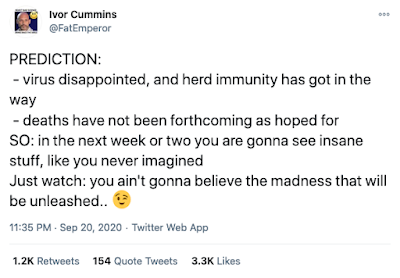
But this was all in the future in September when he began making concrete predictions.
When challenged, he made it clear what he would accept as evidence that he was wrong.
In October he provided another testable proposition.
He also made a video titled 'The Tiger Horn Deceit' which accused the public of mistaking correlation for causation when they saw case rates fall during lockdowns. It was just a coincidence, he said, but governments would whip up fear again and introduce lockdowns in response to a mythical threat in order to convince people that lockdowns work. (I know it doesn't make a lot of sense.)
In it, he said...
"But then the question, recently, the cases are through the roof, but the
deaths are still really low, and it looks like the winter is not going
to be much different than a normal winter [...] so you gotta shut all
this down, big time, and then the deceit, you have to double down on
your lockdown, so when the winter ends up being pretty normal you can
end up saying the lockdown made it so."
You know what happened next. By the end of December, the UK had 8 people per million dying of COVID-19 each day, four times what Cummins predicted. This rose in January to a peak of 18 per million, nine times higher. Between 1 November 2020 and 28 February 2021, 76,000 people died "with positive PCR for SARS-CoV-2", significantly more than had died in the first wave.
There were far more excess deaths than in the winter of 2015 and 2018 (both of which had quite bad flu seasons).
The same was true in Europe as a whole.
This really should have been game over for Cummins and his notions, but he rode it out. Initially, he stuck to the casedemic theory and claimed that there was no excess mortality.
The graph comes from Euromomo, a website which was useful to Cummins at the time because it not only has a big time lag in its reporting (shown in yellow), but it invariably under-reports the figures while it is waiting for the data. It also has such a narrow band that even huge increases in mortality look relatively modest (the red line indicates a 'substantial increase'). In any case, the graph now looks like this...
As cases and deaths mounted in December, he continued to claim that the second wave was nothing more than a "muted" winter resurgence.
On January 4th, Cummins released a video (now deleted) in which he admitted that hospitals in the UK were "filling up here and there" while claiming that mortality was "way, way lower" than in the first wave because of "community immunity".
In the same video, recorded just 11 days, he assures the English that everything’s going to be fine, community immunity, low mortality etc. pic.twitter.com/Cf6SroeD9q
On January 6th, with the UK back in lockdown and with Covid deaths close to a thousand per day, he put out a video
claiming that what was happening was "exactly what we predicted" and that "excess mortality is as per prior years". He claimed that anyone who said otherwise was "lying". In fact, there were thousands of excess deaths that week in England and Wales. In England alone, there would be 15,685 excess deaths in January, 30 per cent more than normal.
In a now-deleted video, he takes Public Health England's weekly surveillance report (wrongly attributed to the ONS) and claims that there is no excess mortality. Like Euromomo, this report suffers from a reporting lag which was made worse by under-reporting of deaths over the Christmas period (bank holidays have a big impact on death registrations). In his video, it looked like this...
By the end of the second wave, it looked like this...
He started ignoring this series of reports once they had outlived their usefulness.
Two days later, Cummins doubled down on his wager that excess mortality in the winter of 2020/21 wouldn't beat prior 'tough' seasons such as 2018.
As shown above, he was very much not correct.
At around the same time, he suddenly backtracked on his claims about the second wave, insisting that he had "foretold" a second wave all along.
At this point he shifted his rhetoric, claiming that the people who had predicted a "Spanish Flu second wave" would be proved wrong. I am not aware of anyone predicting such a thing.
I'm not even sure what it means.
As late as mid-January, when over 1,200 people were dying every day in the UK from COVID-19, he was still insisting that there was no second wave.
Daily deaths peaked on 19 January and then began to gradually drop away. Deaths peaked in Ireland a little earlier and fell sharply for the rest of the month. Having exploited the time lag in excess mortality reporting when the second waves were reaching their peak, he thereafter pointed to falling rates as evidence that the 'seasonal resurgence' had passed and there was nothing to worry about.
Eventually, he even brought back the casedemic rhetoric as if nothing had happened.
A glutton for punishment, he began making new claims about the pandemic which put him at high risk of looking foolish again.
Far from emptying out, Sweden's intensive care wards were reaching maximum capacity in many parts of the country. The chart below shows daily admissions to ICU with COVID-19. This, in a country that Cummins said had reached herd immunity the previous June.
Another country where people were 'bristling with antibodies', according to Cummins, was India.
You know what happened next. India became the global epicentre of the pandemic. Officially, there are more than 4,000 Covid deaths a day, but testing capacity is limited and experts believe the real figure could be ten times higher.
Then there was Croatia which had not locked down in 2021 and seemed to be doing OK.
Alas, the infection rate in Croatia had been rising for three weeks when he tweeted this. Inevitably, deaths followed.
As this graph shows, rates in Europe overall have been up and down, reflecting the fact that different countries have had outbreaks at different times. Note how different Europe’s curve is to that of the UK and Ireland’s - and Croatia’s for that matter. There is no pattern to suggest a seasonal outbreak. It isn’t a normal epidemic curve at all because the main thing controlling it is national lockdowns at different times by national governments.
Nevertheless, Cummins declared VE Day on 26 March...
You only need to look at the graphs he is posting here to see that 2020/21 was nothinglike "every winter season in history". Rates hadn't collapsed resoundingly and Europe certainly wasn’t displaying any “natural classic Gompertz curves”. Indeed, infection rates were rising in many European countries as they entered spring.
I could go on, but it would be exhausting. This has been a long post because Cummins is wrong about a great deal. To return to my original point, it does seem - as Abe Lincoln said - that you can fool some of the people all of the time. Cummins doesn't delete his tweets and he tweets a lot. It's all out there for anyone who wants to check his track record. And yet he inspires such trust and devotion among certain people that they will give him money.
After the tragic and untimely death of Prince, an internet meme
took flight claiming that the singer died ‘at the average age of death
for American pop stars’. This is not really true and, insofar as it
contains a germ of truth, it is not useful.
The origin of the claim can be traced back to an article from 2014
in which an Australian professor of psychology and music compared the
ages at which pop stars died in each decade from 1950 onwards and
compared them to the average age of death of the general population. As
the graph below shows, there is a big gap, albeit one that has been
closing over time.
There is a fundamental problem with this methodology which
renders the results meaningless. Pop stars usually start their careers
at a young age and pop music didn’t exist until the 1950s. The oldest of
the bunch was arguably Bill Haley who rocked around the clock in 1955
at the grand old age of 30. He was born in 1925, a year before Chuck
Berry, seven years before Little Richard and ten years before Elvis
Presley.
Haley died in 1981 at the age of 55 and Elvis died four years earlier
at the age of 42, but Chuck Berry and Little Richard are still rocking
at the age of 89 and 83 respectively. We won’t know what the life
expectancy of a 1950s pop star is until they are all dead and it will be
many years before we know the average age of death of a 1960s, 1970s or
1980s pop star.
You can take any decade and compare the age at which pop stars die
and compare it to that of the general population, but it doesn’t tell
you anything meaningful. The general population can be born at any time
whereas no pop star was born before 1925. It is quite possible that a
pop star will live until the age of 100 but it is a mathematical
impossibility for them to have already done so.
It appears that the definition of pop music used in the 2014 article
is broader than mere rock and roll because the average age of a pop
star’s death in the 1950s is shown as a little over 50 years. Presumably, then, we are including practitioners of ragtime, big band
and other forms of music who were born as early as the 19th century. But
whatever genre we look at, the point still holds. The sheer number of
pop stars has risen exponentially in the last 50 years. All the punk
rockers, rappers and grunge artists who have passed away have died
relatively young, but this could hardly be otherwise given how recently
these genres were created. It will be a long time before geriatric boy
bands pass away and we begin to see the full picture.
There is, then, a basic sampling bias at work which guarantees that
the group being studied will have a lower life expectancy than the
general population. There are lots of reasons why drug-taking rockers
and gun-toting rappers are more likely to die young, and it would be
silly to pretend that there is no difference in life expectancy, but
this is not the way to measure it.
A better way would be to compare people who were born in the same
year, but you could only do that once they were all dead. Prince was
born in 1958 and died at the age of 57. Barring an outbreak of bubonic
plague or an unusually methodical serial killer, it is most unlikely
that the average age of death for musicians born in 1958 will turn out
to be 57. Other pop stars born in 1958 include Ice-T, Madonna, Thurston
Moore (Sonic Youth), Neil Finn (Crowded House), Nikki Sixx (Motley
Crue), Toyah, Simon Le Bon, Joan Jett, Bruce Dickinson (Iron Maiden),
Nik Kershaw, Belinda Carlisle, Paul Weller, Bill Berry (REM), Mark King
(Level 42), Michael Jackson and Andy Gibb (Bee Gees). Of these, only
Jackson and Gibb are not still with us. In fact, nearly all of the celebrities born in 1958 are still alive.
Sadly, Prince did not have a good innings even by the standards of the music industry.
America's lavishly funded (by unwitting smokers) Truth Initiative is not happy about nicotine pouches. The pouches are smokeless nicotine products similar to snus which contain no tobacco, but the Truth Initiative doesn't think manufacturers should describe them as such even though it is, well, the truth.
Increasingly popular oral nicotine products are frequently marketed as tobacco-free alternatives to smoking, claims
that could imply lower-risk and are not authorized by the Food and Drug
Administration, according to a recent Truth Initiative analysis of
direct mail advertisements.
They are tobacco-free alternatives to smoking and they are clearly lower-risk, so what is the problem here?
Does the FDA say that products cannot be described as tobacco-free? I doubt it otherwise the Troof Initiative would have gone straight to them with a complaint rather than writing a crummy study about it.
The Truth Initiative study, which was published in Tobacco Control
and is one of the first to examine marketing claims used to promote
oral nicotine products to U.S. consumers, found that the majority of
mailed ads for oral nicotine pouches or lozenges claimed that they did
not contain tobacco leaf (55%) and that they were an alternative to
other tobacco products (69%). Most advertisements (84%) also featured
claims that the product could be used anywhere.
Again, this is a statement of the obvious. They don't contain tobacco leaf, they are an alternative to
other tobacco products and they can be used anywhere.
So what is the problem?
Oral nicotine pouches and lozenges are a new category of
tobacco product that includes brands such as Zyn, On! and Velo and come
in many flavors. They are similar to snus – a type of smokeless tobacco
pouch that does not produce saliva, making it spit-less – but, unlike
snus, they do not contain leaf tobacco.
Woah! Now you're saying it! Careful now.
The products are still derived
from tobacco and contain nicotine, which is harmful to young people in
any form, but due to the absence of tobacco leaf, the FDA does not
classify it is a smokeless tobacco product.
Indeed. It is not a tobacco product.
Some types of oral nicotine
products are using synthetic nicotine
that isn’t derived from tobacco leaf...
Ooh, awkward. How are you going to wriggle out of that one?
... raising additional concerns about
misleading consumers who may assume that nicotine that doesn’t come
from tobacco is somehow safer than tobacco-derived nicotine.
There's no way to win with you lot, is there?
Until now, there has been little insight into how tobacco companies
market oral nicotine products like nicotine pouches or lozenges to
consumers, including whether they use claims that could imply reduced
harm.
To address the issue, researchers coded a sample of 50 direct-mail
ads for the claims that oral nicotine products were an alternative to
other tobacco products, could be used anywhere, were spit- or
smoke-free, or that the product did not contain tobacco leaf.
SciEnCe.
... terms like “tobacco-free” in oral nicotine marketing could suggest
products are healthier and lower risk to consumers.
This is a strange thing for an anti-tobacco organisation to say. Tobacco-free pouches may be slightly healthier than snus, which is itself extremely low risk, but they are definitely healthier than any smoked tobacco product. Regulation means that the manufacturers can't say that, even though it's true, so they don't. What people might infer is irrelevant.
Using language that
signals a tobacco product is “free of a substance” may meet one criteria
of an unauthorized modified risk claim under FDA rules.
It may or it may not. Somehow I suspect it may not.
Researchers found that direct-mail advertising positioned
oral nicotine products as alternatives to existing tobacco products,
including traditional smokeless products, cigarettes, and e-cigarettes.
They obviously are alternatives to existing tobacco products. What has the Truth Initiative got against the truth?
About half (52%) of the direct mail pieces included claims that oral
nicotine was “spit-free,” appearing to position oral nicotine products
as an alternative to traditional smokeless products.
They are and it is.
About one-third
(31%) described the product as “smoke-free,” implying that it is an
alternative to cigarettes.
Which it is.
Many ads contrasted oral nicotine pouches and
lozenges to e-cigarettes, urging consumers to “forget about the
chargers,” for example, potentially promoting oral nicotine as a product
to use in combination with existing tobacco products or as a substitute for other tobacco products.
That is exactly what they're doing. They are substitutes.
The availability of increasingly popular oral nicotine products in
flavors coupled with evidence of marketing the products as alternatives
to existing tobacco products calls for greater attention and regulation
from the FDA.
Quite right too. Who knows what other factual information might reach the public if the FDA doesn't act firmly?
I've written an article for Brussels Reporter about the clouds gathering over vaping in the EU. Last year, the EU’s Scientific Committee on Health, Environmental and Emerging Risks (SCHEER) published a preliminary opinion on electronic cigarettes. As I said at the time...
Reading it is like taking a step back in time, or being in Australia.
The
authors of the SCHEER report appear to be biased against e-cigarettes
and harm reduction. The report reheats several arguments, such as the
‘gateway effect’ and the ‘renormalisation’ hypothesis, which are now a
decade old and have been contradicted by real world evidence. While it
downplays strong evidence showing that e-cigarettes have been a gateway
from smoking for millions of people, it amplifies speculation about
hypothetical risks. When the authors are unable to find adequate
evidence for anti-vaping claims, they quote from organisations which
share the same prejudice. Much of the evidence is treated selectively
and some of the conclusions made about the strength of evidence are
baffling.
The final draft was published earlier this month. Some of its claims were toned down but it remains a one-sided and inaccurate piece of work. So what? Well, as I say in today's article...
This is a worry for consumers because the SCHEER report is
designed to alert the European Commission to the ‘potential need for
legislative amendments’ to the Tobacco Products Directive.
It wanted to regulate e-cigarettes as medical devices in the
last Tobacco Products Directive, which came into force in 2016. Its
plans were derailed by the European Parliament, but it may soon try
again. The European Commission seems particularly interested in
banning flavours in e-cigarette products, a policy copied from American
prohibitionists which would make vaping much less appealing to smokers
who are thinking of switching to a product that could save their lives.
In reality, the SCHEER report does not compel the Commission to do anything.
The only evidence for health risks which the SCHEER report rates as
‘strong’ in the final opinion relates to poisoning and injuries due to
burns and explosions. These hazards have already been dealt with in the
existing Tobacco Products Directive and do not require further
legislation.
However, while the report does not explicitly call for any
new laws, it gives the European Commission ammunition if it wishes to
table some. As the evidence that e-cigarettes are relatively harmless
and effective smoking cessation devices continues to grow, the SCHEER
report will be used as a crutch for those who continue to lobby against
them.
It could soon be time for vapers to make their voices heard in Brussels again.
Meanwhile, the corrupt and incompetent World Health Organisation is up to its old tricks. To mark World No Tobacco Day, it has put out this rubbish about e-cigarettes...
The tobacco industry has continuously attempted to subvert
these life-saving public health measures. Over the last decade, the
tobacco industry has promoted e-cigarettes as cessation aids under the
guises of contributing to global tobacco control. Meanwhile,
they have employed strategic marketing tactics to hook children on
this same portfolio of products, making them available in over 15,000
attractive flavours.
The scientific evidence on e-cigarettes as
cessation aids is inconclusive and there is a lack of clarity as to
whether these products have any role to play in smoking cessation.
Switching from conventional tobacco products to e-cigarettes is not
quitting.
"We must be guided by science and evidence, not the
marketing campaigns of the tobacco industry – the same industry that has
engaged in decades of lies and deceit to sell products that have killed
hundreds of millions of people”, said WHO
Director-General Dr Tedros Adhanom Ghebreyesus. “E-cigarettes
generate toxic chemicals, which have been linked to harmful health
effects such as cardiovascular disease & lung disorders."