Saturday, 30 July 2022

A reasonable question and a sensible answer about the Covid vaccines

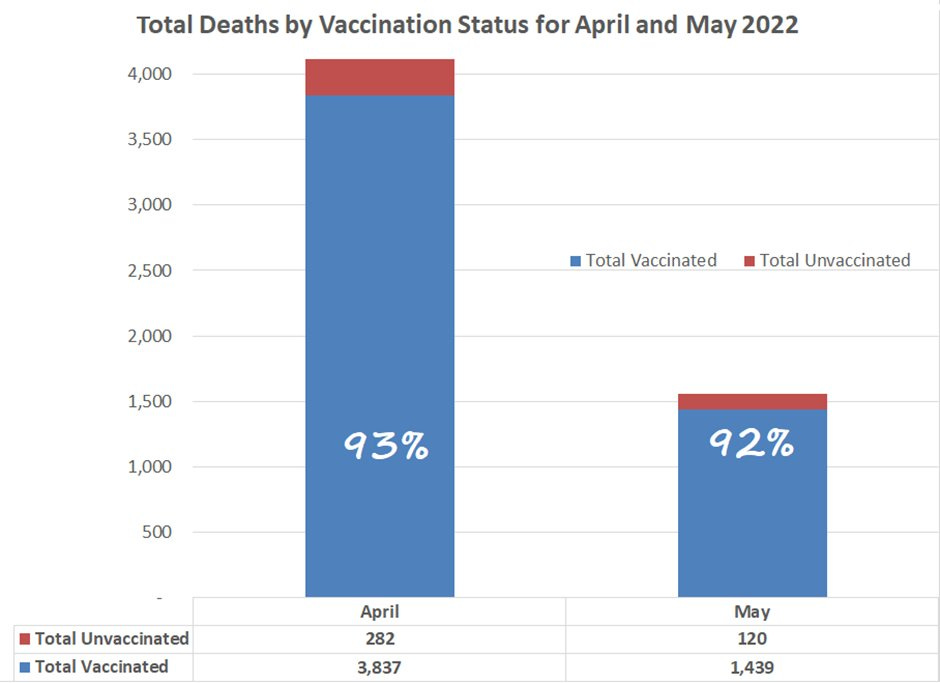
This graph has been doing the rounds recently…
 
 
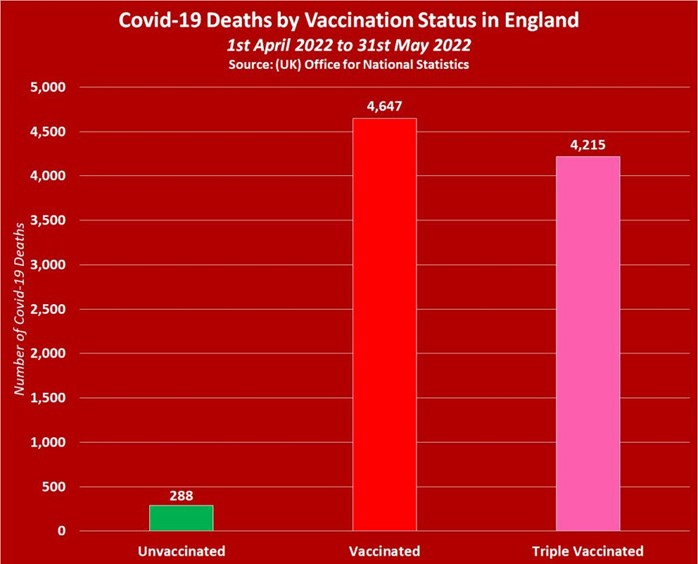
It is based on an Office for National Statistics (ONS) dataset which the vaccine hesitant have been getting excited about. Toby Young, editor of the Vaccine Sceptic Daily Sceptic mentioned it a few days ago…


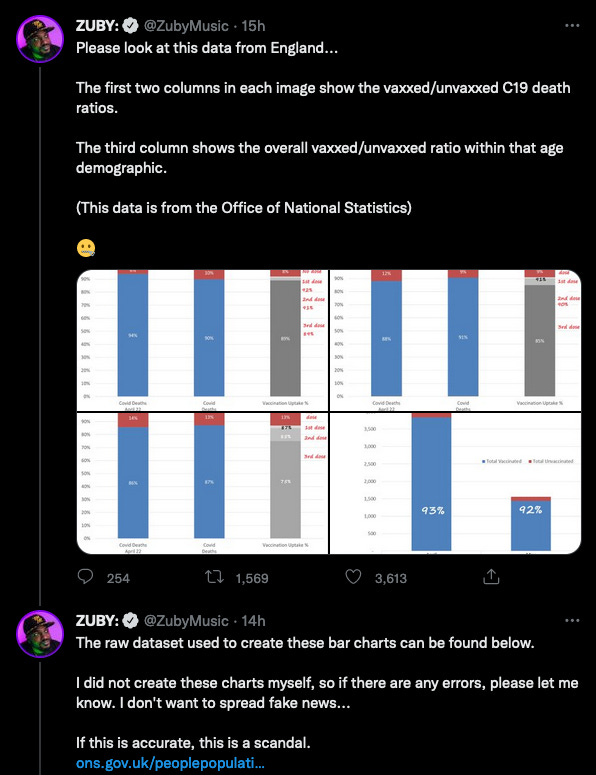
And the rapper Zuby has been tweeting images like this…
 
 
Zuby seems to think that the vaccines are useless at best and dangerous at worst. This is, he reckons, a ‘scandal’.
 

In his defence, he posted a link to the relevant ONS spreadsheet and asked people to put him straight if he had misunderstood. He doesn’t want to spread fake news, you see?

It is a pretty hollow defence because numerous people have explained why he is wrong and yet, at the time of writing, he still hasn’t deleted his tweet.

Throughout the pandemic, smileys and anti-vaxxers have been blissfully ignorant of the base rate fallacy. Insofar as a few of them are aware of it, they don’t think they have fallen into it on this occasion. They note that 93% of the British population have been vaccinated and, since a similar proportion of Covid-related deaths are among the vaccinated, this strikes them as the final proof that the jabs don’t work.

Their raw figures are broadly correct. If you go to Table 1 of the spreadsheet, you can see all the Covid-related deaths each month by vaccination status. And if you go to the effort of tallying them all up, in April 2022 there were 3,571 deaths of which 206 were among unvaccinated people. In May 2022, there were 1,364 deaths, of which 82 were among the unvaccinated (NB. the numbers are based on death certificates so the figure for May will rise once all the deaths have been registered).

The overwhelming number of deaths were indeed among people who had had at least one vaccine: 94% in April and 94% in May. (Zuby’s chart has slightly different figures for some reason, but the general picture is similar.)

Add these figures together and you get 4,935 deaths for April and May combined, of which 288 were among the unvaccinated. These are exactly the figures shown in the red graph above. 94% again.

As the ONS’s Sarah Caul and others have pointed out, none of this tells you very much unless you adjust for the age and characteristics of the people who died. If you look at the age-standardised mortality rates, the picture is rather different.

In April, the age-standardised rate for Covid-related mortality was 204.7 per 100,000 person-years among the unvaccinated and 96.5 per 100,000 among the ever-vaccinated.

In May, the age-standardised mortality rate for Covid-related death was 77.6 per 100,000 among the unvaccinated and 35.5 per 100,000 among the ever-vaccinated.

In other words, people who have been vaccinated are half as likely to die a Covid-related death as those who ‘trust their immune system’.

I won’t go over the base rate fallacy again. Plenty of people have explained it before and those who don’t want to hear it - or can’t understand it - will never be persuaded by me. But it is worth noting that you really have to go out of your way to arrange the figures in the manner shown in the graphs above. You have to add up a whole bunch of numbers, work out the percentages and plot them on a graph. Why go to such trouble when the age-standardised figures are right there in Table 1 next to numbers you’re adding together?

However, in the spirit of genuine sceptical enquiry, it is reasonable to ask why the vaccines only seem to be halving the risk of death when the original trials showed that they reduced the risk by over 90%. Funnily enough, the reasons involve issues with which smileys are very familiar. They just choose to ignore them on this occasion because they don’t fit their narrative.
The first is that the deaths listed in the ONS spreadsheet are what the ONS call ‘deaths involving COVID-19’ (which I call ‘Covid-related deaths’ above). These are deaths for which Covid is mentioned on the death certificate but for which Covid may not have been the primary cause. You may recall the whole ‘with Covid’’ versus ‘of Covid’ conversation in 2020-21. It was a virtual irrelevance back then because around 90% of deaths involving Covid had Covid listed as the primary cause on the death certificate.

But it is a much more significant issue now because the proportion of Covid-related deaths that are primarily caused by Covid has fallen. Since February 2022, the proportion of Covid-related deaths that the ONS classifies as ‘due to Covid’ has only been around 60-65%.

This means that at least a third of the deaths in the graphs above were mainly due to heart disease, cancer, dementia, etc. and Covid played little or no part. Since Covid vaccines do not prevent heart disease, cancer, dementia, etc., you wouldn’t expect a markedly higher survival rate among the vaccinated. Around a third of the deaths could not have been prevented with a Covid vaccine and they cannot therefore be used to gauge the efficacy of the vaccines. They only muddy the water.

It is extremely likely that if the ONS spreadsheet Zuby linked to confined itself to deaths due to Covid, rather than involving Covid, the age-standardised Covid mortality rate would be even lower among the vaccinated and higher among the unvaccinated.

Secondly, there is the issue of another smiley favourite: natural immunity. We were more than two years into the pandemic by April 2022 and the vast majority of people had already had Covid. The ONS estimates that between 27 April 2020 and 11 February 2022, 71% of people in England caught Covid at least once. Something in the region of 5% of the population caught it before 27 April 2020 and a very large number of people have had it since 11 February 2022.

A reasonable guess is that around 90% of the population have been infected at some point and the figure for unvaccinated people may be even higher.

Infection obviously produces a good deal of immunity and makes it likely that your next infection will be milder. If you survived Covid the first time, you’re very unlikely to die from it the second time.

By April 2022, virtually everybody in hospital with Covid had antibodies from vaccination or prior infection. That is why so few people are dying of Covid these days despite high rates of infection in the community.

There is also the small matter of lots of unvaccinated people already being dead by April 2022. They can only die once.

The clinical trials studied vaccinated people versus people who had not yet been infected - and they worked very well indeed. They work less well, relatively speaking, when you compare people who have antibodies from vaccination with people who have antibodies from prior infection. A combination of vaccines plus prior infection works best of all - that is why we still see better outcomes among vaccinated people relative to unvaccinated people - but the pool of unvaccinated people who have yet to be infected and die from it is inevitably running dry.

If Zuby, Toby, et al. want (further) proof the vaccine’s efficacy among people who have not been infected before, they need look no further than Table 1 again. If we check the figures for last April, the age-standardised Covid-related mortality rate was 146 per 100,000 among the unvaccinated but just 16 per 100,000 among the vaccinated.

In May 2021, the rate was 45.5 per 100,000 among the unvaccinated and a mere 6.2 per 100,000. Among those who had received a second dose, it was just 2.8 per 100,000.

All this stuff is right there on the same page of the same spreadsheet that the ‘sceptics’ have pored over to make their cute little graphs. How strange that they didn’t notice it.


Friday, 29 July 2022

Trussonomics and Sunakonomics

I was on the Sky News podcast this week with Miatta Fahnbulleh from the New Economics Foundation discussing the economic policies of Liz Truss and Rishi Sunak. You can listen here.


Wednesday, 27 July 2022

How to deal with the cost of living


The IEA has a new paper out today titled Cutting Through which looks at six areas where the government should act to address the cost of living and/or reduce inflation.

I wrote the chapter on sin taxes. Download the whole thing for free here.


Tuesday, 26 July 2022

Immortal time bias strikes again


I don’t write much about e-cigarette junk science because there is too much of it and it is just too depressing. But I just came across this effort, which I missed earlier in the year, because I saw someone tweet about it. It’s worth looking at as a cautionary tale about statistics.

It’s the first study I’ve come across that purports to show that vaping gives you cancer. The headline claim is: 

The e-cigarette users have lower prevalence of cancer compared to traditional smoking (2.3% vs. 16.8%; P < 0.0001), but they were diagnosed with cancer at a younger age.

Even the suggestion that vapers have a (much) lower rate of cancer than smokers seemed doubtful after they did a regression analysis…

Our regression analysis showed that e-cigarette users have 2.2 times higher risk of having cancer compared to non-smokers (odds ratio (OR): 2.2; 95% confidence interval (CI): 2.2 - 2.3; P < 0.0001). Similarly, traditional smokers have 1.96 higher odds of having cancer compared to non-smokers (OR: 1.96; 95% CI: 1.96 - 1.97; P < 0.0001).

See that? Vapers have a higher cancer risk than smokers, according to this piece of research.

The authors looked at data from the USA’s National Health and Nutrition Examination Survey (NHANES) between 2015 and 2018. They found 154,856 participants, of whom 5% were e-cigarette users, 63.6% were nonsmokers, and 31.4% were ‘traditional smokers’ (the authors insist on calling smokers ‘traditional smokers’, presumably to imply that vaping is a form of smoking). The survey has a question asking whether the participant has ever had cancer.

None of the vapers in the study would have been vaping for more than a decade and the majority would have only been vaping for a few years. Since ‘traditional smoking’ typically takes several decades to cause cancer, the idea that a few years of vaping would have the same - or bigger - effect is deeply implausible, even if you ignore the fact that vapour doesn’t contain smoke and has far fewer, if any, potential carcinogens.

Since the vast majority of vapers are former smokers, you would expect them to have a higher cancer rate than lifelong nonsmokers, all things being equal. But as it happens, none of the vapers had ever had lung cancer.

Looking at all cancers combined, the rate was lowest among the vapers (2.3%), highest among the smokers (16.8%), with the nonsmokers in between (9.5%).

If it seems a little odd that the nonsmokers didn’t have the lowest rate, you need to consider that the average age of the nonsmokers was 50, the average age of the smokers was 62, but the average age of the vapers was just 25. Age is the biggest risk factor for the vast majority of cancers.

Once the researchers adjusted the data for confounding variables, the cancer rates were as mentioned at the start of this post: a relative risk of 2.2 (2.2-2.3) for vapers and 1.96 (1.96-97) for smokers, as compared with nonsmokers.

The authors don’t say which confounding factors they adjusted for. The obvious one would be former smoking, but it is not obvious that they did adjust for it. The fact that vapers were more than twice as likely to get cancer than nonsmokers in the adjusted analysis - and were even more likely to get cancer than the ‘traditional smokers’ - suggests that they didn’t (or that they didn’t do a very good job if they did). There is no credible biological mechanism for a few years of vaping being more dangerous than a lifetime of smoking.

The authors say they had data on age, sex, race, annual household income and various comorbidities so presumably some of these were adjusted for. But the only questions about smoking were “[Have you s]moked at least 100 cigarettes in life” and “Do you now smoke cigarettes?”, so maybe there was no question about whether they used to smoke? If so, this is an absolute howler.

The researchers may have been aware of this shortcoming and were slightly embarrassed about the extraordinary finding that vaping is worse than smoking because they don’t lead with it in the abstract or the conclusion. Instead they focus on the arguably less insane finding that vapers who developed cancer got it at a younger age than nonsmokers.

But which cancers were vapers more likely to get? Not lung cancer. None of them got that. Nor did any of them get cancer of the bladder, colon, prostate, uterus or kidney. Of the vapers who got cancer, they were less likely to have had breast cancer and melanoma than were the nonsmokers.

The only cancers that were more common among the vapers - not in absolute terms, but as a proportion of cancers among the people who had ever had cancer - were cervical cancer, thyroid cancer, leukemia and one form of skin cancer. What these have in common is that they are either not ‘smoking-related’ or not strongly associated with smoking and they have a tendency to affect younger people more than most cancers.

Smoking is associated with a lower risk of thyroid cancer and two-thirds of all thyroid cancer cases are found in people aged between 20 and 55. The highest rates of cervical cancer are among women aged between 30 and 35 and the disease is caused by the human papillomavirus. It’s not clear from the study what type of skin cancer vapers had a greater risk of, but smoking is associated with reduced risk for two types and an increased risk for one. The only outlier is leukemia which was weirdly high among the e-cigarette users who had cancer, accounting for 33 cases (8.5%) as opposed to 1-2% of the smokers’ and nonsmokers’ cases. Childhood leukemia is obviously associated with younger people and has a high survival rate, but it still seems odd.

I can’t explain that bit, but how likely is it that vaping not only causes cancers that smoking doesn’t cause, but also causes them at a younger-than-average age?

The answer is that it almost certainly doesn’t. The authors have fallen into the survivorship bias trap. They say:

Interestingly, cancer respondents had a lower prevalence of e-cigarette use than traditional smoking (2.3% vs. 16.8%), and e-cigarette users were diagnosed with cancer at a younger age than respondents with traditional smoking (median age of 45 years vs. 63 years).

These two statements might seem hard to reconcile on the face of it, but they can both be explained by the e-cigarette users being much younger than the other two groups. The vapers had much lower rates of diabetes, heart disease and stroke for the same reason.

The authors could have pointed out that the ‘cancer respondents’ were more likely to be nonsmokers than vapers, but this has the same explanation: people with cancer are disproportionately old and old people are less likely to vape.

Very few of the vapers had experience of cancer because they were younger than the other groups, but because they were younger than the other groups the ones who got cancer were more likely to have developed it when they were young! A 30 year old vaper can hardly claim to have developed prostate cancer when he was 80.

This is a classic case of immortal time bias. You need to wait until these people are very old, or preferably dead, before you can draw any conclusions from data like this.

You may recall the study which claimed that rock stars die younger than ordinary people and rap stars die youngest of all. This is probably true, but we don’t have the data to prove it until all the rock and rap artists dead. The only rap stars who have died are the ones who died relatively young. No rock star has yet lived to 100 but one of them probably will.

We know the average age of death of the ones who died. We have no idea when the ones who are still alive will die. Keith Richard is still going strong but people like him - i.e. the living - were excluded from the study by design.

In The Spirit Level Delusion, I discussed the study which claimed that actors who win Oscars live longer than actors who don’t. And so they do - but not for the reasons given by the authors (clue: you have to live long enough to win an Oscar).

It’s an easy mistake to make, I guess, but the authors of the vaping study should have been aware of it. Their research tells us absolutely nothing. The fact that vapers with an average age of 25 are less likely to have had cancer (as of 2018) than nonsmokers who are twice their age is entirely unsurpising, as is the news that the relative handful of vapers who have had cancer developed the disease at a lower-than-average age.

Don’t these things get peer reviewed?


UPDATE 

Bay Area purveyor of quackery Stanton Glantz has picked up on the study and is trying to turn one of its weaknesses into a strength.
 

The interesting thing about this finding is that these are not the major smoking-induced cancers (lung and bladder).  This result reinforces the view than e-cigarettes are not simply cigarettes without some of the bad chemicals; they expose users to a different mix of toxic chemicals than cigarettes.


Hmm. If the problem isn't happening in the place where the 'chemicals' make contact (i.e. the lungs), there's some explaining to do.


Friday, 22 July 2022

A swift half with Clive Bates

The new episode of the Swift Half is a lively discussion about tobacco harm reduction with Clive Bates (formerly of ASH, Greenpeace, etc.). Be sure to watch...


Thursday, 21 July 2022

Nanny state round up

You may fondly recall the activists at Stirling University producing a study - i.e. an online survey - pushing for cigarette-style labelling of alcohol in April.

The same state-funded puritans were back yesterday with another piece of alleged research in the same vein, this time based on focus groups of fifty people, as reported by The Times...
 

Alcohol packaging must be regulated or come with health warnings similar to cigarettes, say campaigners after a study illustrated how beer and spirits were designed to appeal to young people.

Stirling University found alcohol packaging captured attention, boosted appeal and helped shape the perceptions of the drink and the people who consume it.

 
I haven't read the study yet as I can think of a thousand things I'd rather do, but this bit amused me...
 

One participant said: “I don’t actually like beer but I bought it specifically because I liked the packaging.”


Surely a contender for the Didn't Happen of the Year award. As someone said on Twitter (I forget who), this person is either a liar or is insane. Either way, let's not base policy around them. 

An overwhelming majority of EU citizens who responded to a European Commission initiative say they support tobacco harm reduction products.

The Commission’s “Call for Evidence” on the legislative framework for tobacco control received an unprecedented level of feedback, with consumers of alternatives to tobacco products – vaping, heated tobacco and oral nicotine pouches – making their voices heard in huge numbers.

More than 24,000 EU citizens responded to the call, launched by the Commission as part of its ongoing evaluation of what future EU tobacco laws will look like through revision of the Tobacco Products Directive.

The massive interest in the issue may surprise some and may put the European Commission on the back foot as has been seen by some as having previously failed to support ‘tobacco harm reduction’.


Nice. Well done to everyone who responded.

Finally, it was my pleasure to speak to Eric Crampton on the New Zealand Initiative podcast this week. There was plenty to talk about as the Kiwi government is going off the deep end with its Prohibition 2.0 policies. Check it out.


Wednesday, 20 July 2022

Delusional anti-vaping ignoramuses

Australia is a basket case when it comes to vaping. Reading newspaper op-eds from Down Under, you would think the country had been completely cut off from the rest of the world. Its health establishment is so detached from reality that all you can do is laugh at it.

So let's do that, starting with this amazing editorial from a chap called Dr Sukhwinder Singh Sohal and a lady called Dr. Kathryn Barnsley. The former is a medic. The latter is best known for working for various anti-smoking pressure groups in Tasmania and recently did a PhD in Tasmanian tobacco control.

They begin by noticing that the prohibition of e-cigarettes in Australia has been accompanied by a black market in e-cigarettes. This is a stupefyingly predictable outcome of prohibition, but as far as the two doctors are concerned, the ban would have worked fine had it not been for a shadowy force at work…
 

"The advocates for unregulated e-cigarette sales, say that it is causing a black market".

It is almost certainly the industry itself which is fuelling the black market.

The tobacco industry use smuggling to open new markets. This is what they are doing with e-cigarettes.

 
I don’t know why the first line is in speech marks (or why there’s a comma in it). As far as I can see, nobody has ever said this. Nobody is arguing for unregulated e-cigarette sales and the only countries that have unregulated e-cigarettes are countries that have banned them.

The claim that the tobacco industry is smuggling e-cigarettes into Australia desperately needs a citation or some shred of evidence. It seems rather unlikely as it would require blue chip, listed companies who have to publish their accounts to have extensive contacts in the criminal underworld. On the face of it, this is an unnecessarily high risk strategy for the sake of the nickel-and-dime rewards of flogging a few vapes in Australia when they make so much money operating in the legal market.

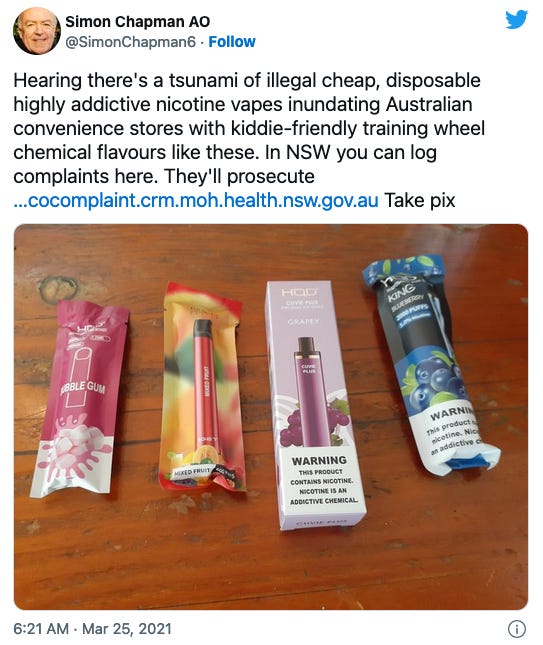
In any case, most vapes are not made by the tobacco industry. All the products shown in the tweet below by the outraged prohibitionist Simon Chapman are made by HQD, an independent company.

The photo below comes from an article published in May which says that over $1 million of illegal vapes have been seized in New South Wales since the start of the year. The only brand with any connection to ‘Big Tobacco’ is Juul (Philip Morris has a minority stake in the company).

In the highly unlikely event that tobacco companies were smuggling e-cigarettes into countries that have banned them, you’d think they’d smuggle in their own brands.

To be clear, I very much doubt that independent vape companies are in the international smuggling game either. We can safely assume that smugglers bring in whatever vapes they can from wherever they can.
 

Big tobacco has directly engaged in smuggling all over the world, including Asia, Europe and Canada. In Canada, they also used it to argue for tobacco taxes to be reduced. A University of Bath report says "Growing and diverse sources of evidence indicate that the tobacco industry remains involved in tobacco smuggling and that TI cigarettes account for around two-thirds of the illicit cigarette market".

 
Tobacco companies have sometimes been accused of ‘facilitating’ smuggling by selling more cigarettes in certain countries than domestic demand requires, knowing that they might be smuggled to other countries. I don’t really a problem with that. The cigarettes were sold legally and what happens to them after they leave the warehouse is not their responsibility.
Others would say that the companies were complicit and should try harder to control their supply chain. Whichever view you take, I don’t think anybody is suggesting that the companies are physically smuggling cigarettes themselves.
 

The big tobacco plan is to get as many people addicted as possible, especially children and adolescents, because the nicotine alters their brain structure, makes them addicted, then they will clamour for vapes to be "legalised" as a recreational drug.

 
This is becoming a bit of a fever dream. No country is going to legalise e-cigarettes because children want to vape. If anything, that would make the government double down on prohibition, as has happened in Australia. This is a terrible plan! It’s a good job there’s absolutely no evidence for it.
As for nicotine changing people’s brain structure, do you remember being told this as a child in your anti-smoking class? Have you ever heard this mentioned as a side effect of nicotine replacement therapy? No. It is nonsense based on rodent studies. As Clive Bates, former director of Action on Smoking and Health says:
 
“Over the last 60 years, millions of adolescent nicotine users have grown up as smokers and either continue to use nicotine or have quit.  The problem for the Surgeon General and others is that there is no sign of any cognitive impairment in the population of former teenage smokers and many of today’s finest adult minds were once young smokers. If a detrimental cognitive effect of nicotine existed in the human population, it is inconceivable that we would not already have seen extensive evidence of it from the study of smokers, non-smokers and ex-smokers over several decades.”
 

There are many things we don't know about the health effects of e-cigarettes because it is too early in the pandemic to ascertain.

 
We’re two and a half years into the pandemic. Is that early? What’s the pandemic got to do with it anyway?
There are many things we do know about the health effects of e-cigarettes, none of which are mentioned in the article. Crucially, we know that they do not emit smoke. We know that they do not emit carbon monoxide. We know that the Royal College of Physicians - amongst others - concluded that the long-term health risks are “unlikely to exceed 5% of those associated with smoked tobacco products, and may well be substantially lower than this figure”. We know that the lifetime cancer risks are estimated to be less than one per cent of that associated with smoking. And we know that e-cigarettes have been around for over a decade without a single recorded death being attributed to a conventional, regulated vape device.
 

However, e-cigarettes will likely cause head, neck and oral cancers, cardiovascular disease, strokes, pediatric injury, and are likely to exacerbate COVID-19 respiratory symptoms.

 
This is quite a series of assertions coming from people who have just said they don’t know much about the health effects of e-cigarettes. It falls under the category of ‘asserted without evidence and can be dismissed without evidence’.
 

Indeed, in a recently published study, we confirmed that electronic cigarette condensates increase the expression of SARS-CoV-2 (COVID-19) receptor on human lung cells.

 
The only study that meets this description is this hastily written effort published on 20 March 2020. Not exactly ‘recently’ in the context of COVID-19 and it was highly speculative, saying that ‘smokers may be more susceptible to infection by SARS-CoV-2, and possibly Covid-19.’ As it turned out, this couldn’t have been more wrong. Since then, many dozens of studies have shown that smokers are less likely to be infected with SARS-CoV-2, although that hasn’t stopped these two authors penning such articles as ‘Covid-19 and smoking: the elephant in the room?’ and their understated masterpiece ‘COVID-19, propelled by smoking, could destroy entire nations’
 

In Australia, e-cigarettes can be prescribed by a doctor and dispensed by a chemist, for people who are interested in quitting smoking.

 
Indeed that is the only way Australians can get hold of them, but it is too much for Drs Sohal and Barnsley.
 

Unsurprisingly few doctors will do this, as there are many other drugs, proven to be relatively safe, and which have been approved by the TGA, and services available to help people quit.

Furthermore, the evidence on successful quitting using e-cigarettes is very thin.

 
This can only be described as a lie. There is a wealth of evidence showing that e-cigarettes not only help smokers quit but are more effective than nicotine-replacement therapy. This has been shown in numerous observational studies such as this, as well as evidence from entire countries such as this. Impressively, e-cigarettes lead to quitting even among smokers who express no interest in quitting. There is a growing body of economic research showing that e-cigarettes and cigarettes are clear substitutes, with suppression of one leading to consumption of the other. Last but by no means least, there are randomised controlled trials (RCTs) like this and the Cochrane Review of RCTs which found that e-cigarettes help smokers quit.
If this evidence base is ‘very thin’, how should the evidence base for the claim that vaping causes head cancer and pediatric injury be described? Microscopic? Invisible?
 

One 2022 study concluded, "The use of e-cigarettes as a therapeutic intervention for smoking cessation may lead to permanent nicotine dependence."

 
E-cigarettes are not designed to wean people off nicotine. They exist to give people a much less harmful way of consuming nicotine. If you don’t know that, perhaps you should keep your opinion of tobacco harm reduction to yourselves?
 

Doctors prefer evidence.

 
You’d hope so, wouldn’t you? And yet surveys consistently show that doctors are woefully misinformed about e-cigarettes and most of them wrongly believe that nicotine causes cancer. Just this week in the UK, an over-confident doctor went on TV and claimed that vaping causes ‘popcorn lung’. Vaping has never caused a single case of this rare disease.
 

And as patients, we prefer doctors who follow evidence-based medicine. Not quacks who have been "bought" by industry".

 
Who are these mercenary shysters? We should be told. Alas, the authors do not name names, presumably for fear of successful litigation.
 

Numerous researchers agree that the development of electronic cigarette-related illnesses will outweigh any short-term benefits, but the evidence for short-term benefit is lacking. Of utmost importance, we amongst an array of other scientists have repeatedly shown electronic nicotine delivery devices to be toxic and in no regard a "safer" option for smoking tobacco.

 
It is a shame that these ‘numerous researchers’ are not identified because it would be interesting to see their work. Looking at the thin publication CV of Kathryn Barnsley, I can see no studies showing that e-cigs are toxic. Dr Sohal has co-authored a number of journal articles about e-cigarettes but these are mostly glorified opinion pieces containing no original research and a good deal of scaremongering.
I’m not aware of any study by anyone showing that e-cigs are as dangerous as combustible cigarettes. Even anti-vaping headbangers like Martin McKee and Stanton Glantz acknowledge that vaping is at least somewhat safer than smoking.
 

Tobacco manufacturers can lawfully insert anything they choose, however toxic, in their products and the same applies to electronic cigarette manufacturers.

 
No it doesn’t. Here is a non-exhaustive list of some of the ingredients that cannot be put in e-cigarettes in the UK, for example:
  • Diacetyl

  • Pentane 2,3 dione

  • Diethylene glycol

  • Ethylene glycol

  • Formaldehyde

  • Acetaldehyde

  • Acrolein

  • Metals, including cadmium, chromium, iron, lead, mercury and nickel

  • Preservatives liable to release formaldehyde.

  • vitamins or other additives that create the impression that a tobacco product has a health benefit or presents reduced health risks;

  • caffeine or taurine or other additives and stimulant compounds that are associated with energy and vitality;

  • additives having colouring properties for emissions;

  • Substances classified as carcinogenic, mutagenic or reprotoxic (CMR categories 1 and 2)

  • Substances classified with specific target organ toxicity for the respiratory tract (STOT category 1)

The sensible thing for Australian regulators to do would be to legalise e-cigarettes and produce a similar list, rather than tolerate Aussie vapers inhaling whatever the people who run the black market give them.
 

We do not believe that substantial evidence exists for electronic cigarettes to be used as a tool for smoking cessation.

 
In fairness, it has already established that you don’t know what you’re talking about and that your opinions are worthless.
 

The risks of electronic cigarettes are far too great for them to be deemed safe to be prescribed by medical professionals.

 
Let’s leave that the judgement of medical professionals, shall we? Even in Australia, some of them must know more than you.


You can get articles like this delivered straight to your inbox if you subscribe to my Substack.