Tuesday, 8 March 2022

Minimum pricing and cross-border shopping

Scotland's minimum pricing evaluation continues. The latest chapter looks at cross-border booze shopping and the headline claim is that it has been "minimal".
 

Cross-border alcohol purchasing ‘minimal’, research finds

Public Health Scotland report shows very few Scots travelling across the border to buy cheaper alcohol. 
.. The report, released on Tuesday, found that just 3% of the more than 1000 people asked said they had travelled to another part of the UK solely to buy alcohol.

The 3% figure comes from a relatively small survey and relies on people self-reporting, but let's go with it. Is it a small number? It's about 130,000 people. That is actually quite a lot of people travelling to England solely to buy alcohol. Aside from a relatively small number of people living on the borders, it's a 100 mile round trip at a minimum. As the study says...

Analysis shows that substantial bulk purchasing would be needed for individuals to make significant savings whether purchasing in-person or online, once travel and delivery costs are taken into account.


Well, quite. It therefore seems likely that "substantial bulk purchasing" is exactly what they are doing, whether for personal use or private sale. Moreover, the survey found that a further 13% of Scots said they brought back alcohol from England when travelling there for other purposes.

Analysis of off-trade alcohol sales data in the combined areas of North East and North West England in the 12 months following implementation of MUP showed a small increase (1.14%).


But it is not really "small", is it? There are a lot more people in the North of England than in the whole of Scotland - and a lot more alcohol sold there too. If "only" three percent of Scots were travelling South to buy alcohol, they must have been buying a fair quantity to have a measurable impact on overall alcohol sales in the North of England. 

The 1.14% figure was calculated by looking at sales in the North of England and adjusting for sales in the rest of England and Wales. In the North East, in particular, there are some telltale signs that the increase was driven by minimum pricing...

When examining changes in alcohol sales in north-east England in the 12 months following the implementation of MUP, controlled for sales in the rest of England and Wales, we observed a small statistically significant increase in total alcohol sales (1.46%, 95% CI 0.31%, 2.62%, p=0.01). For individual drink types, larger increases in sales of cider (4.51%) and RTDs (5.85%) were observed, and these were statistically significant

Cider and RTDs ("ready to drink" AKA alcopops) were heavily affected by minimum pricing. Sales of perry rose even more, by 6.96%. If I was minded to drive a white van from Edinburgh to Berwick, these are the kind of drinks I'd be buying.
 
If you think that these are small numbers, remember that advocates of MUP are clinging to the claim that alcohol consumption in Scotland fell by 3.5% in 2019. This is the closest thing they have to a "success" since there has been no decline in crime, no decline in A & E attendances, no decline in alcohol-related hospital admissions and alcohol-related deaths are at a ten year high.
 
The report doesn't attempt to calculate what effect the cross-border shopping had on that 3.5%, but it cannot have been trivial. Furthermore, there are people buying alcohol by mail order from England, but the researchers couldn't find any data on that so it is essentially ignored.

The authors downplay the significance of their findings at every turn. For example...
 

The majority (86%) of respondents did not report purchasing alcohol from across the border with England in person.

 
But 14% of them did and that is a lot of people! And if 1.14% of all the booze sold in the North of England was taken to Scotland, that is a lot of booze and it means that the drop in consumption attributed to MUP in 2019 was even smaller than we thought.

Not going very well, is it? 

Finally, let's take a moment to hear from Scotland's public health minister:

“Reducing alcohol-related harm is a key priority for the Scottish Government and the 3.5% decrease in alcohol sales we have seen following the introduction of minimum unit pricing in May 2018 reinforces why Scotland was right to take this innovative step.

Given the clear and proven link between consumption and harm, minimum unit pricing is the most effective way to tackle cheap, high-strength alcohol that causes so much damage to so many families.


Contrast the highlighted section with the last paragraph of the article:
 

According to figures released last year, alcohol sales in Scotland dropped to the lowest point in 26 years in 2020, but during the same year, deaths linked solely to alcohol increased by 9% to 1190.

When will the penny drop?


Monday, 7 March 2022

A swift half with Jason Miller

There's a new episode of the Swift Half out in which I speak to Jason Miller, the CEO of Gettr and former communications advisor to Donald Trump. Check it out...


Thursday, 3 March 2022

The Tobacco Control Research Group say the quiet part out loud

As reported in a handful of regional newspapers...
 
Introduce price cap on cigarettes to reduce smoking – study

A maximum price cap for cigarettes sold in the UK would help cut smoking rates, according to a study.

A price cap set by a tobacco regulator would allow for only a minimal profit for firms, researchers from the University of Bath said.


Yes, it's our old fiends at Anna Gilmore's Bloomberg-funded Tobacco Control Research Group at Bath Uni.


Currently, tobacco companies have generally been able to cushion smokers from the full impact of regular tax increases on cigarettes by keeping prices on some products low and offsetting costs with increases on their other, higher-end products, the study found.

This means there is currently a wide variation in cigarette prices in the UK – a difference of up to £5 from the cheapest to most expensive brands from around £9.75 at the lowest end to £14.65.

As consumer goods go, that isn't actually a very wide variation.

A price cap, by comparison, would effectively mean there was a standardised cost for cigarettes, helping to make future tax rises “much more effective”.

A price cap on cigarettes sounds like a pretty cool idea if you're a smoker, but it's not obvious what the appeal is to the prohibitionist fanatics at Bath University.

Like regulation for utilities industries, a wholesale price cap on cigarettes would be imposed by government or a regulatory agency. Excise duty, sales taxes, retailer mark-ups and any other legitimate costs would be added to that price to produce a shop price.


A cap on wholesale energy prices is designed to keep prices low. That is the whole point of a price cap.

There is an effective minimum price on cigarettes because of the massive tax rate, currently £5.25 a pack plus an ad valorem tax of 16.5% of the retail price, plus VAT. If you had a maximum price as well, the government could effectively control the price of cigarettes. This doubtless appeals to the pocket dictators at Bath Uni, but it would only bring prices at the top end down. That would clearly not 'help cut smoking rates'. Indeed, it might make smokers of premium brands smoke more.

A price cap would get rid of the premium end and leave only the cheapest cigarettes available. This is the exact opposite of what people in 'public health' are trying to do with alcohol through minimum pricing.

At first glance, it doesn't make any sense. So what is the point? To understand, we need to go back to the second line...
 

A price cap set by a tobacco regulator would allow for only a minimal profit for firms, researchers from the University of Bath said.

 
They're saying the quiet bit out loud here, aren't they? For a large number of 'public health' activist-academics, the campaign against smoking ended a long time ago. It is a campaign against business and capitalism now. That's why Anna Gilmore teamed up with the far-left crank David Miller. That's why they're against vaping. A lot of the paradoxes in 'public health' can be explained by the fact that they are not primarily concerned with health.


Wednesday, 2 March 2022

Scottish consultation on e-cigarette advertising


The Scottish government is running a public consultation on banning e-cigarette advertising. It's exactly the kind of thing the SNP would do. Devolution doesn't give them many levers of power to pull so they tend to pull them all. And since they don't have much ability (or inclination) to liberalise anything, it's a one-way ratchet of illiberalism. 

Obviously, they shouldn't do it, but let's look at their reasoning...

Reducing exposure to the advertising and promotion of vape products is the best way to protect non-smokers, young people and children from being enticed to experiment with these products.

 
They don't give a citation for this claim and I doubt any evidence exists for it. 
 

Early indications from studies have shown a potential link between use of e-cigarettes containing nicotine and the development of lung diseases such as chronic obstructive pulmonary disease (COPD).


They do give a citation for this claim. The study's participants were mice. 

The clinical impacts of long-term use could take decades to manifest. In addition, there are mixed views among academics, health professionals and scientists about the amount of harm these products could pose to human health. However, evidence does exist to suggest that the long-term use of these products could cause potentially life-threatening illnesses such as COPD.

 
A citation is also given for the claim about COPD. It is the same experiment carried out on mice as above. The Scottish government seems to find this study strangely compelling.
 

In July 2020, the UK Committee on Toxicity of Chemicals in Food, Consumer Products and the Environment published a paper on the potential toxicological risks from e-cigarettes. It found no immediate risks to health from exposure to the glycerol and propylene glycol used in vape liquid. However, it did emphasise that “the long-term effects from repeated exposures are unknown.”

 
E-cigarettes were invented twenty years ago and have been widely used for more than ten. As we have failed to find evidence of harm among people who have been vaping daily for over a decade, can we not extrapolate from the absence of short-term and medium-term harm? Surely that makes more sense more sense than extrapolating from studies on rodents.

"But cigarettes take decades to kill!", I hear you say. True, but you can see the biological markers for harm long before that. If cigarettes were invented today, we would be able to tell very quickly that they are potentially lethal. 
 

The Royal College of Physicians believes that “the hazard to health arising from long-term vapour inhalation from the e-cigarettes available today is unlikely to exceed 5% of the harm from smoking tobacco.” Whilst the College promotes the use of e-cigarettes as a safer alternative to smoked tobacco, we do not consider that degree of harm acceptable to young people or adult non-smokers.

 
What degree of harm? Leaving aside the fact that non-smokers can decide what level of risk they find acceptable, "unlikely to exceed 5%" includes the possibility of zero per cent. It is very clear from epidemiological and toxicological evidence that the true figure is well below 5% and is almost certainly a small fraction of one per cent, with zero per cent being a realistic possibility. 

It is crucial to remember that these are all the risks relative to smoking. The relevant question is what impact, if any, a ban on advertisements for an alternative to smoking will have on smoking and on overall harm. That question is never really addressed in the consultation document.
 

As it is currently understood that using vape products is less harmful than smoking tobacco, we recognise the benefits in these products as a cessation tool. We would like to ensure that smokers are able to access a range of accessible and understandable information about vapes to inform them about the potential benefits of these products as an aid to stopping smoking. This will help counter significant levels of misinformation and misunderstanding about the respective risks of smoking and vaping.

 
This is a bit more like it. There is a vast amount of misinformation about vaping which has led to public understanding about the relative risks going backwards in recent years
 
‘Perceptions of the harm caused by vaping compared with smoking are increasingly out of line with the evidence’.
 
The proportion of adult smokers in England who think vaping is as dangerous or more dangerous than smoking rose from 36 per cent to 53 per cent between 2014 and 2020. If this is how misinformed people are in a country where health agencies have been broadly supportive of tobacco harm reduction, it is easy to see why vaping is facing a backlash in other places.
 
With a growing number of people believing that vaping is as dangerous as smoking, allowing e-cigarette advertisements is a good way of signalling that they are not.
 
The proposed restrictions already apply to tobacco products.

 
Exactly. Surely you want to differentiate them?
 
There is limited evidence on the impact on e-cigarette advertising, but two studies have looked at the issue in relation to smoking cessation. The first found that "e-cigarette advertising reduces demand for traditional cigarettes" and the second found that e-cigarette advertising on television - which is now banned in the EU - reduces the number of smokers.

The Scottish government says it is inviting responses to the consultation until March 31 but, rather confusingly, says that responses must be submitted by April 28. To be on the safe side, get your response in by the earlier of these two dates. If you want some tips on what to say, see this from the New Nicotine Alliance.


Monday, 28 February 2022

Vital Strategies, another Bloomberg puppet

It's hard to keep up with Mike Bloomberg's web of front groups. The mothership is Bloomberg Philanthropies which funnels money down to the likes of STOP (which funds Anna Gilmore's crew at Bath University) from which cash drips down to groups like the Investigative Desk

Then there is the Campaign for Tobacco-Free Kids which was originally funded by the USA's Master Settlement Agreement but now get millions from Mini-Mike. And there is his funding of the WHO's MPOWER programme and the WHO in general, with Bloomberg Philanthropies explicitly funding a WHO report on vaping. All these organisations now take a hard anti-vaping line.

One of the main Bloomberg mouthpieces is Vital Strategies. I had always assumed that Bloomberg created this organisation from scratch, but reading this thread made me realise it used to be a legitimate public health group. Bloomberg pumped his cash into it with the usual result that it became a vocal opponent of harm reduction.

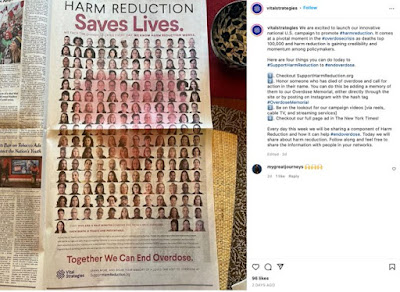
But not all harm reduction. It was recently publishing newspaper ads supporting harm reduction for drug users. Vital Strategies finds itself in an absurd position. On one hand, it wants to cling to its credibility as a public health group. On the other hand, it wants to keep the Bloomberg cash rolling in. And so it runs campaigns like this...


While simultaneously campaigning to ban and restrict e-cigarette use as much as possible.  
 

How humiliating.

Thursday, 24 February 2022

My life

I did the Media Masters podcast recently, talking about the COVID-19 pandemic, lockdowns, paternalism, libertarianism and what I do working for a think tank. You can listen here.


Wednesday, 23 February 2022

The temperance mask slips

From an anonymous editorial in Lancet Global Health...

For an addictive substance with profound public health consequences, alcohol also remains stubbornly engrained in much of the world's social and cultural structures, openly indulged in and endorsed by people of all rank and profession.
 
Cry more.

As long as the status of alcohol consumption as an enjoyable and even beneficial recreation remains, not least via the multitude of advertising outlets globally, the alcohol industry will be free to exert its nefarious influence while policymakers turn a blind eye.

Was this written by Carrie Nation?

The editorial is about the WHO's Global Alcohol Strategy. This is the most revealing bit...

The draft Action Plan approved at the 150th WHO Executive Board session in January was drawn up in light of the limited policy traction seen, particularly in low-income and middle-income countries, since the Global Strategy to Reduce the Harmful Use of Alcohol was endorsed in 2010. One of the key barriers, according to the Action Plan preamble, is industry interference in alcohol policy development and implementation and governments’ reluctance to resist it, whether from weak leadership or competing interests.
 
Ironically, the Action Plan itself seems to have been subject to such interference, according to a report from the Centre for Alcohol Policy Research at La Trobe University, Melbourne, Australia. The report's authors examined submissions to WHO's online consultation on the draft Action Plan in 2020, finding that 60 (24%) of 251 submissions were from alcohol industry actors. The thrust of many of these submissions centred on countering the Action Plan's proposals to limit industry involvement in policy making and the Plan's focus on reducing overall consumption rather than minimising harms. More worryingly, these tactics appear to have worked. An analysis of before-and-after versions of the draft Action Plan by the Foundation for Alcohol Research and Education showed that one of the global targets had been changed from a reduction in per capita alcohol consumption to a reduction in the “harmful use of alcohol”, and that reference to “self-regulation” by industry had been inserted.
 
Why would anyone in public health be bothered by the WHO targeting the harmful use of alcohol rather than alcohol consumption per se? Surely they should support this change. They're meant to be all about health, right? It's not some moral crusade, is it? 

Or is it?