Tuesday, 22 February 2022

Buy your own lateral flow test

I've written for the New Statesman about how we could find better ways of spending £2 billion a month than testing people for SARS-CoV-2.
 

NHS Test and Trace has been the subject of an extraordinary amount of misinformation since it was set up in May 2020. There are corners of the internet where people seem to genuinely believe that £37 billion was given personally to Dido Harding or to Serco and that all the money was spent on an app. It is widely believed that the system has “failed”. In fact, Harding has not been involved with it since last April, Serco never received more than a small portion of the budget and the amount spent on the app was smaller still. Nearly all of its money goes on testing and if that has failed, why are so many people desperate to keep doing it?

 
As ever, have a read.


Monday, 21 February 2022

A swift half with Lionel Shriver

It was a great pleasure to interview best-selling author and columnist Lionel Shriver on The Swift Half last week. We covered various issues, not least vaping which is a subject I remember her writing about years ago and wondered if she still had strong opinions about. It turns out she did. You can see the vaping segment here. The full episode is below.


Saturday, 19 February 2022

Apparently, the NHS has money to burn

From the Guardian...
 

The NHS has severed its links with the charity GambleAware due to concerns over its connections to the gambling industry.

Announcing two new clinics to deal with record demand for gambling addiction services in England, the mental health director of the NHS, Claire Murdoch, decried the “predatory tactics” of gambling companies.

... GambleAware, which describes itself as “an independent, grant-making charity commissioning prevention and treatment services” is funded almost entirely by donations from the gambling industry.

Last year it announced a three-year funding arrangement with the UK’s four biggest gambling companies totalling £100m. It has previously been criticised for having too big an influence on the funding of research into and treatment of gambling addiction.

NHS England has had a “dual commissioning and funding” arrangement with GambleAware since 2019, with £1.2m a year going into the National Gambling Treatment Service, which currently operates five clinics in London, Leeds, Manchester and Sunderland as well as a national telephone helpline.

 
This is outrageous. The taxpayer is going to have to step in to make up the shortfall because this woman has an irrational moral aversion to using money from the gambling industry to treat problem gamblers. 
 
There is absolutely no upside to this. It is pure virtue signalling. So much for the NHS being 'under-funded'. 

It is particularly ridiculous because in 2019 Claire Murdoch was calling on the industry to "ensure a fair amount of its profits help its customers who may suffer from addiction". It is less than a year since she was telling the industry to provide more money for treatment. From the Guardian in April 2021...

“After seeing the destruction the gambling industry has caused to young people in this country, it is clear that firms are focused on profit at the expense of people’s health, while the NHS is increasingly left to pick up the pieces,” she said.

“In a year when the NHS has dealt with our biggest challenge yet in Covid-19, the health service’s psychologists and nurses having been treating hundreds of people with severe gambling addictions.

“The gambling industry must take more responsibility, as the nation has come together over the last year to support the NHS, whether it be volunteering as vaccinators or showing their gratitude to staff. The bookmakers must also step up and agree to a mandatory levy to pay for dealing with the harms of problem gambling.”


There is a lot to unpick in this quote. Firstly, you may have noticed that Murdoch sounds more like an activist than a senior NHS official. She has form for this. She often uses NHS press releases to attack the gambling industry in Student Union terms, accusing it of "hijacking sport in pursuit of profit" and being "shameless".

Secondly, she hasn't been keeping up with developments if she thinks the bookmakers have got money to spare. They've been busy closing down thousands of betting shops since the government effectively outlawed fixed-odds betting terminals. Wasn't that supposed to reduce the number of problem gamblers, by the way? How's that going? 

Thirdly, the industry could agree to a mandatory levy but it cannot implement one. Alternatively, the government could implement one and it wouldn't matter whether the industry agreed with it or not. The fact is that the government hasn't implemented a mandatory levy so the only way the industry can contribute is with voluntary donations. 
 
In any case, GambleAware isn't 'the industry'. It is an independent charity funded by industry. 

Unfortunately, this fanatic won't accept voluntary donations even from GambleAware so taxpayers have to put their hand in their pocket again.

It's a disgrace. Sajid Javid needs to look into this. Why has an anti-gambling activist been appointed mental health director of the NHS? Why is she being allowed to use the NHS as a platform for her little rants about a legal industry? And why hasn't she been told to get on with job with whatever money is available?


Last Orders with Dominic Frisby

 We were pleased to welcome back Dominic Frisby for this month's Last Orders podcast. Have a listen.


Friday, 18 February 2022

Calories and the Transport for London food advertising ban


From the Guardian...
 

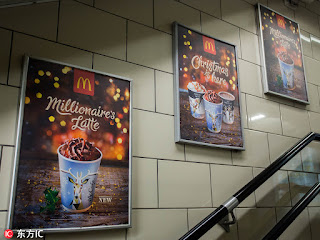
A ban on junk food advertising by Transport for London has contributed to a 1,000 calorie decrease in unhealthy purchases in people’s weekly shopping, a study has estimated.

... Dr Amy Yau, from LSHTM and the study’s lead author, said: “Many governments and local authorities are considering advertising restrictions to reduce consumption of HFSS products as part of obesity prevention strategies.

“However, evidence of the effectiveness of such policies, especially away from broadcast media, is scarce.

“Our study helps to plug that knowledge gap, showing TfL’s policy is a potential destination for decision-makers aiming to reduce diet-related disease more widely.”

 
As you can probably tell from Dr Yau's quote, the study in question was created a number of activist-academics who are keen supporters of food advertising bans, including Emma Boyland and Martin White
 
The claim they are making is a big one. 1,000 calories a week is quite a lot. Even divided by the 2.1 people in the average household, it amounts to 476 calories a week or 68 calories a day. This is much, much more than the Department of Health - and several of the authors of this study - expect to achieve from its pre-watershed broadcast advertising ban and its total online ban combined. Could an advertising ban on 'high in fat, sugar and salt' food (HFSS) on buses and trains in one city really reduce calorie consumption by this much? It seems fishy from the outset.
 
The study uses Kantar survey data to see how food purchases changed in the ten months after the ban started. The Kantar survey involves enrolling households to scan the barcode of all food brought into the home. Importantly, it does not include restaurant meals, fast food, snacks bought outside the home, etc. This is significant not only because a large amount of HFSS food is bought from the 'out-of-home' sector, but because this is the kind of food that is (or was) most often advertised on TfL. I use the Tube fairly regularly and in my experience it was companies like Pizza Hut and McDonalds that were advertising. It would be interesting to see the breakdown, but I don't remember seeing adverts for biscuits or breakfast cereal very much.
 
Data from nearly a thousand households in London and a similar number in the North of England were used in the study. The North of England was chosen as the control because the people there are unlikely to take the tube (or, as the authors put it, suffer from 'contamination ... through regular commuting to London'!). 

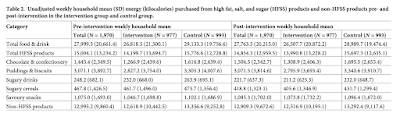
If you look at the data, both sets of households reduced their overall calorie purchases and they reduced the amount of HFSS food purchased. HFSS food sales fell by 1.47% in London and by 0.51% in the North. Click to enlarge...
 
 
Both groups increased the amount of chocolate and confectionery they bought. Both groups reduced the amount of sugary drinks and sugary cereals they bought. The Londoners slightly decreased their purchases of puddings and biscuits while the Northerners slightly increased them. And the Northerners slightly reduced their purchases of savoury snacks while the Londoners slightly increased them. 

The differences here are tiny and seem indistinguishable from random noise. The biggest difference is in the 'puddings and biscuits' category, purchases of which went up in the North by 35 calories a week and down by 31 calories in London. It seems unlikely that this was caused by a ban on advertising 'junk food' on trains and buses in London and it should be put in the context of overall calorie purchases which amounted to 26,819 a week in London and 29,133 a week in the North before the ban was introduced (note the large difference between the two areas).

There isn't much to see here and certainly no evidence of the TfL food ban reducing household calorie consumption by 1,000 calories a week. To achieve this finding, the authors turn to their old friend, the opaque counterfactual model. In classic 'public health' style, details about the variables in this model are thin on the ground, but once the authors start imaging what might have been had Sadiq Khan never banned Burger King adverts, they come up with a much more impressive conclusion:

The implementation of HFSS advertising restrictions was associated with a relative reduction in average weekly household energy purchased from HFSS products of 1,001.0 kcal (95% CI 456.0 to 1,546.0), or 6.7% (95% CI 3.2% to 10.1%), in the intervention group compared to the counterfactual.

Er, OK. If you say so. For what it's worth, here's the model...

 
Even with a model of their own design, they fail to find a statistically significant difference between London and the North for most categories. The main exception is chocolate and confectionery...
 
Chocolate and confectionery. Using the whole study period, average weekly household purchases of energy from chocolate and confectionery fell by 317.9 kcal (95% CI 200.0 to 435.8) in the intervention group relative to the counterfactual, equivalent to an observed decrease of 19.4% (95% CI 13.4% to 25.4%).

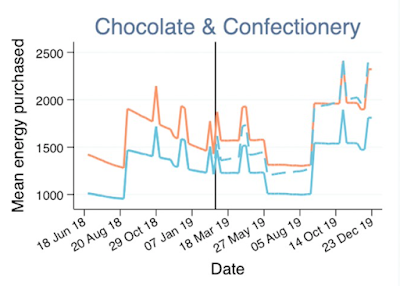
This is slightly astonishing because the actual data show that the amount of chocolate and confectionery rose in both areas, by 3.3% in London and by 4.9% in the North. Somehow, the authors have turned a 42 calorie increase in chocolate and confectionery purchases in London after the TfL ban into a 318 calorie reduction! 

A look at the model shows how this trick was pulled off. They created a counterfactual in which purchases of these products in London (blue line), which had consistently been well below the North in the recent past (orange line), suddenly leapt up in late 2019 to Northern levels (dotted blue line).

Why would demand for chocolate and confectionery rise so far above the secular trend in London out of the blue like this? Alas, the authors do not explain, but we don't need to worry about it because HFSS food ads were banned on the Tube before it could happen. Phew, what a close shave!

If you believe this obvious nonsense, you will believe anything.

London mayor Sadiq Khan said: “I am pleased to see the positive impact these groundbreaking measures have had, leading to a real reduction in the amount of junk food being purchased.”


We're being taken for fools.

Still, a reduction of 1,000 calories a week is enough to make a real impact on obesity rates so I'm sure we can expect them to start falling any day now, right?


Tuesday, 15 February 2022

Spot the odd one out

Three messages from Mike Bloomberg's prohibitionist outfit Vital Strategies. One of these things is not like the other ones...


🤔


Friday, 11 February 2022

China's war on vaping

The Chinese government has arrested Chu Lam Yiu, the owner of Huabao, China's biggest e-cigarette company.
 
She is being held in “residential surveillance”, a form of off-grid detention used by the Chinese Communist party and criticised by human rights groups for lacking due process. Her son, Lam Ka Yu, who was educated in the US and the UK and is in his late 20s, was also detained. 
.. For Chu, the future is far from clear. The CCDI, the highly secretive extralegal body that can investigate and detain party members, might afford some leniency in exchange for co-operation. But acquittals are a rarity in a judicial system with a near-100 per cent conviction rate. 
 
The Cercius Group, which has studied Chu’s political connections and that of her husband, businessman Lam Kwok Man, said it did not “expect any good outcome”.

Eighteen months ago I asked why the Chinese government, which owns the world's biggest tobacco company, was clamping down on vaping. It was a rhetorical question. Vaping is an existential threat to tobacco. I said...
 

It is obvious what China Tobacco's motivation is. They fear missing out on cigarette sales if people switch to vaping. The Chinese government, insofar as it can be distinguished from the tobacco monopoly, doesn't want to miss out on tax revenue. More vapers means fewer smokers, hence the online sales ban and scare stories.

Does this sound familiar? The United States has been awash with scare stories about e-cigarettes for several years, culminating in the 'EVALI' panic last year. A ban on online sales (disingenuously titled the Preventing Online Sales of E-Cigarettes to Children Act) passed the Senate earlier this month and will be voted on in the House any day now.

The only difference is that China Tobacco doesn't have the 'public health' lobby cheering it on.
 
But it seems that I was wrong. China Tobacco does have the 'public health' lobby cheering it on.  

For months, the e-cigarette market has been squeezed by dual pressures. Health groups are concerned about youth uptake, supporting government clampdowns on online advertisements and sales to minors.
 
The smoking rate in China is 45 per cent. You'd think 'health groups' had bigger fish to fry.
 
Chinese health groups also happen to be awash with money from the anti-vaping fanatic Mike Bloomberg. The China National Tobacco Corporation and Bloomberg Philanthropies have teamed up to keep people smoking. See how it works yet?