Wednesday, 7 June 2017

'Public health' versus science

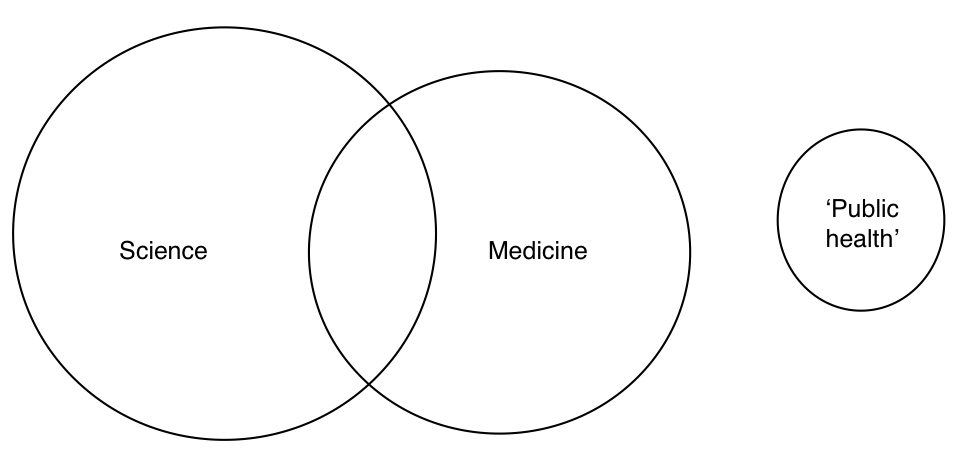
I have used this image before to illustrate the relationship between 'public health' advocacy and science and medicine.


In short, 'public health' as we know it today has nothing to do with either science (the search for truth) or medicine (curing disease). It is a political movement with fixed prior beliefs. It has some of the accoutrements of science and medicine - its own journals, its own PhDs and its own systematic reviews - but, as Eric Crampton says, is it not science. It is 'sciency'.

In truth, it is a grotesque parody of science. Grotesque because it seeks to do the opposite of science by confirming dogma and narrowing thought.

Put in simple terms, the scientific method involves developing a falsifiable hypothesis and putting it to the test. Seeking to disprove - rather than prove - a hypothesis is at the heart of the scientific method, as Peter De Forest explains...

The core of the scientific method is the rigorous testing of hypotheses. Hypotheses that endeavor to explain the event are put forward, and then an earnest attempt is made to disprove each. A hypothesis that fails this testing is discarded. A modified hypothesis or new alternate hypotheses are developed and tested in turn. Only a hypothesis that survives repeated vigorous testing develops into an explanatory theory of the event. The scientific method and hypothesis testing is a cyclical, iterative process. The key to the process is the vigorousness and rigorousness of the testing. There is a human tendency to identify with a hypothesis that one has developed and to subconsciously overlook observations or data that do not fit the hypothesis. This is antithetical to good science and must be avoided. Scientists must be involved in actively attempting to disprove their own hypotheses

This is not how it works in 'public health'. In 'public health', the activist-researchers 'know' the truth before they turn on their lap top. They 'know' what the problems are (availability, advertising and affordability) and they know the solutions (bans and taxes). There is ample evidence that these beliefs are wrong-headed or, at the least, overly simplistic, but this evidence is never published in journals that are sympathetic to the cause.

One clue that 'public health' is not scientific is that their hypotheses are always proven correct (for example, take this risible attempt to claim that policy-based computer models pass the Bradford Hill criteria for causality). Its policies always work. This suggests a degree of infallibility that is beyond the reach of mere mortals.

Insofar as hypotheses are altered by 'public health' research, it is only by purporting to show that the problems are even worse than was previously believed and the solutions are even more effective than was previously believed. It is no coincidence that this is what the media and politicians want to hear. It is not science. It is PR.  

Occasionally, an activist-researchers will speak a little too freely and give the game away. Anti-smoking campaigner and Californian 'public health' professor Stanton Glantz once told an audience: 

'…that’s the question that I have applied to my research relating to tobacco: If this comes out the way I think, will it make a difference? And if the answer is yes, then we do it, and if the answer is I don’t know, then we don’t bother. Okay? And that’s the criteria.' ('Revolt Against Tobacco' conference, Los Angeles, 2/10/92. Transcript, p. 14)

And here is Gerard Hastings speaking today at a neo-temperance meeting...


When Hastings talks about consumption, he does not mean the consumption of specific brands, but of the overall category. So, for example, he thinks that an increase in Heineken advertising leads to an increase in per capita alcohol consumption.

Acres of economic evidence based on real world data suggest that he is wrong about this, but he 'knows' he is right. He has known it all his career. To him, it is the 'bleeding obvious' and he has spent 30 years trying to prove it to everybody else.

In truth, the only thing that is bleeding obvious is that real scientists do not proceed on the basis that their hypothesis is self-evidently true and then spend years looking for evidence to confirm it.

Hastings is not a real scientist. He is a professor of social marketing, whatever that means, but that does not stop him being commissioned by the WHO to give his jaundiced view of the evidence and being treated as if he were an expert by parliamentarians. And while his statement today - assuming it has been correctly reported - was a little too candid for a public event, there are plenty of others on the 'public health' gravy train who will say the same in private.

UPDATE

As you can see from the photo below, Hastings sees his next task to be 'proving' that banning alcohol advertising works. You almost have to admire the shamelessness of the man.


Monday, 5 June 2017

Lifestyle regulation and the general election

It might not be front of mind for everybody at election time but for single issue voters like me, only one question matters: where do the parties stand on the nanny state? For the benefit of those who have similar concerns, I have waded through every party’s manifesto to see what our would-be masters have in store for drinkers, gamblers, smokers, vapers and people who like eating food. And so, in alphabetical order and with marks out of five for devotion to lifestyle liberties, let us proceed:

Conservatives
**

I have previously argued that Theresa May is relatively sound on nanny state issues. She is reputed to have been one of the cabinet ministers who dissuaded David Cameron from introducing minimum pricing. She voted against the ban on smoking in cars and there is evidence that she watered down Cameron’s hideously paternalistic obesity strategy. We will have to wait and see if my hunch is correct because there is previous little to go in the manifesto. Aside from a vague pledge to ‘continue to take action to reduce childhood obesity’, lifestyle regulation doesn't get a look-in. Nothing on alcohol, nothing on smoking and nothing on gambling. In the spirit of misplaced optimism, I was going to assume that no news is good news and award three stars, but then I remembered plain packaging, the sugar tax and the outrageous food reformulation scam and downgraded it to two.

Green party
**

After publishing a loony’s charter of a manifesto in 2015, the Greens are keeping their cards close to their chest this year. It is reasonable to assume that they still want to ban horse-racing, foie gras and rabbit hutches. They probably still want to squeeze an extra £5 billion out of drinkers and smokers. But they do not explicitly say so. Nor do they explicitly say they want to legalise marijuana. Since they are maintaining a dignified silence over their policies, I will have to judge them on their previous manifesto and award two stars. Without the cannabis legalisation, it would be one.

Labour
**

Jeremy Corbyn might want to resurrect Old Labour but his first Five Year Plan doesn’t involve rolling back taxes on booze and fags to the levels of the 1970s. The great helmsman describes himself as ‘totally anti-sugar’ despite his hobby of jam-making and his manifesto promises ‘a new childhood obesity strategy within the first 100 days, with proposals on advertising and food labelling.’ In practice, this means a ban on so-called ‘junk food’ advertising on primetime television in a futile attempt to put people off eating tasty meals. The manifesto also pledges to ‘implement the Soft Drinks Industry Levy, commonly known as the ‘sugar tax’’, but the legislation for that has already passed through the Commons and is taken as read.

Labour has nothing to say about alcohol, tobacco or e-cigarettes, but it says it will ‘reduce the maximum stake on Fixed Odds Betting Terminals from £100 to £2.’ It will also ‘increase the delay between spins’ which is currently 20 seconds. This would make them completely unplayable. To all intents and purposes, it would be a ban and it would almost certainly lead to the closure of hundreds of bookmakers around the UK.

Liberal Democrats
*

According to the Lib Dem manifesto, ‘Liberal Democrats believe that we should all be free from an overreaching state’. Three cheers for that. Alas, these fine words are rather at odds with the policies put forward. The manifesto contains a nanny state wish list that makes a mockery of the first part of the Liberal Democrats’ name, just as their refusal to accept the referendum result makes a mockery of the second.

Like Labour, they want to restrict food advertising before the 9pm watershed, but they are also keen on ‘closing loopholes in the sugary drinks tax’. It is unclear whether this means they want to tax other soft drinks or if they want to extend to tax to food products. Either way, it won’t be good for our wallets.

Farron’s freedom fighters want to introduce minimum pricing for alcohol and ‘encourage the traffic light labelling for food products’. Ironically, the UK is prevented from doing either of these at the moment thanks to the Lib Dems’ beloved EU.

They also want to make the sugar reduction targets legally binding, reduce stakes on fixed odds betting terminals to £2, and introduce a levy on tobacco company profits ‘so they fairly contribute to the costs of health care'. It will be interesting to see how they intend to do the latter, as most tobacco companies are not headquartered in the UK and therefore cannot be subject to a windfall tax. Whatever tax they come up with will no doubt be passed on to consumers one way or another, thereby adding to the £11 billion tax already paid by smokers each year, a sum that covers the 'costs of health care' associated with smoking several times over.

Once again, the Lib Dems have put together another monstrosity of a manifesto to make John Stuart Mill turn in his grave. On the other hand, they want to legalise marijuana - albeit in the most useless and miserable way. I would normally give an extra star for cannabis legalisation but the rest of the manifesto is so horribly paternalistic that I cannot bring myself to give them more than one.

Plaid Cymru
*

The Welsh nationalists have nothing to say about any lifestyle issues in their manifesto, but given that they tried to ban vaping indoors and are keen supporters of minimum pricing, we must assume the worst. One star. [Update: In fairness, it was the Welsh Labour Party that pushed for the vaping ban. Plaid Cymru seemed broadly happy to go along with it, but ended up voting against due to an unrelated spat.]

SNP
**

Why do nationalist parties have so little faith in their own people? Like Plaid Cymru, the SNP are past masters at treating their electorate like children. In their latest manifesto, the Scotch Nats reaffirm their commitment to imposing a deadweight loss on drinkers through minimum pricing and, like the Lib Dems, talk about ‘closing loopholes in the sugary drinks tax’. They also want to shaft commercial broadcasters with a watershed ban on advertisements for food that is high in salt, fat or sugar.

The only tiny glimmer of hope comes when they say that they 'will continue to advocate a review of alcohol taxation to better reflect alcohol content’. I have previously argued that alcohol should be taxed by the unit, rather than the current system which privileges cider drinkers at the expense of those who prefer spirits. The SNP appears to want to move in this direction because ‘the Scotch Whisky industry is a key sector of Scotland’s economy’. Given this hint that they might want to reduce duty on spirits, I will give them two stars rather than the one star that they almost certainly deserve.

UKIP
*

Under Nigel Farage, UKIP could be relied on to take a relaxed approach to booze and tabs, but those days are over. The Kippers' longstanding pledge to amend the smoking ban is notably absent from the 2017 manifesto. Rather than repeal the worst thing Labour ever did, they are going to repeal the best. They want to get rid of the 2003 Licensing Act which was supposed to create 24 hour drinking but never did. UKIP cite some worthless research from the UK Temperance Alliance - or the 'Institute of Alcohol Studies' as it now calls itself - to justify closing the boozers at 11pm. It will, they reckon, ‘protect emergency workers from abuse’. They also want to ‘bring in new legislation to reduce the density of alcohol outlets and restrict trading times’. Back to the Fifties with Nutall!

As if that weren’t enough - and it really is - UKIP are the third party promising to reduce the stakes on gambling machines in bookmakers which, as mentioned above, amounts to a de facto ban on fixed odds betting terminals. They will also ‘keep and enforce current legislation on the use of illegal drugs’. So much for the purple libertarians.


Conclusion

All of these scores are probably too generous. Politicians know that nanny state legislation is not popular with the public and are therefore reluctant to show their full hand in their manifestos. Labour brought in a draconian smoking ban in 2007 despite its 2015 manifesto explicitly exempting drinking establishments that did not serve food. David Cameron did not mention plain packaging in his 2010 manifesto and the sugar tax did not feature in his 2015 manifesto. The only major nanny state policy to feature in a ruling party’s manifesto in the last decade is minimum pricing for alcohol - and that never happened.

Do your own research and let the buyer beware, but it doesn’t really matter who you vote for, the nanny statists always get in.


[Cross-posted from Spectator Health]

Thursday, 1 June 2017

Australian smoking rate has flatlined since 2013

Image courtesy of the Australian Institute of Health and Welfare


When plain packaging came into full force in the UK two weeks ago, anti-smoking campaigners claimed that it would somehow lead to 300,000 fewer smokers in the first twelve months. This figure was essentially plucked out of thin air. Only one country has had plain packaging in force for more than a year. That country is Australia and since we know that cigarette sales rose in the first year, it seems unlikely that the smoking rate fell at the same time.

Australian smoking prevalence statistics are not very helpful if you want a year on year comparison. Nationwide statistics are only collected every three years and plain packaging occurred at the back end of the three year period of 2010-13.

When the figures for 2010-13 were published in 2014, plain pack campaigners pretended that there had been a steep fall thanks to plain packaging. Mike Daube falsely claimed that the 'decline in smoking is really dramatic and exceptionally encouraging – even speeding up' and the risible Simon Chapman said that plain packaging was 'like finding a vaccine that works very well against lung cancer'.

This was the sheerest nonsense. The smoking rate fell at much the same rate as it had been falling for years and it was impossible to tell whether it had risen, dropped or stayed the same since plain packaging was introduced in December 2012.


Today, the Australian Institute of Health and Welfare released its figures for 2013-16, the first full three year period since plain packaging was introduced. You won't hear the 'public health' lobby shouting about them because the figures show that...

12.2% of people aged 14 or over were daily smokers in 2016. While smoking rates have been on a long-term downward trend, for the first time in over two decades, the daily smoking rate did not significantly decline over the most recent 3 year period (2013 to 2016).

Tobacco taxes are incredibly punitive in Australia, with increases of 12.5% being implemented every year since plain packaging was introduced in a desperate attempt to reduce smoking prevalence. A statistically insignificant drop in the smoking rate from 12.8% to 12.2% is not what was promised when these tax rises were combined with the, er, 'vaccine for lung cancer' of plain packaging.

The graph below comes from Sinclair Davidson of RMIT University (who explains the tricks used by 'public health' campaigners to retrospectively justify plain packaging in the video at the bottom of this post).


The frenzy of anti-smoking activity fanaticism has done nothing except push smokers onto the black market, as was predicted by the reality-based community. 
 
We saw a similar flatlining of the smoking rate in the UK after the smoking ban ushered in a wave of extremist policies. Between 2007 and 2012, the smoking rate barely budged. However, unlike Australia, Britain did not ban e-cigarettes and there has been a significant fall in smoking prevalence since vaping became popular in 2013.


We don't have the British figures for 2016 yet, but between 2012 and 2015 the rate fell from 20.4% to 17.8%, a drop of 2.6 percentage points. In Australia, by contrast, the last three year period saw a statistically insignificant drop of just 0.6 percentage points.

If the 'public health' industry was even slightly evidence-based, Australia would have legalised vaping and Britain would have never bothered with plain packaging. But is not evidence-based. It is a cult, and the chief turnip on the turnip farm has already come up with his pathetic excuses, which amount to 'give us more money'...


I've said it before and I'll say it again, tobacco control is not a results-driven business.


Wednesday, 31 May 2017

Prohibitionists for human rights

This is a new one...

After completing a collaboration with multi-national tobacco giant Philip Morris International (PMI) to develop a “human rights implementation plan” for the company, the Danish Institute for Human Rights (DIHR) concluded that immediately stopping the sale and marketing of tobacco is the only way for tobacco companies to uphold basic human rights...

Following DIHR’s completion of their work, they concluded:

"Tobacco is deeply harmful to human health, and there can be no doubt that the production and marketing of tobacco is irreconcilable with the human right to health. For the tobacco industry, the [United Nations Guiding Principles on Business and Human Rights] therefore require the cessation of the production and marketing of tobacco."


These hideous prohibitionists will cling to any argument to achieve their goals. Tobacco is a plant. Insofar as people have a 'right' to health, it is a right that is breached by nature and the ageing process every day. In any case, a 'right' to health is very different to an obligation to be healthy. 

As so often in the topsy-turvy world of 'public health', the truth is the very opposite of what these people claim. Individuals have ownership of their body. If they wish to smoke a plant that grows naturally in the earth, they should have the right to do so. If they want to make this easier by paying somebody else to plant it, grow it and process it, they should have the right to do that as well.

Quite obviously, the 'production and marketing of tobacco' is not 'irreconcilable with the human right to health' because it does not harm health without the active participation of the individual. Equally obviously, banning people from buying a product is a violation of their rights, even if it might improve their health. If this has to be spelt out, it is only because single-issue pressure groups have debased the currency of human rights.

Thursday, 25 May 2017

The nanny state we're in

Since the first edition of the Nanny State Index was published in March 2016, there have been many regulatory changes, most of them for the worse. Of the 28 countries included, all but six of them have a higher score than they did last year.

2016 was a particularly bad year for vapers. Eleven countries now forbid the use of e-cigarettes wherever smoking is banned after Finland, Luxembourg, Hungary and Poland joined the fold. As governments seek to raise money and protect their tobacco revenues, there is also a growing trend towards taxing e-cigarette fluid. Greece, Slovenia, Romania, Latvia and Hungary all introduced new taxes in 2016, and e-cigarette tax rates now range from €0.01 per ml in Latvia to €0.60 per ml in Portugal. Although some governments have been slow to recognise the health benefits of safer nicotine products, they have been quick to see their potential for raising revenue. The emergence of ‘heat-not-burn’ technology, such as iQOS, has inspired Greece and Slovakia to approve new taxes that specifically target tobacco for ‘electronically heated’ products.

The most significant change that took place in 2016 was the introduction of the EU’s Tobacco Products Directive (TPD) which came into effect in May. This legislation is principally aimed at smokers, with a ban on packs of ten, mandatory graphic warnings and, from 2020, a ban on menthol cigarettes, but it also places a significant burden on vapers. The TPD bans all e-cigarette fluids containing more than two per cent nicotine, restricts the sale of e-cigarette fluid to small, 10ml bottles, and bans e-cigarette advertising in printed media, online and on television and radio. As a result of the TPD, twelve countries that scored a perfect zero for nanny state regulation of e-cigarettes now have at least 16 points (out of 100).

The UK and France decided to gold-plate the TPD by becoming the first countries in the Northern hemisphere to ban branding on tobacco packaging (‘plain’ or ‘standardised’ packaging). Hungary, Slovenia and Ireland look set to join them in the next few years and there have inevitably been calls to roll this policy out to food and alcohol.

It is not all bad news, however. Some governments used the TPD as an opportunity to liberalise their vaping laws. Countries that previously had a de jure or de facto ban on e-cigarette sales, including Finland, Denmark, Hungary and Belgium, now permit their sale under varying degrees of regulation.
There are a few flickers of liberalisation in other areas as well. Finland discarded its tax on confectionery, chocolate and ice cream in January 2017 and the Finnish government is considering relaxing its highly restrictive alcohol laws by, for example, making it legal to buy a round of drinks and pay by credit card. In Slovakia, cyclists are now permitted to drink a pint of beer before using a cycle lane. Last year, the Czech Republic’s finance minister pledged to halve VAT on draft beer (this has not yet happened) and, in Bulgaria, a proposed tax on fast food and energy drinks in Bulgaria was rejected thanks to the finance minister.

The most sensational piece of deregulation came in Sweden where the e-cigarette market went from complete illegality to laissez-faire by accident. After Sweden’s Supreme Administrative Court ruled that e-cigarettes are not medical devices and cannot be regulated as such, they fell into legal limbo where they remain at the time of writing. Unsurprisingly, there have been no reports of any health problems as result of e-cigarettes being freely bought and sold. The Swedish government should bear this in mind when it finally gets around to regulating the vaping market.

Looking to the future, the prospects for lifestyle freedom generally look bleak. A number of countries are seeking to join Hungary, Finland and France in putting a ‘sin tax’ on sugary drinks. Belgium has already done so. Ireland and the UK will join them next year. Latvia and Lithuania have set a precedent by banning the sale of energy drinks to people aged under 18. France banned free refills of fizzy drinks at the start of 2017. Sweden is set to regulate alcoholic ice cream. Greece has introduced a tax on wine for the first time.

The Czech Republic will soon introduce an indoor smoking ban, albeit with plenty of exemptions. Romania introduced a more severe smoking ban last year, leaving only Austria, Germany and Slovakia as the last truly smoker-friendly countries in the EU - and Austria has a ban planned for 2018. Cyprus is looking to both extend its ban to some outdoor places and include vaping in it. The governments of Scotland and Finland have set a deadline for making their countries ‘tobacco-free’. Estonia and the Netherlands are seriously considering a retail display ban for tobacco.

There has been little in the way of nanny state regulation of alcohol since the last Index was published, but that looks set to change. Lithuania, Latvia and Estonia are all on the verge of introducing heavy temperance legislation, with the health minister of Estonia publicly stating that he wants to treat alcohol and tobacco in the same way, ie. with draconian regulation. Minimum pricing for alcohol is tied up in the courts at the time of writing but, win or lose, the Scottish government will be able to introduce this regressive policy after Brexit. Meanwhile, Ireland has tabled a temperance law that will introduce minimum pricing, extensive advertising restrictions and possibly even a retail display ban similar to that already in place for tobacco.

This rising tide of lifestyle regulation confirms C.S. Lewis’s view that ‘those who torment us for our own good will torment us without end for they do so with the approval of their own conscience.’ The nanny state never sleeps. There is so much legislation and so many new proposals that it can be difficult to keep up, but that is what the Nanny State Index aims to do.

[This is an excerpt from the 2017 Nanny State Index which you can download here.]

Tuesday, 23 May 2017

The eating ban

The European Congress on Obesity took place last week in Portugal and various British journalists were sent over to find a story. The organisers were happy to oblige. First they announced that you can't be fat and fit (based on a verbal discussion of an abstract of an unpublished, unreviewed study) and then they upped the ante with a demand for 'junk food' to be banned on public transport.

Both stories got acres of newspaper coverage and the media were particularly attracted to the idea of an eating ban. From the Telegraph...

Fast food should be banned from buses and trains, as part of efforts to “nudge” the public out of round-the-clock snacking, obesity experts say.

The call for radical restrictions, in an attempt to reset social norms, came amid warnings that “guzzling on the go” is fuelling Britain’s weight problem.

Experts at the world’s largest obesity conference urged politicians to make sweeping changes to limit the availability of junk food on public transport.

They said buses, trains and trams should take action, in the same way that other health threats, like smoking, and alcohol, have been banned.

This is a policy taken wholesale from the anti-smoking lobby. Public transport was the first target of campaigners for smoking bans back in the 1970s, but while restrictions on smoking in small, shared, government-owned spaces could be justified on the grounds that some people don't want to smell smoke, the case for banning 'junk food' on public transport is wholly arbitrary.

You might assume that the issue is about the smell of hot food, but that is not what the nanny statists are interested in. Their intention is paternalistic. Alleged obesity expert Jason Halford (who is obese) says:

“Food is everywhere and the type of food that is most ubiquitous is unhealthy. We need more action across the public sector, we are seeing changes with hospitals it needs to spread to other sectors – councils, transport, universities.”

They are concerned that you will get fat if you eat certain foods and so they want to make it a crime to do so. They are starting with public transport.

Although it is snacking per se that they have a problem with, they can leverage support by focusing on hot food that has a strong smell. People eating a Burger King or Wasabi next to you on a train is one of life's minor nuisances. I don't want it banned but some intolerant prigs do, and there are enough intolerance prigs to give any call for a ban a bit of traction.

Yesterday morning I was on the Good Morning Britain sofa with Tam Fry of the National Obesity Forum to discuss the eating ban. It's a dreadful idea but I'm glad they have proposed it because it lays bare the authoritarian impulse at the heart of the nanny state industry. It also happens to be unworkable because there is no legal definition of 'junk food'.

Mr Fry tried to avoid the more obvious criticisms by focusing on hot food and pretending that the main issue was the aroma. Like many food snobs, he is obsessed with hamburgers, although what is so dangerous about bread and meat was never explained.

Alas, it all went wrong when he forgot to maintain the pretence that his concern was about the smell of secondhand food. Under pressure from Piers Morgan, he was asked to give an example of a hot dish that people would be allowed to eat on a train under a Tam Fry dictatorship. What happened next will amaze you.

You can watch the video here or read about it here.

Sunday, 21 May 2017

Weekend review

I've been sent a few products to review recently and have been discussing them on Twitter. For those of you who don't follow me on Twitter, here are my reviews (click on the tweet and follow the thread).

First up was a 50w Sub Ohm vape from Kik E-cigs. It's an attractive little gadget but I'm not that keen on Sub Ohming when other people do it and I found I wasn't that keen on it when I did it either. However, if this is the kind of thing you like, you'll like this kind of thing. Looks nice doesn't it?


Next up was some nicotine-free snus from Snus Direct. I suppose this is for snus users who want to give up. I have the opposite problem. I like using snus but struggle get hold of it (thanks, EU). Still, it can't be denied that it has all the features of snus without the nicotine. The only way it could be improved would be by adding some nicotine.


Most recently, I reviewed the PockeX e-cigarette and some unflavoured fluid sent to me by E-Cig Wizard. The fluid has proved to be a more-or-less suitable replacement for my discontinued brand (thanks again, EU) and the e-cigarette itself is a bobby dazzler for a starter kit.

Here it is...


The review starts below...


Please note that I am also available to review hard liquor and cigars.