Today sees the publication of the 2017 edition of the Nanny State Index, a league table of the best and worst places in the European Union to eat, drink, smoke and vape. Each country is given a score according to the scale of its paternalistic regulation of alcohol, e-cigarettes, food and tobacco. There is no change at the top, with Finland enjoying a seemingly impregnable lead as the EU’s number one nanny state thanks to draconian restrictions on all four product categories, but the UK and Ireland are not far behind, saved only by their more liberal approach to vaping. The best performing countries are those which have relatively low taxes and a tolerant attitude to smokers, drinkers and vapers. The Czech Republic and Germany stand out at the foot of the table.
Since the first edition of the Index was published in March 2016, there have been many changes, mostly for the worse, and all but six of the 28 countries studied have a higher score than they did last year. Vapers have been particularly badly hit. When we compiled last year’s index, only one country taxed e-cigarette fluid. That number has now risen to six and seems likely to rise further as governments scramble for money to offset falling tobacco revenues. The number of countries that ban the use of e-cigarettes indoors has risen to eleven. And thanks to a new EU directive, a wide range of vaping products are now illegal, along with most e-cigarette advertising.
While the EU has been responsible for some big changes to e-cigarette and tobacco regulation in the past year, it would be wrong to blame Brussels for more than a fraction of the nanny state activity seen in Europe. The wide variation in scores between the freest countries at the foot of the table and the more restrictive countries at the top shows that national governments have considerable latitude in regulating personal behaviour. Nobody forced the French government to ban free refills of sugary drinks. Nobody forced the Finnish government to ban happy hours in bars. The growing tendency towards taxing soft drinks and banning branding on cigarette packs is the result of politicians capitulating to pressure groups in their own countries. As Germany and several other countries have shown, these vocal minorities can be ignored without the sky falling in.
It is an inconvenient but important fact that there is no correlation between Nanny State Index scores and life expectancy, no correlation between tobacco control scores and smoking rates, and no correlation between alcohol control scores and binge-drinking. Moreover, countries with the toughest anti-obesity policies do not have lower rates of obesity. It is more difficult to evaluate anti-vaping policies as it is not obvious what they are trying to achieve, but if the aim is to somehow improve health, they have failed.
Failure would not be so bad if the policies did not create so many problems and costs. ‘Sin taxes’ fall most heavily on the poor. High prices fuel the black market. Advertising bans restrict competition and stifle innovation. Smoking bans damage pubs and clubs. Excessive regulation creates costly bureaucracies and drains police resources. Perhaps most importantly, nanny state policies prevent adult consumers from living their lives as they choose.
Nevertheless, the nanny state crusade marches on, proof of C. S. Lewis’s observation that ‘those who torment us for our own good will torment us without end for they do so with the approval of their own conscience.’ Looking to the future, the prospects for lifestyle freedom generally look bleak. A number of countries are seeking to join Hungary, Finland and France in putting a ‘sin tax’ on sugary drinks. Lithuania, Latvia and Estonia are all on the verge of introducing heavy temperance legislation. Sweden is set to regulate alcoholic ice cream. Ireland is due to introduce plain packaging for tobacco and may introduce a display ban for alcohol. Even the Czech Republic is buckling to the ‘public health’ lobby by introducing an indoor smoking ban later this month. As the Nanny State Index shows in graphic detail, the hyper-regulation of private behaviour is on the rise all over Europe and things are going to get worse before they get better.

Wednesday, 10 May 2017

Monday, 8 May 2017
Worthless research into thirdhand smoke
There's a wacky psychologist over in San Diego called Georg Matt who has been pushing the concept of 'thirdhand smoke' for a decade. Thirdhand smoke is the ludicrous name for any measurable deposits of nicotine found in hair, clothing, carpets and furniture. It is not smoke and it is not in the least bit dangerous, but in chemophobic California the mere presence of CHEMICALS is enough to start a panic.
You have to take your hat off to the way Matt played journalists with this study. His research never found any 'risk' from thirdhand smoke and this set the pattern for all the research that has come after it (and there has been plenty because the cranks of California hived out millions of dollars from smokers to pay for a Thirdhand Smoke Research Consortium). There has never been any real attempt to show actual harm from the smell of tobacco on an old sofa because there is none.
It's a simple process. Modern technology can detect chemicals at the tiniest of trace levels. All the activist-researchers have to do is report that scary-sounding chemicals have been identified and the media lap it up. You don't need to find evidence of harm if journalists are going to infer it.
Matt has been at it again in the latest issue of the amusing comic Tobacco Control. His latest study should be a set text in any course on junk science. He took samples from 25 kids who showed up at a hospital to see if their hands contained traces of nicotine or cotinine (cotinine is a biomarker for nicotine). 18 of them lived with a smoker and all of them had what Matt calls 'potentially SHS-related complaints' (SHS is secondhand smoke and a potentially SHS-related complaint is pretty much everything except a broken leg in California).
So what did he find? It turns out that all of the kids - every single one of them - had detectable levels of nicotine on their hands. All but one of them had detectable levels of cotinine.
Given that cotinine is a biomarker for nicotine it seems likely that something went wrong with the test they did on the one kid who had traces of nicotine but no traces of cotinine. Although Matt claims that 'nicotine is specific to tobacco', both nicotine and cotinine are found in various common vegetables. Matt's little experiment shows nothing more than that cool technology can find nanograms of nicotine on anybody. As his study notes, 'Reported smoking behaviour [of the parents] was not correlated with nicotine or cotinine.'
The fact that these kids were showing up to hospital is irrelevant. It tells us nothing since Matt doesn't bother to assemble a control group of kids who are not showing up to hospital. Even if he had, it wouldn't have told us anything about the health impact of mythical thirdhand smoke.
Indeed, it's pretty difficult to see what conclusion we are supposed to come to after reading this study. Matt emphasises the supposedly interesting finding that nicotine levels were 'higher than expected'. Previous studies have found levels of 25 nanograms per wipe on adults who live with smokers whereas he found an average of 86 nanograms per wipe (for reference, smokers have around 650 ng/wipe on their hands). But even this finding seems to be due to his team wiping a different part of the hand to previous researchers:
To make his research seem worthwhile, Matt invents the concept of OTS which stands for Overall Tobacco Smoke and says...
The invention of OTS doubles down on the patently false claim that trace residues are 'smoke', and the use of the word 'toxicants' is designed to imply evidence of harm where there is none. Elsewhere in the study he makes the homeopathic claim that 'there is concern that THS may be more toxic than SHS'. Insofar as there is 'concern', it mostly comes from Georg Matt who cites himself no fewer than nine times in the study's 16 references.
This is a study that tells us nothing about a non-existent health threat. Its only purpose is to keep the concept of thirdhand smoke going and to keep the grant money rolling in.
Readers with long memories will fondly recall Matt getting headlines around the world with a study of zero academic merit in 2009 when he conducted a phone interview asking parents if they were concerned about thirdhand smoke. Since Matt had just invented the concept, most of them were obviously not concerned about it, but the gullible media (eg. the BBC) still reported the 'news' as he hoped...
Many people are unaware that even smoking away from babies or pregnant women presents a risk, according to US research.
You have to take your hat off to the way Matt played journalists with this study. His research never found any 'risk' from thirdhand smoke and this set the pattern for all the research that has come after it (and there has been plenty because the cranks of California hived out millions of dollars from smokers to pay for a Thirdhand Smoke Research Consortium). There has never been any real attempt to show actual harm from the smell of tobacco on an old sofa because there is none.
It's a simple process. Modern technology can detect chemicals at the tiniest of trace levels. All the activist-researchers have to do is report that scary-sounding chemicals have been identified and the media lap it up. You don't need to find evidence of harm if journalists are going to infer it.
Matt has been at it again in the latest issue of the amusing comic Tobacco Control. His latest study should be a set text in any course on junk science. He took samples from 25 kids who showed up at a hospital to see if their hands contained traces of nicotine or cotinine (cotinine is a biomarker for nicotine). 18 of them lived with a smoker and all of them had what Matt calls 'potentially SHS-related complaints' (SHS is secondhand smoke and a potentially SHS-related complaint is pretty much everything except a broken leg in California).
So what did he find? It turns out that all of the kids - every single one of them - had detectable levels of nicotine on their hands. All but one of them had detectable levels of cotinine.
Given that cotinine is a biomarker for nicotine it seems likely that something went wrong with the test they did on the one kid who had traces of nicotine but no traces of cotinine. Although Matt claims that 'nicotine is specific to tobacco', both nicotine and cotinine are found in various common vegetables. Matt's little experiment shows nothing more than that cool technology can find nanograms of nicotine on anybody. As his study notes, 'Reported smoking behaviour [of the parents] was not correlated with nicotine or cotinine.'
The fact that these kids were showing up to hospital is irrelevant. It tells us nothing since Matt doesn't bother to assemble a control group of kids who are not showing up to hospital. Even if he had, it wouldn't have told us anything about the health impact of mythical thirdhand smoke.
Indeed, it's pretty difficult to see what conclusion we are supposed to come to after reading this study. Matt emphasises the supposedly interesting finding that nicotine levels were 'higher than expected'. Previous studies have found levels of 25 nanograms per wipe on adults who live with smokers whereas he found an average of 86 nanograms per wipe (for reference, smokers have around 650 ng/wipe on their hands). But even this finding seems to be due to his team wiping a different part of the hand to previous researchers:
Another limitation is that we may have found higher-than-expected nicotine levels, because we wiped the insides of children’s entire hands (ie, palm and volar aspect of fingers). Our ongoing research now includes hand surface area measurements so that we can compare new findings with our previous work.
To make his research seem worthwhile, Matt invents the concept of OTS which stands for Overall Tobacco Smoke and says...
Our findings indicate that children carry tobacco smoke toxicants on their hands, even when nobody around them is smoking. Thus, nicotine and other THS compounds on children’s hands may contribute to OTS, independent of SHS.
The invention of OTS doubles down on the patently false claim that trace residues are 'smoke', and the use of the word 'toxicants' is designed to imply evidence of harm where there is none. Elsewhere in the study he makes the homeopathic claim that 'there is concern that THS may be more toxic than SHS'. Insofar as there is 'concern', it mostly comes from Georg Matt who cites himself no fewer than nine times in the study's 16 references.
This is a study that tells us nothing about a non-existent health threat. Its only purpose is to keep the concept of thirdhand smoke going and to keep the grant money rolling in.
Friday, 5 May 2017
When alcohol prophecies fail

In 2014, Ian Gilmore, chair of the Alcohol Health Alliance said that his aim was to get alcohol consumption back to where it was '30 or 40 years ago'.
'Of course, we do not want everybody to stop drinking. That is not the endgame. However, nonetheless, if we could just get the whole consumption curve shifted down by 10 or 20% - if we could get back to where we were in the UK, say, 30 to 40 years ago in our per capita consumption and we would see a huge benefit in health.'
Gilmore seemed unaware that alcohol consumption had already fallen so much by 2014 that it was already back to the levels of 30 or 40 years ago. His chums at the Institute of Alcohol Studies have this handy graph which I have annotated:
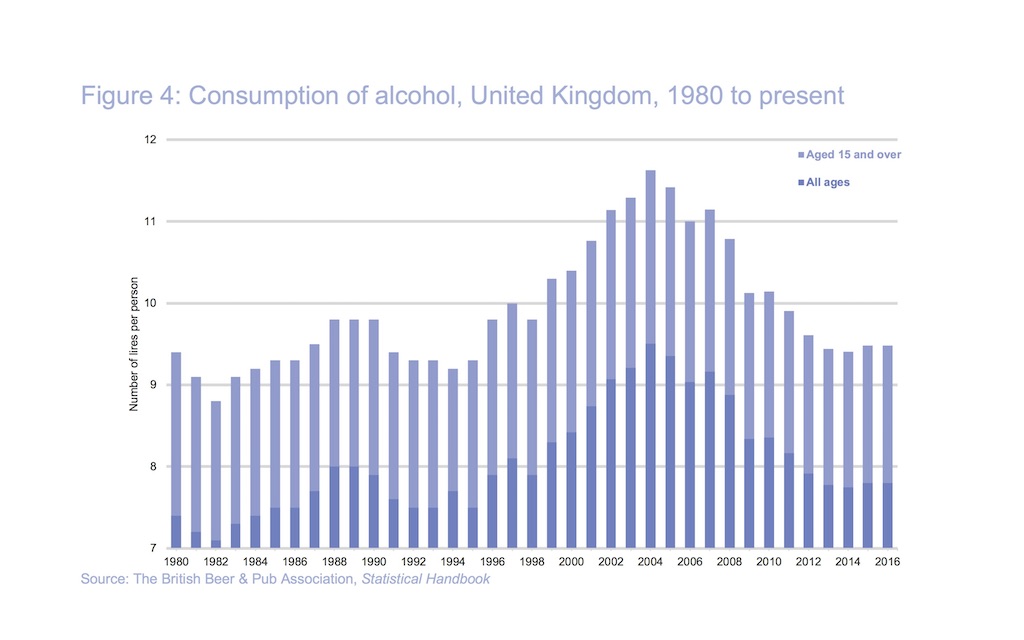

So Ian Gilmore must be pleased, right? Time to give up the crusade and move onto something more important?
Of course not. In response to the latest figures on alcohol consumption and harm published this week, he says:
'We know that over the long term, rates of binge drinking are falling, and more people are choosing to abstain from alcohol.
Worryingly, however, these trends do not appear big enough to stop alcohol harm from continuing to rise, and the sharp increase in alcohol-related hospital admissions over the last few years means hundreds of thousands more people each year are experiencing the misery associated with harmful alcohol consumption.
The data released today should be sobering reading for whoever wins the upcoming general election, and we would urge the next government to make tackling alcohol harm an immediate priority to save lives, reduce harm, and reduce the pressure on the NHS.'
It is slightly surprising that Ian Gilmore, who professes expertise on alcohol policy, did not know that alcohol consumption was at 1980s levels when he spoke out in 2014. It is less surprising to find a neo-prohibitionist pressure group demanding further action even achieving its stated goals.

By the logic of the total consumption theory, health outcomes should have shown a marked improvement as a result of a 20 per cent reduction in alcohol consumption. Like most people in pretend 'public health', Gilmore is an advocate of this ridiculous theory, which is why he says 'if we could just get the whole consumption curve shifted down...'
It has taken a long time, but the decline in alcohol consumption is now a recognised fact. The BBC even published an article titled 'Are we falling out of love with booze?' yesterday. And yet estimates of the number of alcohol-related hospital admissions continue to rise.
There are two explanations for this. The first is that the hospital admissions estimates are bunkum. The second is that the total consumption theory is wrong. These two explanations are not mutually exclusive. In fact, I think both of them are correct.
Under the 'broad measure' of alcohol-related hospital admissions, numbers have risen by a third since 2004/05 despite a 20 per cent fall in alcohol consumption. Under the somewhat more realistic 'narrow measure', numbers have risen by 22 per cent. For those who believe in the total consumption theory, these figures are awkward, but even for those of us who are sceptical about the theory, it is difficult to take these figures seriously as a proxy for alcohol-related harm when there is so much evidence that 'binge-drinking' has declined.
The reality is that we could all stop drinking tomorrow and the number of alcohol-related hospital admissions would keep rising, not because of the 'lag effect' of chronic disease but because alcohol-related admissions are assumed to be a fixed proportion of each disease or injury. Alcohol-related admissions statistics are not compiled by people who work in hospitals. Statisticians simply take the aggregate number of admissions for each disease and assume that a certain percentage are alcohol-related.
As people live longer and develop more chronic diseases, the number of supposedly alcohol-related admissions is bound to rise, regardless of whether alcohol-related problems are getting better or worse. There is a large amount of garbage in, garbage out about alcohol-attributable fractions and it leads to counter-intuitive findings like this. They are counter-intuitive because they are probably wrong.
Nevertheless, if we look at diseases that are specific to alcohol or that result in the 'hard endpoint' of death (which is less susceptible to miscounting), there is no evidence of an improvement since the decline in consumption began twelve years ago. The rate of alcohol-related death has not risen but nor has it fallen.
That is because the total population theory is nonsense. It is a theory created to justify policy, rather than the other way round. It is perfectly obvious that reducing per capita consumption does not magically reduce heavy drinking or alcoholism (although a decline in heavy-drinking could certainly lead to a decline in per capita alcohol consumption). The overall decline in consumption seen in Britain since 2004 has not had any of the effects that would be predicted by the total consumption theory.
The 'public health' lobby are too thick and lazy to help people who are putting their health at serious risk from alcohol. It's much easier to go to conferences, talking drivel about 'the whole consumption curve' and lobbying the government for regressive, pig-headed, anti-market policies than it is to target the small minority of drinkers who are at serious risk of harm and who require help.
Thursday, 4 May 2017
What is Public Health England doing to our food?
Lucozade's Twitter feed has been a lot of fun recently, as the company responds to outraged customers who have tasted the new, low-sugar version of the drink. Day after day, Lucozade is inundated by complaints and day after day the company adopts the PR strategy of Comical Ali, insisting that their flagship drink has changed due to consumer demand and has a 'great taste'.
Poor old Lucozade. This was not a business decision. Under pressure from the government, they were trying to do their bit to combat the non-existent childhood obesity epidemic. They wanted to avoid the sugar tax and get in the 'public health' racket's good books. And they will - because soon they won't be selling any drinks.
James Delingpole has written about the Lucozade farce in the Spectator today but the media have generally ignored the unfolding story of Britain's food supply being systematically degraded at the insistence of the state. No other country is attempting anything on this scale and for good reason: it is insane. You can't just cut 20 per cent of the sugar out of food products and expect people not to notice. It's going to taste bad.
Part of the reason for the media blackout is that the reformulation process is being carried out in secret. They literally call it 'health by stealth'. I have tried to get the minutes of the meetings with industry out of Public Health England to find out exactly what is being done to specific products but have come up empty-handed. All we have to go on are a succession of announcements about chocolate bars getting smaller, with Brexit-inspired inflation cited as a cover story, and a handful of documents from PHE: Sugar reduction and wider reformulation: stakeholder engagement, Sugar reduction and wider reformulation meetings: November 2016, and Sugar reduction: Achieving the 20%.
There is enough information in these documents to tell that PHE have started to realise the size of the challenge they have set for themselves. The whole thing is a disaster waiting to happen and PHE are bringing nothing to the table except an arbitrary demand to reduce sugar consumption by 20 per cent by 2020 (because who needs sensible policy when you can have a numerically alliterative target?).
The aim is to reduce sugar content by 20 per cent as measured by the sales weighted average. This means that the target cannot be achieved without the biggest selling brands being degraded. This is a massive problem in itself, because consumers do not want their favourite brands to change, but it is also a big problem for the manufacturers because if they ruin their biggest selling brands, they will no longer be the biggest selling brands. People will vote with their wallets and buy something else. And if consumers abandon the leading brands in search of something tastier, the targets will not be met.
This problem is hinted at - but not grasped - in one of the PHE documents when they say...
PHE do not seem to give any thought as to why reduced-sugar products have 'limited appeal'. They seem to assume that people will always buy the biggest-selling brands regardless of how they taste and, therefore, that they can be tricked into buying 'healthier' options if companies change the recipe.
As Lucozade have recently discovered, this is a fantasy, but it is what happens when economically illiterate 'public health' dogma becomes government policy. The imbeciles of Action on Sugar (who attend PHE's meetings as 'stakeholders') believe that people's choices are made for them by corporate power and advertising. 'Public health' fools talk about companies 'controlling' a certain percentage of the market. As a result, they think that if you control the companies, you control the people. They massively underestimate consumer sovereignty and fundamentally misunderstand how markets work.
PHE discourage companies from making healthy alternatives because they know that people don't like them. Alternatives imply choice, and choice is the last thing PHE wants to give people. They want manufacturers to debase their flagship brands. The companies could do this, albeit reluctantly, while launching a new brand that tastes like the old one, but PHE warn them against this, saying...
In other words, do not give consumers choice because there is a risk that consumers will choose the tasty versions. This is draconian as hell and PHE dress it up in Orwellian language, saying:
But what choice is there when the popular brands are turned into diet versions and the companies dare not launch a classic version?
The bottom line is that most people prefer the taste of sugar to that of artificial sweeteners, and many of the products in the firing line are inherently sweet. Products such as chocolate, confectionery and jam are not going to be magically reformulated with sweeteners. There is a dawning realisation that reducing portion sizes or having a calorie cap (which amount to much the same thing) are the only viable options.
PHE repeatedly acknowledge that shrinking products is the way forward for a wide range of foods...


Over the next three years, you are going to hear about a lot of sugary products getting smaller. It will have nothing to do with Brexit or the fall in the pound (quite obviously, the normal response to inflation is to increase the price, not shrink the product). It is because the food industry is desperately trying to comply with the demands of government apparatchiks.
And it doesn't stop there. PHE are also going to be interfering in what restaurants and takeaways can sell (or, as they euphemistically put it, 'engaging with the eating out of home sector to ensure that a level playing field is established'.)
And very soon they will soon be embarking on the next stage of the reformulation programme by reducing flavour in everything...
These maniacs have to be stopped.
@louise_wileman Hi Louise, we’ve been working on how to reduce sugar and keep the great taste for years – and we’ve cracked it!— Lucozade Energy (@LucozadeEnergy) April 21, 2017
@LucozadeEnergy why change this when recently you have brought out 'zero' version for people who want a 'healthier' choice? Taste is not the same at all— Louise Wileman (@louise_wileman) April 21, 2017
@LucozadeEnergy @louise_wileman You have not cracked it, it's undrinkable now— Fono (@lukefono) April 23, 2017
@LucozadeEnergy @louise_wileman Nope. You have failed. Only thing cracked is my love for Lucozade, quickly do a coke and go back to the classic— DJHOLLAND (@djjamesholland) April 21, 2017
@LucozadeEnergy @louise_wileman You've cocked it up more like— Jamie Woodhall (@Woodhall_Jamie) April 24, 2017
@LucozadeEnergy @louise_wileman Cracked it? You shattered it and stepped in the remains. Sort this out, because this is godawful.— Sean Harmon (@SeanHarmon_) April 21, 2017
Poor old Lucozade. This was not a business decision. Under pressure from the government, they were trying to do their bit to combat the non-existent childhood obesity epidemic. They wanted to avoid the sugar tax and get in the 'public health' racket's good books. And they will - because soon they won't be selling any drinks.
James Delingpole has written about the Lucozade farce in the Spectator today but the media have generally ignored the unfolding story of Britain's food supply being systematically degraded at the insistence of the state. No other country is attempting anything on this scale and for good reason: it is insane. You can't just cut 20 per cent of the sugar out of food products and expect people not to notice. It's going to taste bad.
Part of the reason for the media blackout is that the reformulation process is being carried out in secret. They literally call it 'health by stealth'. I have tried to get the minutes of the meetings with industry out of Public Health England to find out exactly what is being done to specific products but have come up empty-handed. All we have to go on are a succession of announcements about chocolate bars getting smaller, with Brexit-inspired inflation cited as a cover story, and a handful of documents from PHE: Sugar reduction and wider reformulation: stakeholder engagement, Sugar reduction and wider reformulation meetings: November 2016, and Sugar reduction: Achieving the 20%.
There is enough information in these documents to tell that PHE have started to realise the size of the challenge they have set for themselves. The whole thing is a disaster waiting to happen and PHE are bringing nothing to the table except an arbitrary demand to reduce sugar consumption by 20 per cent by 2020 (because who needs sensible policy when you can have a numerically alliterative target?).
The aim is to reduce sugar content by 20 per cent as measured by the sales weighted average. This means that the target cannot be achieved without the biggest selling brands being degraded. This is a massive problem in itself, because consumers do not want their favourite brands to change, but it is also a big problem for the manufacturers because if they ruin their biggest selling brands, they will no longer be the biggest selling brands. People will vote with their wallets and buy something else. And if consumers abandon the leading brands in search of something tastier, the targets will not be met.
This problem is hinted at - but not grasped - in one of the PHE documents when they say...
...businesses are also encouraged to focus on the everyday, ‘standard’ products rather than producing alternative ‘healthier’ options as these tend to be of limited appeal and may have a limited effect on the sales weighted average
PHE do not seem to give any thought as to why reduced-sugar products have 'limited appeal'. They seem to assume that people will always buy the biggest-selling brands regardless of how they taste and, therefore, that they can be tricked into buying 'healthier' options if companies change the recipe.
As Lucozade have recently discovered, this is a fantasy, but it is what happens when economically illiterate 'public health' dogma becomes government policy. The imbeciles of Action on Sugar (who attend PHE's meetings as 'stakeholders') believe that people's choices are made for them by corporate power and advertising. 'Public health' fools talk about companies 'controlling' a certain percentage of the market. As a result, they think that if you control the companies, you control the people. They massively underestimate consumer sovereignty and fundamentally misunderstand how markets work.
PHE discourage companies from making healthy alternatives because they know that people don't like them. Alternatives imply choice, and choice is the last thing PHE wants to give people. They want manufacturers to debase their flagship brands. The companies could do this, albeit reluctantly, while launching a new brand that tastes like the old one, but PHE warn them against this, saying...
If a business brings new products onto the market that are above the guideline sales weighted average sugar level, and they are successful, that business is unlikely to achieve the 5% and 20% targets for sugar reduction.
In other words, do not give consumers choice because there is a risk that consumers will choose the tasty versions. This is draconian as hell and PHE dress it up in Orwellian language, saying:
Our intention is that as a result of the sugar and calorie reduction programme, the healthier choice becomes the default choice for families.
But what choice is there when the popular brands are turned into diet versions and the companies dare not launch a classic version?
The bottom line is that most people prefer the taste of sugar to that of artificial sweeteners, and many of the products in the firing line are inherently sweet. Products such as chocolate, confectionery and jam are not going to be magically reformulated with sweeteners. There is a dawning realisation that reducing portion sizes or having a calorie cap (which amount to much the same thing) are the only viable options.
While the achievement of the 20% reduction by 2020 is the overall focus of the programme, smaller gradual reductions can provide a useful contribution to reducing sugar and calorie consumption, and ultimately towards achieving the overall goal. This applies particularly in those products where sugar reduction per 100g can be more difficult, for example, in chocolate confectionery. Where this is the case, businesses are expected to employ additional mechanisms, such as reducing portion size, to achieve the total 20% reduction.
PHE repeatedly acknowledge that shrinking products is the way forward for a wide range of foods...


And it doesn't stop there. PHE are also going to be interfering in what restaurants and takeaways can sell (or, as they euphemistically put it, 'engaging with the eating out of home sector to ensure that a level playing field is established'.)
And very soon they will soon be embarking on the next stage of the reformulation programme by reducing flavour in everything...
The wider reformulation programme will also commence later in 2017. At first this will concentrate on setting guidelines to reduce total calories in a wider range of products than those covered by the sugar reduction work (eg savoury snacks, burgers, pizzas) that contribute significantly
It is anticipated that the SACN report on saturated fat will be published by early 2018. This will be used to review and inform our future work on saturated fat reduction. In addition, businesses are expected to continue working towards achieving the current salt reduction targets and we will consider this work in more detail at a later stage this year.
These maniacs have to be stopped.
Wednesday, 3 May 2017
The curse of plain packaging
One of the indisputable facts about plain packaging that should be universally known but is barely acknowledged, is that cigarettes sales rose every quarter after it was introduced in Australia until large tax rises started nudging them down again.
This is quite remarkable. It should go without saying that cigarette sales have been falling in most developed countries for a very long time. Between 2012 and 2015, they fell by 14 per cent in Britain.
Because this unusual rise has never really been acknowledged, it has never been fully explained. The most plausible explanation is something that I hinted at way back in 2012 before the policy had been introduced.
If smokers downgrade to cheaper cigarettes, it is quite possible that they will smoke more of them. If that is not the reason then perhaps it has something to do with the 'forbidden fruit' aspect, or maybe smokers are flicking up two fingers at authority. Who knows?
Of course, it could just have been a bizarre coincidence that cigarette sales happened to rise when a silly anti-smoking policy was introduced. And yet, it seems to be happening again...
Contrary to what the news report says, this is not necessarily evidence that the number of smokers has gone up, but it is certainly evidence that the number of cigarettes sold has gone up. A case of déjà-vu?
This is starting to look like a habit.
 |
| Image from City AM |
This is quite remarkable. It should go without saying that cigarette sales have been falling in most developed countries for a very long time. Between 2012 and 2015, they fell by 14 per cent in Britain.
Because this unusual rise has never really been acknowledged, it has never been fully explained. The most plausible explanation is something that I hinted at way back in 2012 before the policy had been introduced.
Should we care if cigarette companies becomes less profitable and are only able to compete on price? If smokers buy cheaper cigarettes from the licit and illicit market, perhaps we should.
If smokers downgrade to cheaper cigarettes, it is quite possible that they will smoke more of them. If that is not the reason then perhaps it has something to do with the 'forbidden fruit' aspect, or maybe smokers are flicking up two fingers at authority. Who knows?
Of course, it could just have been a bizarre coincidence that cigarette sales happened to rise when a silly anti-smoking policy was introduced. And yet, it seems to be happening again...
It's perhaps a cliché that the French love their cigarettes, but as they say, there's no smoke without fire.
In fact new figures reveal that even despite the French government's controversial efforts to turn the population off cigarettes, the number of people smoking has gone up.
Since France introduced a ban on branded cigarettes in January 2017, more packets of cigarettes have been sold compared to last year when branding was allowed, according to the country's Customs Office (L'administration des Douanes).
In March alone the French bought four million packets of cigarettes, over four percent more than during the same period last year.
Throughout the first four months of 2017, the French shipped over 1 percent more tobacco products into the country than they did in the same period of 2016, officials say.
Contrary to what the news report says, this is not necessarily evidence that the number of smokers has gone up, but it is certainly evidence that the number of cigarettes sold has gone up. A case of déjà-vu?
This is starting to look like a habit.
Tuesday, 2 May 2017
The Nanny State Index Conference is coming

It's going to be in Brussels and you can come. See here for details.
Monday, 1 May 2017
The soda tax scam
News in from Seattle...
That's right, it's another 'sugar' tax being rolled out to drinks which contain no sugar. Another supposed anti-obesity measure being applied to products which contain no calories. Just like in Philadelphia, just like in France.
It's almost as if the whole soda tax ruse is just another way of the government dipping its greasy hands into the pockets of the gullible public and has nothing to do with health. Say it ain't so!
And if you think the money raised will go towards tackling obesity, you haven't been paying attention. Oakland, California is the latest place to let the mask slip...
To be fair, it's better for taxpayers' money to go towards fixing potholes than to be dished out to the venal 'public health' industry, but that is not how soda taxes are sold to the public. If the dumb saps of California knew that the cash would go towards budget deficit reduction they would, quite reasonably, say that the money should be raised through general taxation rather than a regressive sugar tax.
The fact that nanny state twonks are being prevented from squandering soda tax revenues is the heart-warming silver lining of this cloud, but it doesn't stop the whole thing being a massive scam.
Today Mayor Ed Murray announced his revised proposal for a tax on sodas and other sugary beverages, which will now also apply to diet soda and similar drinks.
That's right, it's another 'sugar' tax being rolled out to drinks which contain no sugar. Another supposed anti-obesity measure being applied to products which contain no calories. Just like in Philadelphia, just like in France.
It's almost as if the whole soda tax ruse is just another way of the government dipping its greasy hands into the pockets of the gullible public and has nothing to do with health. Say it ain't so!
And if you think the money raised will go towards tackling obesity, you haven't been paying attention. Oakland, California is the latest place to let the mask slip...
Oakland council members blast Mayor Schaaf for soda tax ‘bait and switch’
Three council members are blasting Mayor Libby Schaaf’s plan to spend revenue from a successful soda tax measure to help close the city’s budget deficit, calling the mayor’s proposal a “bait and switch” on voters.
Voters in November passed the penny-per-ounce tax on the promise that while the tax revenue would go to the general fund, it would be spent on an advisory board to use the money to fight childhood obesity and educate the public on the health risks of drinking soda.
Councilmembers Annie Campbell Washington, Desley Brooks and Rebecca Kaplan, who co-authored the measure, said the mayor’s final budget proposes using the revenues to fill the city’s budget deficit.
To be fair, it's better for taxpayers' money to go towards fixing potholes than to be dished out to the venal 'public health' industry, but that is not how soda taxes are sold to the public. If the dumb saps of California knew that the cash would go towards budget deficit reduction they would, quite reasonably, say that the money should be raised through general taxation rather than a regressive sugar tax.
The fact that nanny state twonks are being prevented from squandering soda tax revenues is the heart-warming silver lining of this cloud, but it doesn't stop the whole thing being a massive scam.
Subscribe to:
Posts (Atom)