Friday, 10 June 2016

The WHO is very concerned about Syria

You really can't make this stuff up. With hundreds of people dead and millions fleeing for their lives, the failed state of Syria is being told by the World Health Organisation to concentrate on... plain packaging.

In a statement last week, the U.N. health agency warned that "notwithstanding the current crisis in the country," Syrian officials should collaborate with the U.N. health agency to control the use of tobacco and water pipes among its people, especially young adults, women and teenagers. 

This is rather like telling passengers on the Titanic that 'notwithstanding the iceberg' they should collaborate with staff to tidy away the deckchairs.

WHO's Syria representative, Dr. Elizabeth Hoff, warned that using tobacco and water pipes endangers the health and lives of smokers and people around them. Hoff said using water pipes to smoke shisha, a common pastime in the Middle East, is 20 times more dangerous than cigarette smoking. 

That would make cigarettes 95 per cent safer than shisha which is obviously bollocks. There is a shortage of good evidence on the health risks of shisha but that doesn't justify making stuff up.

Despite believing that cigarettes are much, much safer than shisha, it is cigarettes the WHO are going after, presumably because they can't apply their risible plain packaging policy to waterpipes.

She urged Syrian officials to implement a "plain packaging" approach for cigarettes to reduce their "attractiveness and glamour." 

If you ever doubted that the WHO has lost its way, here is the proof. It has been taken over by western idiots who obsess over micromanaging personal lifestyles and waging war on 'Big Tobacco, Big Food, Big Soda, and Big Alcohol' while the developing world literally burns.
   
Syria's war is estimated to have killed several hundred thousand people amid the rise of the Islamic State group. But Dr. Ahmad Khlefawy, Syria's deputy minister of health, said the war cannot be an excuse for Syrians to endanger their lives by consuming tobacco. 

We've gone well beyond parody here, folks.

The irony is that parts of Syria already have a very - what's the word? - comprehensive tobacco control strategy in place already courtesy of the lads from ISIS. (UPDATE: As Nisakiman points out in the comments, they have taken to executing tobacco vendors.)

Smoking is also banned by Islamic State, which considers the habit to be against the tenets of Islam. The militants punish smokers by whipping them. 

Cage for smokers in ISIS held territory

The anti-smoking teetotallers of ISIS appear to be losing ground in Syria and Iraq. Perhaps that's what WHO is worried about?


Wednesday, 8 June 2016

Richard Peto on snus

A reader has asked me if I have copies of the letter written by Richard Peto about snus/Skoal Bandits in 1984. I do indeed and here they are. See here for background and click to enlarge.


Tuesday, 7 June 2016

Alcohol Concern, Lundbeck and nalmefene


It was reported yesterday that the anti-drinking drug nalmefene (AKA Selincro) is not particularly effective and that studies cited by its manufacturer Lundbeck are flawed. This is not the first time questions have been asked about this drug and I can't say I'm surprised. When I looked at the evidence in 2014, I was surprised by how weak it was. There are not many studies, for a start, and taken together they suggest that the drug is only marginally more effective than a placebo.

Why, then, was it approved by NICE and dished out at a cost of £3 per dose to the NHS for treatment of so-called 'mild alcoholics'? 

Dr Niamh Fitzgerald, a pharmacist and lecturer in alcohol studies at the University of Stirling, questioned why health watchdogs at NICE (the National Institute of Healthcare and Excellence) gave the go-ahead for the drug to be prescribed based on the evidence provided by the manufacturer.  

She said: "We found multiple problems with the way the trials for this drug were conducted.  

"We can't tell whether it's effective or not and we normally don't licence drugs unless we have really strong evidence that it is effective so that's what we're saying the evidence isn't yet strong enough.
 
"If the pharmaceutical company believe that it's effective then it should have continued and conducted further trials to prove that.  

"We require people to prove that the drugs are effective rather than just assume that they are based on unplanned analysis.  

"We want to know how the system has failed in such a way that a drug with not good enough evidence has been licensed and has been recommended by NICE."

This news was reported by the BBC yesterday morning and the alcohol research 'community' was abuzz on social media talking about. One group was strangely quiet, however. Neither Alcohol Concern nor its Welsh cousin Alcohol Concern Cymru have said a word about it. This is strange because Alcohol Concern have been very vocal about nalmefene in the past. They responded to the NICE consultation on Lundbeck's drug in 2014 and when NICE approved nalmefene for NHS use, Alcohol Concern came out to bat for Lundbeck, saying the drug was 'a useful addition to the clinician’s toolbox'.

Lundbeck have funded various Alcohol Concern initiatives such as this. In 2014, they gave Alcohol Concern money to produce an Alcohol Harm Map which was released to the press with the highly contentious claim that there are nearly 10 million drink-related NHS admissions per year. Alcohol Concern also runs the All Party Parliamentary Group on Alcohol Abuse 'with the assistance of a grant paid by Lundbeck Ltd'.

Lundbeck funded the Alcohol Concern conference in 2014 and gave them an additional £51,000 last year. At least, that's what Lundbeck's website says now. A few months ago it said £109,000.


Either way, it's a lot of money to be getting from Big Pharma for an organisation that is obsessed with the real or imaginary conflicts of interest of other people. Maybe they don't consider it to be a conflict for some reason? That would explain how Alcohol Concern's president, Ian Gilmore, could co-author a study about nalmefene in 2015 without mentioning any competing interests (how does that work?).

As I said in 2014, I would rather Alcohol Concern get their money from industry than from taxpayers. They may genuinely believe that Lundbeck's drug is a useful product which advances their mission. They may see themselves as commentators on all things alcohol and see nalmefene as being within their remit. If so, why the radio silence now?

Monday, 6 June 2016

ASH: the early years

In the last post I showed some ASH documents from the 1980s when they were fighting for snus to be banned. While I was in the Wellcome library five years ago I also looked at some documents from 1970-71 when ASH was being formed. I wish I'd seen some of this stuff when I was writing Velvet Glove, Iron Fist because there are some interesting nuggets. Here's the story...

The National Society for Non-Smokers (NSNS) had been formed in the 1920s. Lennox Johnston was its most notable member and they were a lone voice in the wilderness in the golden age of smoking that followed. To be blunt, they were considered cranks.

In July 1970, they held a conference at which they announced the following policy goals: the elimination of cigarette coupons; a ban on all forms of tobacco advertising; a smoking ban in all government buildings, restaurants, cinemas, theatres, buses, trains and aircraft (with “separate accommodation, if desired, being provided for smokers”); a ban on cigarette vending machines; licensing for tobacconists, and a ban on duty free cigarettes. Pretty extreme stuff for 1970.

On 16th September that year, T. W. Hurst, the chairman of the NSNS, discussed setting up an anti-smoking pressure group with the Royal College of Physicians (RCP). The organisation was initially going to be called the National Council on Smoking and Health.

Hurst was optimistic about being able to raise the funds and attract many members. He wrote...

...the new National Council must have teeth and to have teeth it must have financial support. It would be reasonable to expect that the member organisations of the Council should contribute annually, but this sum would obviously be limited and in my view a National Appeal should be launched as soon as possible for say £500,000 to enable the work of the Council to proceed effectively. I am sure this sum could be raised and in this connection the question of the new Council being registered as a Charity for tax purposes should be considered.

A working party got underway on 24th September 1970 at which the name was discussed...

The title of the new organisation was discussed. Dr. Hunt felt that the word “commission” was stronger than “council”. He also felt that good initials were of the utmost importance as, for instance, “A.S.H.” which might stand for the “Association on Smoking and Health."

(Incidentally, the document from which this quote is taken also contains the observation that 'the actual consumption of cigarettes had not gone down in the areas in which advertising had been prohibited.')

At this point the main players were Lord Rosenheim (RCP), Dr Ball (RCP), Dr William Jones (Health Education Council) and Dr Harding (Medical Officers of Health). They considered calling their group British Action on Smoking and Health to distinguish it from the American ASH but the acronym BASH was considered unhelpful and by November they had settled on Action on Smoking and Health. However, they were finding it harder than expected to attract any donations, let alone the £500,000 they anticipated...

The Royal College of Physicians has lent A.S.H £1,500 to cover the initial running costs… Apart from the cheque from the College, A.S.H. has received no money so far.

They hoped the money would start pouring in once ASH became known and so decided to approach businesses and wealthy individuals such as Rupert Murdoch and David Frost as a stop gap. At one point they even considered asking the tobacco industry for a donation!

The object of the initial appeal is to raise sufficient funds to launch an effective national fund-raising campaign at a later date in order to obtain the money required for ASH to be a viable independent organisation.

Dr Robert Murray, medical advisor to the TUC, was invited to join the ASH committee, leading to this interesting exchange in August 1970...

Murray: 'I should say that I have been a pipe smoker since 1947 when the first evidence of cigarettes smoking and lung cancer began to appear. I am quite prepared to defend pipe smoking but I hold no brief for cigarette smoking. If you think that this is a disqualification for service on the committee, please let me know.'

G. M. Tibbs (RCP company secretary): 'Your pipe will certainly not be a disqualification for service on the committee. It is really cigarettes we are after!'

By the end of 1970, ASH were ready to launch. A document dated 30th December contains another comment that you would never hear from ASH today...

Most people start to smoke by observing other people smoking, and by copying them. It would be unfair on the tobacco industry to suggest that they play an important role in initiating smoking. But their activities certainly encourage and strengthen the habit.

Minutes from a meeting in April 1971 show that ASH were still finding fund-raising difficult and had applied for the first of their many government grants that would sustain them for decades...

If the DHSS turned down the request for the grant for ‘ASH’ money would have to be obtained some other way. .. If the DHSS did nor grant the appeal from ‘ASH’ for funds, there would probably have to be a further loan from the [Royal] College [of Physicians].

One option under consideration was a donation from Wrigleys, the chewing gum company. ASH approached them and were told...

Wrigleys were willing to donate to ‘ASH’ anonymously. They required to know what they would gain from this though... It was agreed that we could not give any commitment that we would advertise their gum, but only imply that if they are helpful, we will be too.

A letter of 26th March 1971 written to ASH's first director, John Dunwoody of the Royal College of Physicians, explains that the RCP's recent report on smoking and health had been of benefit to the chewing gum industry...

I have spoken, informally, and without committing you to anything, to the Managing Director of Wrigleys the chewing gum people. He is very conscious of the fact that his sales went up when your report was published and have now gone down again. He would be very interested to talk to you and us about handing over part of his advertising budget to help ASH to persuade people not to smoke. 

A document from around the same time notes that chewing gum sales rose by 30 per cent after the RCP report was published and suggests that 'approaches be made to companies which stand to benefit commercially by a decrease in smoking and consequent increase in their potential market'. Companies under consideration included Rowntree, Mars, Cadbury and Golden Wonder. 

Unfortunately for taxpayers, ASH's approaches to the confectionery industry seem to have come to nought. By May, there was still no reply from the DHSS and money continued to be front of mind...

The number one priority was to get out of the position of not having enough money to run the Company, and a full-time secretariat.

ASH eventually got their grant and spent the next forty years appealing for more cash from the government while assuring the Department of Health that they were looking for alternative sources of revenue.

ASH finally managed to get a significant amount of non-government funding a few years ago when Cancer Research UK and the British Heart Foundation started hiving off a few hundred thousand pounds to them. The document below from the 1970s shows that the idea of getting big charities to support ASH was not new.


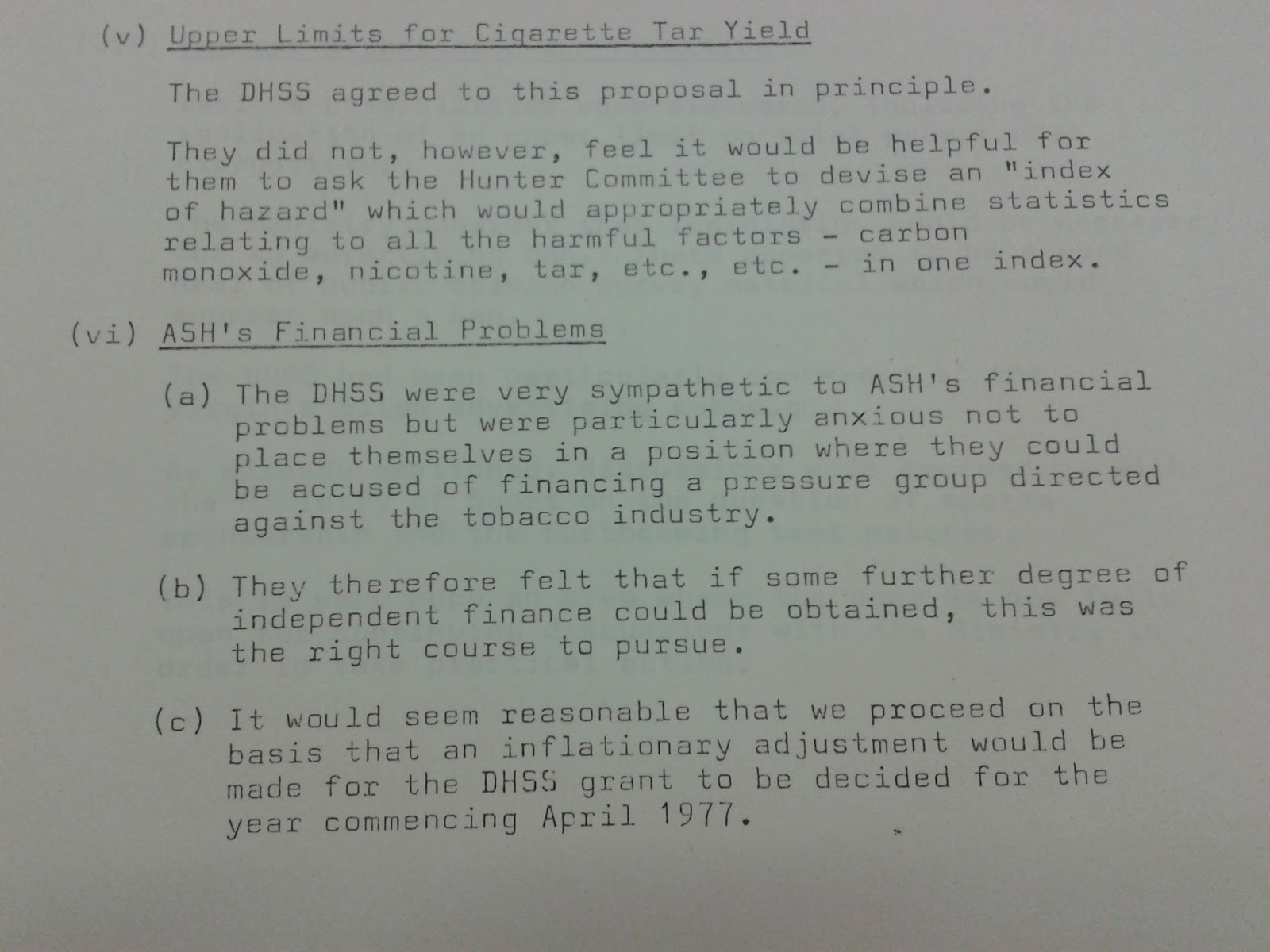
In the 1970s, ASH was dependent on the DHSS for 90 per cent or more of its donations and the government seems to have been worried about being accused of sock-puppetry by funding them to such an extent. The document below says the DHSS was 'particularly anxious not to place themselves in a position where they could be accused of financing a pressure group directed against the tobacco industry' and urged ASH to find some 'independent finance'.


Note also in the document above the reference to lowering tar yields in cigarettes. The history of 'light' cigarettes has been rewritten in recent years to make it look as if making cigarettes less dangerous by reducing tar yields was an industry con. In fact, it was an important goal of anti-smoking groups for many years. EU restrictions on tar yields mean that all cigarettes on the market today are low or very low tar compared to the average cigarette in the 1970s. Whether they are any less harmful is a moot point, but it was government as much as industry that brought about the change.

Lowering tar yields was mentioned again in the minutes of a meeting between ASH and the DHSS in January 1977, along with advertising restrictions and health warnings. These were the 'priorities' of government health officials who said they would 'welcome pressure from ASH'.


This is pure sock-puppetry. The government gives ASH money, tells them what to campaign on and says they 'welcome' the pressure their campaigning creates. ASH have been doing this for decades.

By the late 1980s, still reliant on government hand outs, ASH wrote this begging letter to the government...


Nothing had changed by 1993. With a budget of £400,000 and eleven staff, most of their income was still coming from the Department of Health and ASH's director, David Pollock, admitted in his grant application that...

...we have made repeated and determined efforts to raise funding elsewhere and to earn income through our own efforts, without making any significant contribution to core costs... Anti-smoking activity is not a popular cause for donors.

Evidently.

Friday, 3 June 2016

History repeating: snus and e-cigarettes

Dick Puddlecote has been having some fun raking over the mountain of correspondence between ASH and their friends/donors in government. E-mails reveal the vigour with which the vaper's suppposed friends at this state-funded sockpuppet lobbied for e-cigarettes to be regulated as medicines and then, when that failed, were determined to see Article 20 of the Tobacco Products Directive passed without amendment.

This all reminded me of some much older ASH correspondence that I looked at several years ago when I was writing The Art of Suppression. Back then, I spent a couple of afternoons at the Wellcome Library in London where there is a large collection of ASH documents going back to the group's inception in 1971. I was looking for documents about snus and I wasn't disappointed. There were boxes of them.

The similarities between today's e-cigarette panic and the snus panic of the 1980s are uncanny. So uncanny that you might think that 'public health' people would have learned a lesson. To be fair, some have - including ASH to an extent - but if you look at the WHO, the FDA, the Lancet etc. you can hear exactly the same bogus arguments and hysterical rhetoric that were voiced in the 1980s.


The full story is in the book but the heavily truncated version goes like this: Snus is smokeless tobacco in a pouch that goes under the top lip. It was assumed to cause cancer but doesn't. It was assumed to be a gateway to smoking but isn't. ASH ran a campaign to ban it in Britain and succeeded. The EU then followed. Sweden is now the only EU member state that allows the sale of snus. This graph tells a thousand words...


The whole thing kicked off when an American smokeless tobacco company set up a factory in Scotland to produce a brand of snus called Skoal Bandits, apparently with a government grant.

As early as 1984, Richard Peto had seen the potential of snus as a substitute for people wanting to quit smoking. In 1985, Michael Russell and colleagues (including Robert West) reported the results of new research in a letter to The Lancet. Still working on the (mistaken) assumption that snus caused oral cancer, they concluded that snus 'could help people trying to give up smoking... If all smokers in Britain switched to sachets about 50,000 premature deaths per year might eventually be saved at an annual cost of less than 1,000 deaths from mouth cancer.'

None of this appealed to ASH (then led by David Simpson). Their incomprehension is nicely illustrated by the handwritten comment of 'Weird headline!' next to a news story about snus being a 'threat to cigarettes'. (nb. click to enlarge any of the following images)


Such headlines were rare, however. Thanks to scare-mongering by ASH and the BMA, news reports about snus were almost entirely negative. This, from 1985, is typical. Notice that the BMA were already calling for an outright ban at this stage...


A letter from 1984 shows that ASH were aware of the harm reduction potential of snus but any glimmer of optimism was overwhelmed by the same concerns about 'dual use' that are expressed by anti-vaping activists today...


A 1985 letter from Alexander McCall Smith, the Edinburgh-based chairman of the Association for Non-Smokers' Rights contains another assumption that anti-vaping folk like to make. After stating that his organisation is concerned only with passive smoking and therefore has 'precisely nothing to say about Skoal Bandits', he goes on to say that 'everybody knows' that the product is 'aimed at children' and that 'the whole exercise is to accustom under-age users to nicotine'.


Fears about the 'gateway effect' were commonplace. For example, in this 1985 article headlined '"Ban the Tobacco Bandits" Demand'...


In a letter dated 11 April 1985, David Simpson brings up both the gateway theory and the precautionary principle:

“We have had the matter raised in parliament and numerous times in the press but I fear that by the time there is concrete evidence that young people progress from using this product to smoking cigarettes, it will be too late for action – the usual story.”

In January 1986, Ireland banned snus. Hong Kong and Australia followed suit soon afterwards. A letter from the Australian anti-smoking campaigner Nigel Gray to the Australian Minister of Health shows the lengths to which prohibitionists go to convince people that they are not prohibitionists. 'In relation to civil liberties', he writes, 'this move would not impair them at all. If individuals wish to chew tobacco they can obtain and prepare it for themselves by breaking up cigarettes.' Hmm.


In the UK, the campaign to ban snus was led by David Simpson of ASH and Alison Hillhouse of ASH Scotland. They initially focused on the loophole in the law that allowed oral tobacco to be sold to children. When this was sensibly closed in July, a full ban was the 'next logical step', as a press release from the United Kingdom Coordinating Committee on Cancer Research made clear...

The Government has taken steps to ban the sale of oral snuff to people under 16 but this is unlikely to be effective in stopping the spread of this addictive habit... only a total ban on the import, manufacture and sale of oral snuff will be adequate to prevent the widespread use of this carcinogenic material.

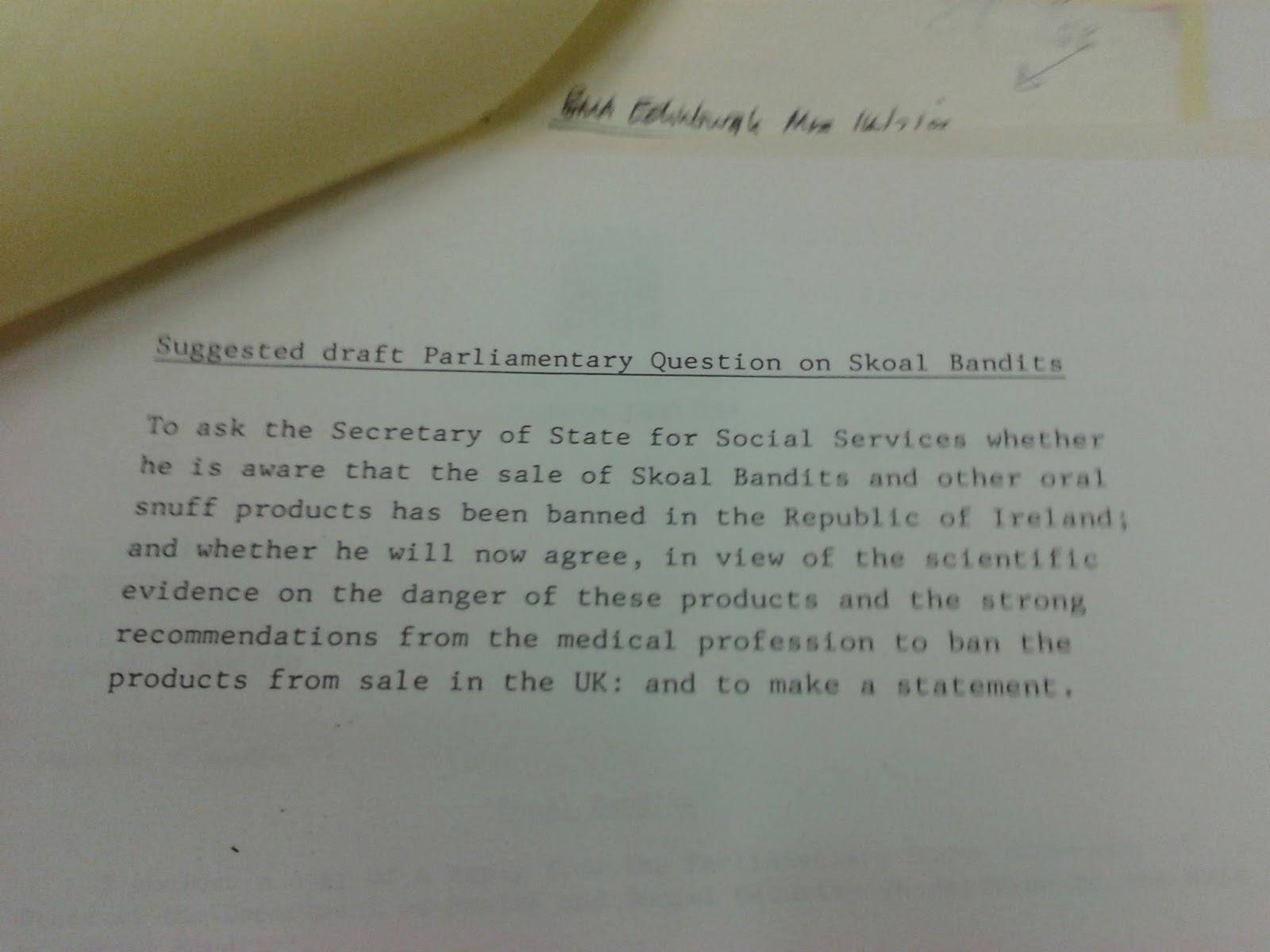
Simpson had extensive correspondence with the Labour MP Robert Wareing who agreed to ask questions in parliament. ASH helpfully gave him the exact wordings of these questions...


In June 1987, the WHO issued a press release calling for a 'pre-emptive ban' on snus - indeed, on all smokeless tobacco - 'to prevent a new public health epidemic from a new form of tobacco use'.

'Although promoted as an alternative to cigarettes, specifically in North America and Western Europe, smokeless tobacco is described by WHO a "new threat to society" - particularly to young males who are thus far the major targets in sophisticated promotional and advertising campaigns.'


The UK banned the sale and manufacture of snus in 1989. The EEC followed suit in 1992. Sweden got an exemption when it joined the EU in 1995. Sweden's smoking rate is now less than half the EU average and is the lowest in the developed world.

Viva public health!

Thursday, 2 June 2016

Plain packaging debunked (again)

The Property Rights Alliance recently put out a letter against plain packaging for which I was one of the signatories. They've since put out a short video debunking the various lies from Down Under about what actually happened when this ridiculous, Soviet-style policy was put into effect. It's well worth watching.


Wednesday, 1 June 2016

Last Orders: episode 3

The latest episode of the Last Orders podcast is online. This month, I'm joined by Brendan O'Neill (Spiked) and Jim Allan (University of Queensland) to discuss the fat vs carbs row, the EU Tobacco Products Directive and the state of Australia.

If you haven't already subscribed on your phone, you can listen here.