Friday, 3 June 2016

History repeating: snus and e-cigarettes

Dick Puddlecote has been having some fun raking over the mountain of correspondence between ASH and their friends/donors in government. E-mails reveal the vigour with which the vaper's suppposed friends at this state-funded sockpuppet lobbied for e-cigarettes to be regulated as medicines and then, when that failed, were determined to see Article 20 of the Tobacco Products Directive passed without amendment.

This all reminded me of some much older ASH correspondence that I looked at several years ago when I was writing The Art of Suppression. Back then, I spent a couple of afternoons at the Wellcome Library in London where there is a large collection of ASH documents going back to the group's inception in 1971. I was looking for documents about snus and I wasn't disappointed. There were boxes of them.

The similarities between today's e-cigarette panic and the snus panic of the 1980s are uncanny. So uncanny that you might think that 'public health' people would have learned a lesson. To be fair, some have - including ASH to an extent - but if you look at the WHO, the FDA, the Lancet etc. you can hear exactly the same bogus arguments and hysterical rhetoric that were voiced in the 1980s.


The full story is in the book but the heavily truncated version goes like this: Snus is smokeless tobacco in a pouch that goes under the top lip. It was assumed to cause cancer but doesn't. It was assumed to be a gateway to smoking but isn't. ASH ran a campaign to ban it in Britain and succeeded. The EU then followed. Sweden is now the only EU member state that allows the sale of snus. This graph tells a thousand words...


The whole thing kicked off when an American smokeless tobacco company set up a factory in Scotland to produce a brand of snus called Skoal Bandits, apparently with a government grant.

As early as 1984, Richard Peto had seen the potential of snus as a substitute for people wanting to quit smoking. In 1985, Michael Russell and colleagues (including Robert West) reported the results of new research in a letter to The Lancet. Still working on the (mistaken) assumption that snus caused oral cancer, they concluded that snus 'could help people trying to give up smoking... If all smokers in Britain switched to sachets about 50,000 premature deaths per year might eventually be saved at an annual cost of less than 1,000 deaths from mouth cancer.'

None of this appealed to ASH (then led by David Simpson). Their incomprehension is nicely illustrated by the handwritten comment of 'Weird headline!' next to a news story about snus being a 'threat to cigarettes'. (nb. click to enlarge any of the following images)


Such headlines were rare, however. Thanks to scare-mongering by ASH and the BMA, news reports about snus were almost entirely negative. This, from 1985, is typical. Notice that the BMA were already calling for an outright ban at this stage...


A letter from 1984 shows that ASH were aware of the harm reduction potential of snus but any glimmer of optimism was overwhelmed by the same concerns about 'dual use' that are expressed by anti-vaping activists today...


A 1985 letter from Alexander McCall Smith, the Edinburgh-based chairman of the Association for Non-Smokers' Rights contains another assumption that anti-vaping folk like to make. After stating that his organisation is concerned only with passive smoking and therefore has 'precisely nothing to say about Skoal Bandits', he goes on to say that 'everybody knows' that the product is 'aimed at children' and that 'the whole exercise is to accustom under-age users to nicotine'.


Fears about the 'gateway effect' were commonplace. For example, in this 1985 article headlined '"Ban the Tobacco Bandits" Demand'...


In a letter dated 11 April 1985, David Simpson brings up both the gateway theory and the precautionary principle:

“We have had the matter raised in parliament and numerous times in the press but I fear that by the time there is concrete evidence that young people progress from using this product to smoking cigarettes, it will be too late for action – the usual story.”

In January 1986, Ireland banned snus. Hong Kong and Australia followed suit soon afterwards. A letter from the Australian anti-smoking campaigner Nigel Gray to the Australian Minister of Health shows the lengths to which prohibitionists go to convince people that they are not prohibitionists. 'In relation to civil liberties', he writes, 'this move would not impair them at all. If individuals wish to chew tobacco they can obtain and prepare it for themselves by breaking up cigarettes.' Hmm.


In the UK, the campaign to ban snus was led by David Simpson of ASH and Alison Hillhouse of ASH Scotland. They initially focused on the loophole in the law that allowed oral tobacco to be sold to children. When this was sensibly closed in July, a full ban was the 'next logical step', as a press release from the United Kingdom Coordinating Committee on Cancer Research made clear...

The Government has taken steps to ban the sale of oral snuff to people under 16 but this is unlikely to be effective in stopping the spread of this addictive habit... only a total ban on the import, manufacture and sale of oral snuff will be adequate to prevent the widespread use of this carcinogenic material.

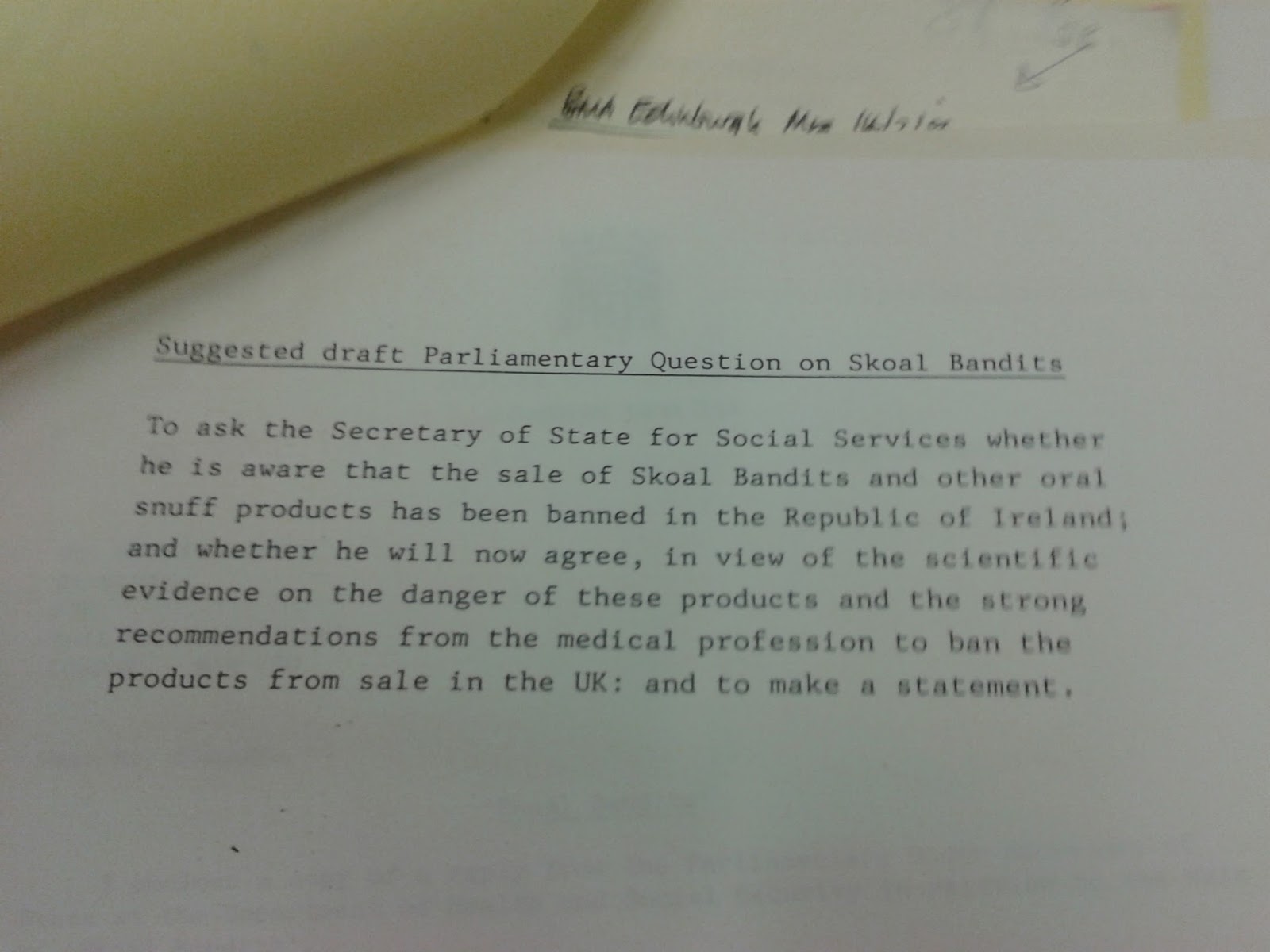
Simpson had extensive correspondence with the Labour MP Robert Wareing who agreed to ask questions in parliament. ASH helpfully gave him the exact wordings of these questions...


In June 1987, the WHO issued a press release calling for a 'pre-emptive ban' on snus - indeed, on all smokeless tobacco - 'to prevent a new public health epidemic from a new form of tobacco use'.

'Although promoted as an alternative to cigarettes, specifically in North America and Western Europe, smokeless tobacco is described by WHO a "new threat to society" - particularly to young males who are thus far the major targets in sophisticated promotional and advertising campaigns.'


The UK banned the sale and manufacture of snus in 1989. The EEC followed suit in 1992. Sweden got an exemption when it joined the EU in 1995. Sweden's smoking rate is now less than half the EU average and is the lowest in the developed world.

Viva public health!

Thursday, 2 June 2016

Plain packaging debunked (again)

The Property Rights Alliance recently put out a letter against plain packaging for which I was one of the signatories. They've since put out a short video debunking the various lies from Down Under about what actually happened when this ridiculous, Soviet-style policy was put into effect. It's well worth watching.


Wednesday, 1 June 2016

Last Orders: episode 3

The latest episode of the Last Orders podcast is online. This month, I'm joined by Brendan O'Neill (Spiked) and Jim Allan (University of Queensland) to discuss the fat vs carbs row, the EU Tobacco Products Directive and the state of Australia.

If you haven't already subscribed on your phone, you can listen here.

Tuesday, 31 May 2016

The state of the World Health Organisation

There were more allegations of incompetence and corruption directed at the World Health Organisation over the weekend. After dropping the ball on Ebola and making a few people very rich with swine flu fear-mongering, the WHO are now accused of turning a blind eye to the Zika virus for fear of spoiling the International Olympic Committee's party.

An open letter signed by 150 international doctors, scientists and researchers criticised a secret agreement between the WHO and the IOC and said they​ risk putting public health in further danger.

It says the influx of hundreds of athletes and thousands of spectators into Brazil will accelerate the march of the virus.

.. One of the letter’s signatories, Professor Edwin van Teijlingen , an expert in reproductive health at Bournemouth University, accused the IOC and the WHO of being “too close for comfort” and of operating behind a cloak of secrecy.

The cloak of secrecy sounds familiar. At the peak of the Ebola crisis, WHO director-general Margaret Chan was 'fully occupied' at a tobacco control jamboree in Moscow to which even journalists were not invited. Chan seems to have little interest in infectious diseases in developing countries. She prefers to spend her time micromanaging the lives of affluent Westerners, suppressing e-cigarettes and waging war on the paper tigers of capitalism. Her sixth form view of the world was captured in the 2013 speech in which she said...

'It is not just Big Tobacco anymore. Public health must also contend with Big Food, Big Soda, and Big Alcohol.'

 And so it continues. Today is World No Tobacco Day...


Every year, on 31 May, WHO and partners mark World No Tobacco Day (WNTD), highlighting the health risks associated with tobacco use and advocating for effective policies to reduce tobacco consumption.

And what 'effective policy' is the WHO 'advocating for' on this year?


For World No Tobacco Day, 31 May 2016, WHO and the Secretariat of the WHO Framework Convention on Tobacco Control are calling countries to get ready for plain (standardized) packaging of tobacco products.

That's right, a policy that clearly failed in Australia and has unwelcome side effects not only in terms of the black market but also in terms of the effect on smokers...


Some may argue that the fact that the images create motivations and desires to stop smoking is a public health victory in its own right. If it wasn’t for the unintended consequences, I would agree. But “plain packaging” has been found to create severe feelings of self-blame and disgust which, in turn, cause stigmatisation of smokers.

On the one hand, these side effects are not justified because they are not outweighed by other benefits of the new plain packaging rules. The fact that smokers feel motivated to stop is hardly a net gain when they at the same time are subject to emotional harm, and their chances of quitting aren’t strongly improved.

Worse, though, some studies demonstrate that certain groups of smokers react negatively to shock messages. For some, the feeling of blame and stigmatisation creates an emotional state of disempowerment, which reinforces the belief that it is impossible to stop smoking. In such cases, plain packaging does not only create emotional harm without sufficient justification, it is quite frankly counterproductive.

Given the lack of behavioural evidence and the serious unintended consequences, the introduction of tobacco plain packaging in the UK is an ill-advised decision, which is most likely not to have a significant impact on one of our biggest public health challenges.

None of the unintended consequences matter to the unelected and unaccountable WHO. They won't have to pick up the pieces. But governments should be asking why they are funding an organisation that so often fails in its primary duty of tackling contagious diseases in poor countries and yet always has ample money to spend on quixotic pursuits such as the global erosion of intellectual property rights.

Sunday, 29 May 2016

National Obesity Forum in meltdown

This is most entertaining. The National Obesity Forum is in meltdown thanks to the Malhotra-driven 'fat is your friend' report. From The Observer...

Britain’s leading anti-obesity campaign group is in turmoil after its controversial new dietary advice provoked serious infighting and threats by leading doctors to shun it over its “misleading” views.

Privately, the National Obesity Forum (NOF) is in disarray over recommendations last week that people should eat more fat, reduce carbohydrates and stop counting calories.

That would explain a tweet I saw last week about NOF's chief spokesman, Tam Fry...

It is noticeable that there is still no mention of the report on the NOF website. It was actually published by the Public Health Collaboration, a recently formed group of low carbers who realised that you can get the media interested in any old rubbish so long as you've got the words 'public health' in your name (the 'collaboration' bit is probably intended to invoke the Cochrane Collaboration).

The link with the National Obesity Forum seems to be confined to three men, two of whom will be familiar to regular readers...

Internal NOF emails seen by the Observer reveal anger among board members that none of them was given the chance to approve the incendiary report before publication, except its chair, Dr David Haslam, who co-wrote it with Dr Aseem Malhotra, an outspoken heart doctor who is the NOF’s cardiological adviser, and others, including Robert Lustig, an American expert on sugar. Haslam, a GP, told them on 12 May that he would seek their advice before publishing but did not do so, it is claimed.

And get the popcorn ready because...

The group plans to issue a statement this week disowning the findings, which will leave Haslam facing serious questions.

And get some more popcorn ready for this...

The emails show that a number of renowned authorities on obesity and medical organisations plan to review their links with the NOF because it was “inexcusable to confuse the public with incorrect science”. Concerns are so great that it may be expelled from the Obesity Health Alliance, a coalition of 30 health organisations that is urging ministers to take tough action to tackle the growing epidemic of obesity.

And then this...

The “fallout” is so great that the forum’s annual conference, due to take place in November, “is now in jeopardy”, adds Capehorn. Obesity expert Mike Lean, professor of human nutrition at Glasgow University, has already withdrawn from speaking because of the controversy, Capehorn claims.

This is all tremendously funny and yet it is difficult to pick a side to cheer on. It's like having to choose between Assad and ISIS, or Clinton and Trump. On the one hand, you have cretins like Aseem Malhotra whose downfall is long overdue. On the other hand, you have horrible nanny statists like Tam Fry, Mike Lean, Susan Jebb and Simon Capewell who are only an improvement on Malhotra insofar as they understand the laws of thermodynamics.

The standard of debate is much as you might expect from the 'public health' racket. Instead of arguing about the scientific evidence, they have retreated to their comfort zone and thrown ad hominems at one another. Malhotra has accused Jebb of being in the pay of Weight Watchers and Jebb has accused the National Obesity Forum of being in the pay of Big Pharma.

It's like watching children at play. The Observer quotes an anonymous (why?) 'expert' who makes the stupidest criticism imaginable of a report that richly deserves to be criticised.

One of Britain’s leading experts in public health, who did not wish to be named, told the Observer that the report’s authors had inadvertently damaged efforts to educate the public about what they should and should not eat. “The report’s conclusion to opt for a ‘balanced diet’ is a disaster. Because that is exactly the phrase the junk food industry use to justify ‘a little of what you like will do no harm’; that is, ‘eat junk, snacks and soda whenever you want – and make us rich’.”

This is absolutely pathetic. The food industry didn't invent the term 'balanced diet' but even if they did it wouldn't make it invalid. Doctors tell people to eat a balanced diet and so does the NHS. In any case, the problem with the Public Health Collaboration report isn't that it advocates a balanced diet. It does pretty much the opposite, telling people to pile their plates up with unlimited quantities of fatty food and not worry about calories. 

These people are so obsessed with the food industry that even while fighting each other they can't give up the rhetoric. Let's not pick a side in this row. Let's hope they keeping punching each other until they both fall over.

Thursday, 26 May 2016

Never Mind The Gap

Ever since I wrote The Spirit Level Delusion in 2010 I've been asked to speak at debates about income inequality. I wasn't interested in inequality when I read The Spirit Level and I'm not particularly interested in it now. My view is that it could be a symptom of a problem but it cannot be a problem in itself. Material living standards, prosperity and growth are what matters, not envy.

Mere indifference to income inequality is enough to make some people angry, but their angry is usually based on a misunderstanding of the basic facts. For example, people think that Britain is one of the world's least equal countries and that inequality is spiralling out of control. These beliefs are simply untrue and so, in a probably futile attempt to bring some facts into the picture, my IEA colleague Ryan Bourne and I have written a mythbuster about income and wealth inequality in Britain. It's called Never Mind the Gap and you can download it for free here.


Wednesday, 25 May 2016

Brainzero: be the change

Last year, the radical citizen activists from Live From Golgafrincham interviewed me for a video about the importance of a diverse civil society supported by people power (ie. taxpayers). This important film is the fruit of their labour. Please sign a petition.


#becausebecausebecausecaring
#change

* May contain satire.