Monday, 11 January 2016

More on those alcohol guidelines

I was going to write about the modelling conducted by Sheffield University's alcohol squad to create the new drinking guidelines, but I am relieved to find that the Stats Guy has got there first. Most of the odd aspects of the research that struck me have also struck him and his post is essential reading for anyone interested in the subject. Be sure to have a look.

As with their efforts to model the effect of minimum pricing, the Sheffield report is superficially detailed but breaks down when you try to find exactly what calculations have been made and what studies have been used as the empirical evidence. It therefore requires more trust in the authors' judgement than I am prepared to invest.

Minimum pricing is an untested policy so theoretical modelling is the only option. By contrast, the link between mortality and alcohol consumption has an extensive empirical literature. As the Stats Guy says, it doesn't require modelling at all. It requires a literature review.

It seems to me that the important question here is how does your risk of premature death depend on your alcohol consumption. That, at any rate, is what was modelled.

But there is no need to model it: we actually have empirical data. A systematic review of 34 prospective studies by Di Castelnuovo et al published in 2006 looked at the relationship between alcohol consumption and mortality. This is what it found (the lines on either side of the male and female lines are 99% confidence intervals).

This shows that the level of alcohol consumption associated with no increased mortality risk compared with non-drinkers is about 25 g/day for women and 40 g/day for men. A standard UK unit is 8 g of alcohol, so that converts to about 22 units per week for women and 35 units per week for men: not entirely dissimilar to the previous guidelines.

Quite so. It should also be noted that the protective effect is stronger for men (ie. they can drink more than women before assuming the same risk as a teetotaller). This makes a mockery of the idea that the only health benefits from drinking apply to post-menopausal women. The evidence simply does not support that.

One thing the Stats Guy doesn't mention, though it strikes me as peculiar, is that the Sheffield research focuses entirely on alcohol-related mortality and alcohol-related hospitalisations. It is a trivial tautology to say that drinkers are at more risk of drink-related problems than non-drinkers, but what we really need to know is what effect alcohol consumption has on overall mortality. The Sheffield report doesn't tell us. Fortunately we have a wealth of epidemiological evidence to show that overall mortality risk does not return to the level of a non-drinkers until alcohol consumption gets to around 20 to 40 units per week.

There are some mildly entertaining attempts to pour doubt on the health benefits of alcohol in the text of the Sheffield report which I will return to another day. For now, read the Stats Guy's post (and, if you haven't seen it, my post from Friday).

Saturday, 9 January 2016

Twists of the ratchet

Regarding the new alcohol guidelines and the 'no safe level' rhetoric spouted by the Chief Medical Officer yesterday, Charles Moore gets it...

Critics of the new guidelines have already pointed out some of their defects – how they depend too heavily upon research at the University of Sheffield conducted by those committed to the minimum pricing of alcohol (another entirely political, unscientific cause); how they concentrate so much on cancer risk that they play down alcohol benefits for the heart; how they show no sense of proportion about what we mean by risk; how binge-drinking is less of a problem than it was 20 years ago. 

But something more important is being missed. These guidelines are not intended to stand alone. They are twists of a ratchet. Public health zealots, like environmentalist ones, work always to construct a net of public policies that will eventually ensnare whatever group it is they dislike. 

The model in their minds is tobacco. Having succeeded in virtually outlawing smoking, they want to do the same with alcohol. If they can create the public “fact” that there is no such thing as safe drinking, they can then attack everyone who brews, distills, makes wine, or runs a pub, club or restaurant, for pushing something which is unsafe. 

They can also have a go at anyone who advertises any of the above, and insist on health warnings and, later, bans.

Emulating the anti-tobacco blueprint is the name of the game. This has been clear to seasoned observers for some time. This week should be a wake up call to the general public.

From this moment on every campaign for policies to attack drinkers will be accompanied by references to there being no safe level of drinking, to alcohol causing cancer (with no reference to the small level of risk or the rarity of the cancer), and to there being no health benefits from drinking (a lie).

Happy new year.


Friday, 8 January 2016

The Chief Medical Officer is misleading the public

The change to the alcohol guidelines today was an opportunity to bring official advice closer in line with the evidence. Instead, the Chief Medical Officer has taken it further away.

I have predicted for years that the guidelines will one day be reduced to zero. This is another step in that direction. In the 1960s, people were told not to drink more than a bottle of wine a day (or the equivalent). Then, in 1979, Britons were advised to drink no more than 56 units a week. This fell in 1984 to 14-21 units for women and 21-36 units for men. By the end of the 1980s it had become 14 units for women and 21 units for men. They have now fallen to 14 for both sexes - one pint of beer a day.

Most men will find their new 14 unit 'limit' laughable and rightly ignore it but guidelines are not really designed for the public. They are designed for 'public health' campaigners. The effect of today's change will be to drag hundreds of thousands of people into the at-risk category and revive the flagging narrative of Booze Britain.

It is also being done because the 'public health' lobby hates a complex message. The reality is that there is no safe drinking level. Being teetotal offers protection against a few cancers but drinking offers protection from other diseases, including heart disease and stroke. So what do you want to be 'safe' from - cancer or heart disease? You have to choose.

Sally Davies has got around this thorny question by ignoring or downplaying the benefits of moderate drinking to health. She relied on one piece of quack research to do so.

Last year, a study claimed that drinking only had a protective effect for certain groups. The authors used a simple statistical trick. They gathered data which clearly showed health benefits from moderate drinking and then divided it into so many subgroups that it was almost impossible for them to produce statistically significant results. By the time the authors had sliced and diced the data, the only people who appeared to benefit from drinking were post-menopausal women. I wrote about it at the time, as did David Spiegelhalter. It was absolute junk.

Everybody knew the guidelines were under review. I said at the time that the study was a concerted effort to overturn decades of evidence. Countless studies have found a J-shaped relationship between drinking and disease/mortality. This can be illustrated with this graph from Doll and Peto (1994)...


Richard Doll returned to the subject in 2005 and found much the same effect...


The J-curved relationship between alcohol consumption and coronary heart disease is particularly strong. It has been summarised in this meta-analysis of 84 studies and can be illustrated with this graph from Corrao et al. (2000)...


What about overall mortality? It's the same picture. As many researchers have shown, for example Gronbaek et al. (1994), the relationship is also J-shaped.


The only real question is how much do drinkers have to consume before they assume as much risk as non-drinkers? Di Castelnuovo et al. (2006) was quite typical in finding a lower rate of mortality up until drinkers consume 40 units of alcohol per week. Beyond this, risk increases above that of the teetotaller. A unit of alcohol is 8 grams so this works out at five standard drinks or more (nb. a unit is 10 grams in the US hence it is four drinks in the graph). 


From time to time, 'public health' people who don't like to admit that drinking can be good for you wheel out the 'sick quitter' hypothesis, a zombie argument that was debunked years ago. (Even the slice-and-dice study showed that the risks of not drinking were not due to unhealthy former drinkers - only lifelong non-drinkers were studied. Doll's 2005 study found the same thing).

The facts are clear. Moderate drinking - or by today's puritanical standards, even relatively heavy drinking - reduces not only heart disease risk but overall mortality risk. And the relationship is causal.

So how does Davies - or rather Davies' advisory group, which was made up of familiar anti-drinking zealots such as Ian Gilmore and Gerard Hastings, with the research shipped out to Sheffield University's minimum pricing modellers - get around this dilemma? She cites that one terribly flawed study from last year which split the drinkers into lots of non-significant subgroups. That's it. Actually she doesn't cite it explicitly - the report contains remarkably few citations to academic studies - but it is clear what she is referring to.

Meta-analyses have identified that for some conditions, notably ischaemic heart disease (IHD), drinking alcohol at low levels may have a protective effect (compared to not drinking), particularly for all-cause mortality. However, the group noted that any potential protective effect seems mainly relevant to older age groups

This claim is repeated again in the main text of the report...

Evidence for a net protective effect of alcohol from risk of death (which has been linked to possible reduced risks of heart disease late in life) is considered less strong than it was. A reduced risk still exists, but, in the UK, it now appears to matter overall in a significant way only for women aged 55 or older.

And again...

Previous analyses suggested the protective effect was only likely to be relevant to men from age 40 onwards and for post-menopausal women. 

She follows this up with some classic merchants of doubt stuff...

The evidence for a direct, protective, effect of alcohol on mortality is a subject of continuing scientific discussion

Whereas there is no scientific discussion about one contrarian study based on nothing more than statistical chicanery?! That study is sufficiently robust to overturn everything else in the literature, is it?

The reality is that the J-curve has been repeatedly shown in a body of evidence that is much larger, stronger and more consistent than the evidence for a relationship between moderate drinking and most of the cancers Davies focuses on and yet she portrays the former as controversial and the latter as rock solid. As Eric Crampton said some years ago, in the world of alcohol research 'every risk is conclusively proven; every benefit needs further study.'

She then seeks to say, in effect, that reducing heart disease risk isn't very important...

Deaths from this type of disease have been falling in the UK population for some years, which means there is less risk for which low alcohol consumption might give protection

Maybe heart disease declined partly as a result of the increase in drinking? Just a thought. In any case, coronary heart disease still kills more people than all the 'alcohol-related' cancers Davies mentions combined.

And then there is this remarkable statement...

Lifestyle changes, such as stopping smoking, increasing levels of physical activity, and eating a healthy diet, can help protect against heart disease, so any potential protective effects from alcohol could be achieved in other ways, which avoid the other health risks which come with any drinking of alcohol.

Imagine them saying this about anything else! Imagine them saying that people don't need to bother about eating too much salt because they can always reduce the risk of having a heart attack by losing weight. In any case, it's not true. A non-smoking teetotaller is as greater risk than a non-smoking moderate drinker.

This whataboutery is a blatant attempt to downplay the significance of alcohol's protective effect on heart disease to such an extent that they are even happy to downplay the significance of heart disease as a cause of death. The lengths these people will go to is extraordinary.

Anyone who cares about scientific probity should be outraged by the Chief Medical Officer's behaviour in this report. Casting out decades of research in favour of a single claim from a single study is a shocking abuse of her authority. People have a right to receive honest and accurate information from the government. I would call for her to be sacked but she'd only be replaced by somebody cut from the same corrupt cloth.

Thursday, 7 January 2016

Obesity drivel

From the BBC...

Rising levels of obesity and unhealthy weights could be linked to 670,000 extra cases of cancer in the next 20 years, a UK report predicts.

Multiplying annual figures over a decade or, as here, over two decades is a sure sign that the PR people have told them they need to get a BIG NUMBER.

If current trends continue, experts say, almost three in four adults could be overweight or obese by 2035, bringing a host of health issues. 

Oh goody, another obesity prediction. That won't be another policy-driven joke that will unravel as the years go by, will it?

Let's just remind ourselves how the last major, widely reported, peer-reviewed prediction from The Lancet is going, based on the latest obesity figures that went almost entirely unnoticed when they were released last month.


As you can see, the actual rate of obesity continues to lag well behind even the lowest bound of the Lancet's confidence interval. The public health mystics predicted that there would be...

"...a rise in obesity prevalence in men from 26% to 41–48% and in women from 26% to 35–43% [by 2030]." 

Current figures are 24 per cent for men and 27 per cent for women. If anyone wants to bet that the Lancet will be proven correct by 2030, I will happily take your money. You can leave a comment here or reach me on Twitter. Anybody? No?

The Cancer Research UK and UK Health Forum report says TV adverts for some food should be banned before 21:00.

Boom! Straight in there will the lobbying by the third sentence. And that, of course, is what this non-news story is all about.

Experts behind the report say they have taken into account that increases in obesity have started to slow in the past few years.

If so, then how on earth have they predicted that 'almost three in four adults could be overweight or obese by 2035'. Let's have a look at how rates of overweight and obesity (combined) have changed since the start of the century.


If that looks like a straight line to you, you are correct. The current rate of 62 per cent is exactly the same as it was in 2001, so these 'experts' can sling their hook and take their pathetic junk science with them.

Surely this stuff is wearing thin for even the most credulous moron by now?


PS. While I've got your attention, do have a read of Carl Phillips' latest blog post about the inherent dishonesty of 'public health'.

Sign o' The Times

The Times came out in support of a sugar tax yesterday. No great surprise. The newspaper has been weirdly obsessed with sugar for a couple of years. I wrote a piece for the Spectator about it. Do have a read.

Wednesday, 6 January 2016

More anti-booze propaganda

Just before Christmas I mentioned the 'error' in an academic study which led the press to report that 70 per cent of A & E attendances are due to alcohol consumption; the real figure in this study of A & E departments in Newcastle was 12-15 per cent. If there is a news story here, it is that.

It seems unlikely that this mistake happened by accident since the same error appears twice in the text of the study and was repeated in the headline of the press release. More likely it was a deliberate (and successful) attempt to keep the narrative of 'binge Britain' rolling in order to promote higher taxes, shorter opening hours and minimum pricing.

This theory is supported by an accompanying editorial by Clifford Mann. Clifford is the person the media go to whenever they want someone to predict that the NHS will 'collapse' due to cold weather or under-funding. His latest editorial resembles a clearing house for every tired old trope and debunked factoid about drinking in Britain in the last fifteen years. Virtually every sentence contains an exaggeration, misrepresentation or outright lie. Here are a few...

Almost 1 in 6 emergency department attenders in this study presented following significant alcohol consumption. This in itself is a cause for concern. However, the prevalence rises to almost 3 in 4 four attendances during the late evening and early hours of weekends.

This statistic is less misleading than the study's press release but it is still wrong. It doesn't rise to almost 3 in 4 'during the late evening'. It only approaches that rate for two hours between 2am and 4am when there is hardly anybody awake who would pass a breathalyser test. How many people are out and about at 3 o'clock in the morning in Newcastle at the weekend who have not had 'significant alcohol consumption'?

The real question is how many A & E attendances are due to alcohol consumption? The NHS, the government and the 'public health' lobby claim 35 per cent. This study—in one of the country's premier party towns—says 12 to 15 per cent.

This study, in an inner city emergency department, best reflects the case load and case mix of other metropolitan and urban centres...

Not necessarily. We don't know how transferable data from Newcastle are to other cities.

...but the key messages are relevant to all emergency departments in countries where alcohol is readily available.

The key message is that A & E departments are not 'swamped with drunks' to anywhere near the extent suggested by the media and pretend public health groups.

Current national and international data describing the financial burden of alcohol are dramatic, yet the response of governments has been woefully inadequate.

Cost-of-alcohol estimates are 'dramatic' because they massively inflate the cost to the public purse by relying on shoddy evidence (such as the 35 per cent figure) and including non-financial intangible, emotional and internal costs without including any savings or benefits. The government makes at least three times more from alcohol duty than it spends on externalities - see Alcohol and the Public Purse for evidence.

In England alone, the National Health Service (NHS) estimates that there are 1 million hospital admissions annually as a direct result of acute or chronic alcohol ingestion.

No it doesn't. The NHS estimates that the figure is around a fifth of that. The Department of Health stopped using the broad measure that allowed an estimate of 1 million admissions to be claimed because its methodology is prone to huge numbers of false positives.

The financial cost to the NHS is £3.5 billion.

No it isn't.

The pattern of alcohol intoxication has changed significantly in the past 10 years. 

People are drinking less and getting drunk less. Could that be what Clifford means?

No longer do people set out sober, in the early evening, to attend licensed establishments where they consume alcohol. 

I do it all the time and so do most people I know.

Instead the phenomenon of ‘preloading’ has become endemic.

Firstly, people have every right to drink alcohol in their own home. Secondly, if home-drinking has become more common, it is principally due to extortionate alcohol taxes and the smoking ban.

In 2005 the licensing laws for England and Wales were ‘relaxed’. The arguments made at the time to amend the legislation emphasised the benefits of the ‘cafe society’.

That was never the main rationale for making licensing laws more civilised. It was done to allow consumers more freedom, to diversify the nighttime economy and to alleviate the problems that came with pubs kicking everybody onto the street at the same time. It achieved all three of these objectives. It was a success.

Since then, accident and emergency departments in the UK have seen ever greater numbers of patients whose presentations are linked to acute or chronic alcohol ingestion. 

Rubbish. There are no national statistics on this whatsoever but studies that looked at A & E attendances before and after the introduction of the Licensing Act mostly found no change or a decline in alcohol-related cases.

Official statistics for England show that hospital admissions for alcohol related diseases or injuries rose 100% between 2003 and 2013.

Wholly attributable alcohol-related admissions have actually risen by a third which is roughly in line with the general increase in hospital admissions for all causes. They represent a mere one per cent of all admissions.

Although the number of licensed premises has risen dramatically in the UK over the past decade...

I haven't got figures for the last five years but there was certainly no surge after the licensing laws were reformed:


Currently it is perfectly feasible to purchase a volume of alcohol that represents a safe weekly maximum for less than £10. 

You can buy more than a 'safe' number of calories for less than £5. So what? It doesn't mean you have to do it.

Alcohol at this price is cheaper than bottled water.

Still using the old chestnut about the most expensive bottled water being cheaper than the weakest, least popular, supermarket own-brand lager, Clifford? What is it supposed to tell us? That people who buy bottled water are being ripped off?

Profit margins may be very slim but the intention is clearly to encourage alcohol consumption with little regard for the notion of responsible drinking.

This fellow seems to genuinely believe that drinks companies are more interested in encouraging irresponsible alcohol consumption than in making a profit. I thought they were supposed to be ruthlessly profit driven?

By contrast, where prices reflect true costs plus the necessary profit margin—for example, traditional restaurants and cafes—the marginal difference between the cost of a soft drink and alcohol again encourages consumption of the latter.

Alcoholic drinks are almost invariably more expensive than soft drinks. You can't just keep making things up, Cliff. We go to cafes and restaurants too. We know how it works.

A recent Canadian study highlighted the correlation between raising the minimum unit price and a consequent reduction in crimes against the person.

It was a laughable piece of junk science.

Public Health England estimates the total annual cost to society of alcohol related harm to be £21 billion. 

That estimate was devised in 2003. Public Health England was formed in 2013. They're just parroting an outdated number from research that doesn't stand up against the facts.

To put this in context, the annual aggregated running cost of every accident and emergency department in the UK is £2 billion.

£2 billion is less than two per cent of the NHS budget and the 'context' is totally inappropriate. The £21 billion is mostly made up of intangible, emotional and internal costs such as lost productivity and premature mortality. The cost of running A & E departments, by contrast, is a real monetary cost to the taxpayer. You cannot compare the two.

Is it any wonder that newspaper editorials about alcohol are so factually incorrect when editorials in peer-reviewed journals are filled with bollocks like this?

Tuesday, 5 January 2016

"We need more teetotallers"

An article appeared on the front page of the Scotsman on Sunday which was unusual in containing absolutely nothing that supported its opening line.

New evidence that shows even a small amount of alcohol can contribute to heart disease has prompted calls for government drinking guidelines to be tightened.

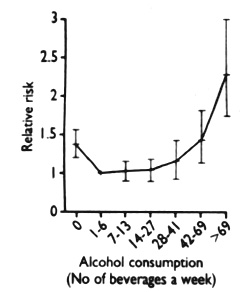
It would have to be pretty impressive evidence to overturn the large body of epidemiological evidence showing that moderate drinkers have lower rates of mortality than teetotallers (see here, here and the graph below - nb. there are 8 grams of alcohol in a UK unit).

So where is it? Alas, the Scotsman does not tell us. It doesn't say who the researchers are or what the research shows. It doesn't tell us when and where it will be published. The 'new evidence' might as well not exist. It probably doesn't.

Instead, the story is based entirely on the opinion of one academic, Professor Naveed Sattar of Glasgow University, who says that all the previous research is 'flawed'. This is a merchant of doubt routine that we saw last year from the neo-temperance lobby. They hate the fact that drinking can be good for your health and are determined to have the drinking guidelines revised towards zero.

“We are looking at new evidence that even small amounts of alcohol may not prevent against heart disease and may in fact be harmful,” he said.

Show us the evidence, Naveed. Get it peer reviewed and published so we can judge for ourselves.

“If people think drinking wine or beer will protect their heart, evidence is not solid on this at all. Some people think it is okay to have a second glass of wine. They think ‘this is good for my heart’, but new evidence does not support this.”

Why not publish it? Why go straight to the media?

He said current guidelines are based on research that fails to take into account that many people who describe themselves as teetotal don’t drink because they are already unwell and at higher risk of death – so called “sick quitters”.

How many more times are we going to hear this zombie argument about sick quitters? It was first made in 1988 and has been tested to death (see here, here, here and here). It doesn't stack up. Anyone who drags this old canard up without acknowledging that it has been debunked is more of an activist than a scientist.

“As a national health policy we need to help people take control of their own health – it’s not about a nanny state. We need more teetotallers and youngsters to be exposed to alcohol at a much older age."

And the mask slips. "We need more teetotallers". This could be the slogan of any booze-hating crusader of the last 200 years. It is not a scientific message. It is not a health message. It is not even a temperance message in the literal sense, since temperance means moderation. Total abstinence is the message of the zealot, the fanatic, the prohibitionist.

From the perspective of health, we do not need more teetotallers. We need more moderate drinkers. If policy was derived from evidence, the Chief Medical Officer would be talking about the scourge of abstinence-related heart disease and calling for tough action on those who fail to drink at least a pint of beer a day.

But policy is not derived from the evidence. The policies come first. Evidence that isn't consistent with them is condemned as 'flawed' and new evidence is created (or claimed to have been created) to support the policies. Since alcohol policies are nothing more than rebadged tobacco policies, it should not be surprising that the 'no safe level' mantra is being borrowed from the anti-smoking racket.

This fanaticism is increasingly influential in Scotland. In October, the Scottish taxpayer was forced to pay for the explicitly teetotal Global Alcohol Policy Alliance to hold a conference which ended with a resolution to fight alcohol marketing because it 'encourages the loss of abstention'. Alcohol Concern signed up to it. And Naveed Sattar is not just some random academic with strange views...

Sattar heads the Scottish Intercollegiate Guidelines Network group, which develops clinical guidelines for the NHS in Scotland and is now looking at changing drinking guidelines in light of the fresh evidence.

The lunatics are taking over the asylum.