Friday, 10 August 2012

A timely plain packaging study

As the plain packaging consultation finally grinds to a halt, I was interviewed by the Voice of Russia for a comment about where the whole thing is likely to lead. The link's here—do listen to the audio as the transcript is inaccurate.

Also speaking was Olivia Maynard, one of Linda Bauld's postgraduate students from Bristol University, who has produced another chunk of quasi-science claiming to show that plain packaging "encourages young smokers to heed health warnings". It does not nothing of the sort, of course. The research—which was barely reported in the media—was merely the latest in a series of studies which use eye-tracking technology to show that plain packs might make people look at health warnings for fractionally longer than normal packs do.

The glaring problem with this as a "plain packaging will reduce smoking" argument is that it does not actually show that people will "heed" the warnings even if they do look at them for 0.1 second longer. In the interview, Maynard makes the puerile claim that "when you look at something more, you understand it more", as if the phrase 'Smoking Kills' was an enigmatic riddle requiring deep meditation. In truth, knowledge about the hazards of smoking is universal and is well-engrained by the age of about seven. People don't start smoking because they think cigarettes have got vitamin C in them.

For the record, Dr Tim Holmes, of Royal Holloway (University of London) happens to be an expert in eye-tracking experiments and has no ties to either the tobacco industry or the anti-tobacco industry. When he conducted a similar experiment, his research found...

...the non-smokers looked at the warning messages much less than the other participants, and there was no difference between plain and branded package designs in the amount of time spent looking at the warning message.

Now, it’s great that the right people are looking more at the warning message, but if this doesn’t result in an increased risk perception then surely the messages aren’t doing their job! Moreover, if removing the brand identity doesn’t change the way people look at the packets then maybe plain packaging, which will be costly to implement, isn’t the best of ideas.

As far as I know, Dr Holmes has yet to publish his research and one can hardly blame him from wanting to avoid the smears and slurs that will inevitably come his way if he does. As for Bauld's team at the University of Bristol, it is quite shameless that this sort of "science" is being press released at such a politically convenient time and that the "scientist" responsible is an overt advocate for the policy in question. As it happens, I remember Ms Maynard as one of the starry-eyed true believers who sat front and centre at the debate I spoke at in Bristol on the same subject. Whilst I cannot blame her for walking the gold-plated path of tobakko kontrol in this challenging job market, neither her interview nor her background are suggestive of a disinterested academic.

Meanwhile, after the Hands Off Our Packs campaign announced that they had 235,000 signatories, the pro-plain campaign announced they had... [drum roll] ... 235,000 signatories. What a coincidence, eh?



Thursday, 9 August 2012

235,000 voices of sanity

Finally, a bit of good news...

235,000 sign petition against plain tobacco packs

A petition against controversial plans for plain tobacco packaging signed by 235,000 people has today been handed to the Department of Health.

The petition, organised by the Hands Off Our Packs campaign, has been presented two days ahead of the deadline for responses to a public consultation on Friday.

This is a quite phenomenal result, particularly when you consider the government's expectations...

Based on past consultation exercises, we expect to receive around 100,000 responses to the consultation.

It is notoriously difficult to get people to put pen to paper in favour of the status quo, especially when you're dealing with a 'denormalised', minority habit such as smoking. It is therefore very encouraging to see that so many people have spoken out against this ridiculous scheme. This, remember, is in addition to opposition from the country's biggest trade union, nine out of ten police officers and members of Parliament.

It should go without saying that this massive petition does not guarantee success in post-democratic Britain. We know that the Department of Health is firmly behind the idea (why else would it spend millions of pounds campaigning for it?). We also know that the Department of Health are past masters when it comes to sexing up public consultations until they get the 'right' result. And we know that ASH, Smokefree South-West and all the other state-funded sock-puppets have been given the resources to gather many signatories themselves.

But even if the liberal side had no more than 235,000 supporters—and there will be many more on paper by the time the consultation is published—it will be a significant and irksome thorn in the prohibitionist's side. The government might start to ask itself, finally, why on earth it is pursuing this obscure policy. Where are the votes in it? And then perhaps we can see a return to some semblance of sanity and perspective from the mother of all parliaments.

Wednesday, 8 August 2012

What is home advantage worth at the Olympics?

Regular readers will know that I am not the biggest fan of the Olympics, but I am keen on statistics and so I wondered how much of an advantage hosting the event provides in terms of medals.

I took the average number of medals won by each host in the years before their Olympics and compared this to the number won when they were the host. Thanks to the cold war boycotting of the 1980 and 1984 games, the USA and South Korea were excluded because they missed a preceding Olympics and the USSR is excluded because its success at the 1980 Moscow games was at least partly due to the absence of the other superpower. West Germany was excluded because it did not compete under that name until 1968.

Here are the results. Click to enlarge. Each nation's home performance is shown in the middle. Figures to the left show preceding Olympic performances going back up to seven Olympics.


As you can see, every host nation wins significantly more medals when they are playing at home. Plausible explanations include increased investment in athletics prior to the the games, favourable climatic conditions, psychological advantages from crowd support and judges being influenced by partisan crowds.

The win rate increases from 41% (Australia, 2000) to 756% (Spain, 1992). This, of course, is a large margin, but the average increase in medal tallies is 222%. Therefore, if 'Team GB' benefits from an average home advantage, we would expect them to win 64 medals this year.


Tuesday, 7 August 2012

Dr Aseem Malhotra: quackery's buddy

Dr Aseem "we must demonise junk food for the sake of our children" Malhotra has been getting his face around recently, popping up on Newsnight and in the pages of The Guardian bemoaning the existence of 'junk food' advertising. He is a cardiologist and therefore—in the eyes of the bovine media—a scientist and food expert.

But, as I never tire of pointing out, he repeatedly gets basic facts wrong and will take any junk statistic on trust if it furthers his vendetta against Ronald McDonald (and, more worrying, against physical exercise).

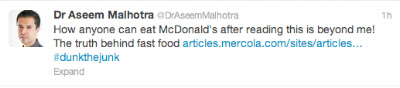
Today, he directed his Twitter followers towards the website of one Dr Joseph Mercola, which promises us "the truth about fast food".


The "article" in question begins thusly...

Ever wonder what goes on behind the scenes at fast food restaurants? Fast-food insiders (i.e. former employees) reveal a slew of nasty secrets that may make you think twice about ever eating in one of these restaurants again …

I like the idea that anyone who has ever worked at a burger joint is a "fast-food insider". This sets the bar rather low for the reliability of the information to come (it's not as if burger chains ever have any disgruntled, stupid or deceitful staff, obviously).

And the bar needs to be set low, for what follows is a load of tommy rot.

Most Fast Food is a Mixture of Chemicals, Sugar, Flavoring and Salt

More precisely and succinctly, one could simply say "Food is a Mixture of Chemicals". As is the whole Universe, of course, but then this webpage is full of chemophobia, organic-worshipping, aversion to genetic modification and other tell-tale quackery. "Additives" and "preservatives" are assumed to be evil without any explanation of what they are or why they should be malign. Equivocation and speculation abounds. Chicken nuggets contain "corn-derived fillers and additives (most likely genetically modified chemicals)". Hamburger buns "allegedly contain" artificial flavours.

It is, in short, two-a-penny tree-hugging anti-science from a rinky-dink website written by an alternative medicine chancer who happens to sell various "natural remedies" and "dietary supplements". It would not be considered a reliable source by a stoned teenager, let alone Wikipedia.

Business Week says that Dr Mercola's huckstering comes from "an unfortunate tradition made famous by the old-time snake oil salesmen of the 1800s". He has been thrice warned by the FDA for making false claims and violating federal law. He thinks microwaves are dangerous because they supposedly alter the chemistry of food. He doesn't think HIV causes AIDS. Instead he thinks that "the severe, acute psychological stress of being diagnosed "HIV Positive" is quickly transformed into a severe, chronic psychological stress of living with a prediction of a horrifying decline that could start at any time. This causes a dangerous suppression of the immune system."

We've gone beyond 'free thinker' and 'maverick' here, I think, and entered 'fruitcake' and 'dangerous crank' territory.

I don't suggest that Aseem Malhotra necessarily shares any of Mercola's other wacky beliefs, but I do find it troubling that a man who is presented by Newsnight as an expert—a man of science, no less—could go to the website of a notorious quack and not smell the bullshit, let alone laud it as "the truth". It's no surprise that the Guardian's go-to man comes out with the whoppers he does if he gets his facts from this sort of lazy, indiscriminate googling, but if I were in public health I would be muzzling this guy because he's an ill-informed accident waiting to happen.

Monday, 6 August 2012

In case it's not mentioned in Dispatches...

This evening Channel 4 will be broadcasting a programme about the bookmaking industry. I would like to think that this will be a fair and balanced look at British gambling habits, but the trailer suggests that it will be an anti-gambling polemic designed to make the viewer believe that the country is being flooded with betting shops.

Just in case Dispatches doesn't bother to mention them, here are the facts. The number of betting shops peaked in 1973 at over 15,000. In 2003, the Department for Media, Culture and Sport published a document showing what happened between 1987 and 2003. What happened was numbers continued to fall gradually...


In 2003, there were 8,804 bookies in operation. I can't find the figures for 2004-2008, but in 2009 there were 8,862. Today, in 2012, there are 9,128. The number of bookmakers has therefore risen by less than 4 per cent in the last ten years (broadly in line with population growth) and remains lower than at any time between the 1960 legalisation and 1996.

If there is a perception that betting shop numbers have rocketed in recent years, it is because the recession has caused the rent on commercial property to fall and so betting shops have been able to move from the side street to the high street.

I understand that Dispatches will focus on fixed odds betting terminals—the new bogeyman of the anti-gambling movement. There are valid questions to ask about where these devices should sit in the regulatory ladder, but do not be fooled into thinking the country is awash with betting shops.


Thursday, 2 August 2012

Another sock puppet?

The Children's Rights Alliance for England is a lobby group which campaigns against things like parental smacking and lobbies for things like lowering the voting age to 16. Their agenda isn't of great interest to me, but this claim—on the 'Our Key Supporters' page of their website—is...

CRAE receives no Government funds.

Fairly ambiguous, that. So why does a quick check on the Charity Commission website suggest otherwise?


Their single biggest donor in 2010/11 was the European Commission. Their third biggest donor—with £61,919—is the Equality and Human Rights Commission. Unless I've missed a meeting, these both fall under the umbrella of 'government'. 

So, is it right for a pressure group that gets more than a third of its grant income from statutory sources to say that it "receives no Government funds"?

I've written to CRAE to ask them about this discrepancy but—whadya know?—no reply.


Wednesday, 1 August 2012

Reponse to HoC committee on alcohol

On behalf of the Institute of Economic Affairs, I responded to the House of Commons Health Select Committee regarding the government's alcohol strategy. This is the consultation which asked about minimum pricing and plain packaging, amongst other things. A sample...

As regards raising the drinking age, lowering the strength of alcoholic drinks, banning advertising and mandating plain packaging, these are all policies entirely at odds with the principles of a free society. Drinking alcohol is an adult pastime and those who are 18 and over should not be prohibited from engaging in it and have a right to know which products are available. Plain packaging, like minimum pricing, would be a serious infringement of commercial freedom which would likely violate a number of free trade agreements to which the UK is a signatory. We find it troubling and scarcely believable that the government is contemplating creating a country in which bureaucrats not only set the price of products but also design their packaging.

If you're interested, you can read it in full here. The list of all respondents is here.