Monday, 31 January 2022

A desperate attempt to deny the benefits of moderate drinking

There is mounting desperation in 'public health' to debunk the benefits of moderate drinking - or, at least, to make the public think the benefits have been debunked. Various academics are offering their services. It's as if there is a reward on offer to whoever can make the best case against the J-Curve. In a sense there is, because whoever manages it will be set for life in the neo-prohibitionist 'public health' industry.

In recent years, we have seen the J-Curve challenged by ridiculous modelling, lying by omission and the inappropriate use of Mendelian Randomisation. None of this casts serious doubt on the existence of health benefits of moderate alcohol consumption, although the drip-drip effect no doubt leaves the public confused about what the science shows (which is presumably the intention). 

Two weeks ago, the gloriously named Beatriz Champagne from the World Heart Federation falsely claimed that any amount of alcohol harms the heart. She said that any claims to the contrary are "at best misinformed and at worst an attempt by the alcohol industry to mislead the public about the danger of their product." I didn't write about this at the time because it was just an assertion with no evidence to back it up.

But then on Friday, a new study was published which claimed to disprove the J-Curve. The study was grossly misrepresented by its own author and was (unsurprisingly) misunderstood by the media.

The study should have set off warning bells to any decent health journalist. For a start, it was accompanied by some hyperbolic, media-baiting quotes from the lead author, who is a physiologist at Anglia Ruskin University...
 

“The so-called J-shaped curve of the cardiovascular disease-alcohol consumption relationship suggesting health benefit from low to moderate alcohol consumption is the biggest myth since we were told smoking was good for us."

 
The title of the study reads more like a headline than a piece of academic research...
 

Alcohol - The myth of cardiovascular protection

 
And the study ends with a dog whistle call-to-action for the government that is not justified by the findings...
 

Our results do not support the current alcohol consumption guidelines for the United Kingdom of up to 14 units per week in relation to CV risk in the general population.

 
As informed readers know, there is 50 years of evidence showing that moderate drinkers live longer than teetotallers, an effect that is mostly due to their lower heart disease risk. The authors of the new study used UK Biobank data to monitor the health outcomes of drinkers and people who have never drunk, but things start badly for them when they find that teetotallers have higher rates of heart disease and have more heart attacks than drinkers. 
 

Never drinkers were older (P < 0.0001), had a higher body mass index (P < 0.0001), higher systolic and diastolic blood pressure (both P < 0.0001), were less physically active (P < 0.0001), had a higher prevalence of diabetes (P < 0.0001) and higher incidence of overall CV events (P < 0.0001), ischaemic heart disease (P < 0.0001) and cerebrovascular disease events (P < 0.0001). The incidence of overall CV events, ischaemic heart disease and cerebrovascular disease were comparable between never drinkers and drinkers consuming more than 14 units per week.

 
This suggests, a priori, that teetotalism is not particularly healthy, although it could be the result of confounding variables. However, when the results are adjusted for confounders, the picture remains the same. (Note that former drinkers are already excluded to rule out a “sick quitter” effect).

Compared to current drinkers in adjusted models, never drinkers were at higher risk for overall CV events (hazard ratio, 1.31; 95% confidence interval, 1.20-1.42; P < 0.0001), ischaemic heart disease (hazard ratio, 1.51; 95% confidence interval, 1.29-1.76; P < 0.0001) and cerebrovascular disease (hazard ratio, 1.46; 95% confidence interval, 1.14-1.87; P < 0.0001). Consequently, using never drinkers as reference resulted in alcohol from all drink types combined exhibiting protection in relation to all outcome measures...
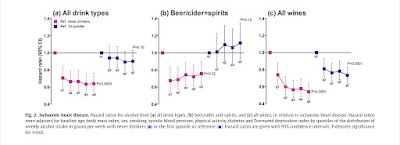
This is rather awkward for the authors. To deal with this inconvenient finding, they have a simple solution. They exclude ALL the non-drinkers from their analysis and compare light, moderate and heavy drinkers instead! They split the drinkers into five quintiles based on their alcohol consumption and show the results in the figures below. The pink data points are what you get when you compare them to non-drinkers. The blue data points show how the drinkers compare to each other. (Click to enlarge.)

As you can see, the drinkers have a lower risk of ischaemic heart disease at every level of consumption. For wine, the risk drops as people drink more, but for beer, cider and spirits (which are grouped together for some reason) the benefits decline somewhat as people drink more (although none of the changes are statistically significant). 
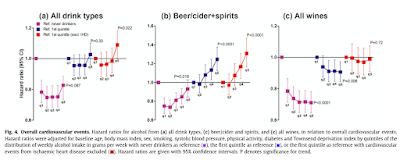
It's a similar story when you look at the relationship with all types of cardiovascular disease, although the authors exclude ischaemic heart disease from one of these plots (red) for reasons that are never properly explained. Here we see a reduction in risk for all wine drinkers and for moderate drinkers of other alcoholic drinks.


In short, the authors are making some pretty extreme claims about moderate drinking without looking at the only reference group that matters (non-drinkers - or never-drinkers). They effectively use light drinkers as the control. And even then, they barely achieve their desired result. 

We’ve seen this trick performed before in a study from 2018 which made similar claims by comparing light drinkers to moderate and heavy drinkers - and generated similar headlines. The graph used in the main body of that study appeared to show no evidence of a J-Curve...
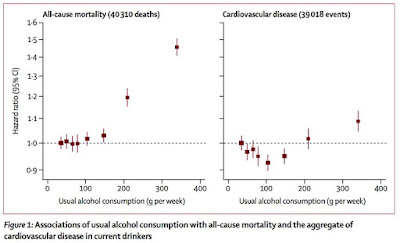
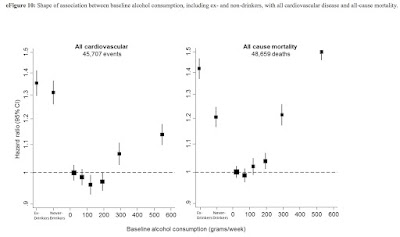


This was sleight of hand designed to catch readers out at a glance. The authors simply ignored the non-drinkers and used light drinkers as their reference point. But if you digged deep into the appendix, there were graphs that showed that the J-Curve was alive and well. Never-drinkers had a 30 per cent increased risk of heart disease and a 20 per cent increased risk of premature death.

Everything about Friday's study seemed designed to mislead. The press release for it said... 
 
 
New study: 14 units a week still harmful to health


Compared to what? Not compared to zero units, that's for sure. It's difficult to find any interpretation of that headline that isn't trivial or wrong.

I see no academic merit in the methodology used in this study. It certainly can't be used to say anything about the relative risks of drinking versus not drinking because it deliberately excludes the non-drinkers. 

It should never have been published.


Friday, 28 January 2022

Unlearning the magic money tree

My City AM column today is about people who believe in the magic money tree developing some desperate excuses for the rise in inflation.
 

When the inflationary chickens came home to roost last autumn, Robert Reich, a professor of public policy in California, insisted that it was not ultra-loose monetary policy that was to blame. Instead, it was the fault of greedy corporations which have “so much market power they can raise prices with impunity”.

Reich was not alone in this belief. When the US faced high petrol prices in November, the obvious explanation was that the price of oil had doubled in the space of a year. Not so, claimed Senator Elizabeth Warren, instead blaming “price gouging” by Chevron and ExxonMobil.

Cartels can exist but there is no reason to think they have suddenly taken over large parts of the American economy. If these markets are so uncompetitive and the companies so powerful, why did they not raise their prices earlier? Why are they not raising prices even more? The answer is that there is ample competition but companies cannot avoid passing on the higher cost of raw materials to their customers indefinitely.


(In addition to the copes mentioned above, the White House blamed the rising price of meat on 'dominant corporations in uncompetitive markets taking advantage of their market power to raise prices'.) 


Monday, 24 January 2022

The COVID-19 alcohol "paradox"

From the Belfast Telegraph (and various other local newspapers)...
 
Concerns over biggest drinking households buying even more during lockdown
 
Health campaigners have called for a minimum price per unit to be introduced in England...
 
Of course they have.
 
...after a study found the biggest drinkers bought more alcohol during lockdowns even though pubs were closed.

Perhaps these health campaigners should call for pubs to be open 24 hours a day?
 

An academic study of 80,000 households’ shopping habits could explain why 2020 saw the biggest increase in alcohol-related deaths in the UK in the last 20 years.

Health experts found Britain’s heaviest drinkers – those in the top 20% of alcohol-buying households – purchased 17 times more drink from shops and supermarkets than those in the bottom 20% during the first lockdown.

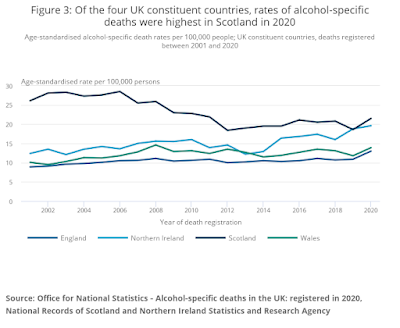
Official data shows that in 2020 there were 8,974 registered deaths from alcohol-specific causes in the UK in 2020 – up 18.6% increase on 2019 and the highest year-on-year rise in two decades.

 
The study in question is by Peter Anderson, a veteran of neo-temperance academia, and is titled 'The COVID-19 Alcohol Paradox'. 
 
British supermarket-panel data suggest no increases in overall sales and purchases of alcohol following COVID-19 lockdowns, yet survey and mortality data suggest otherwise. This paper attempts to unravel the paradox.
 
But mortality data does not and could not suggest otherwise. Alcohol-related mortality rose sharply in 2020, but that does not imply that overall sales of alcohol rose. There is only a paradox here if you believe the discredited whole population theory of alcohol which assumes that there is a fixed link between per capita alcohol consumption and alcohol-related mortality.

The pandemic has once again shown that this theory, which has never been supported by evidence, is wrong. As I said a year ago...

Alcohol sales fell during lockdown and per capita consumption in 2020 seems to have been similar to previous years (we don't have comprehensive figures yet). Orthodox 'public health' theory suggests that we shouldn't see a rise in alcohol-related harm without a rise in per capita consumption. Moreover, the amount of alcohol advertising fell dramatically during lockdown and availability was greatly limited by bar closures. Since these are (supposedly) two of the main drivers of consumption, we should have seen a substantial decline in per capita consumption and a commensurate decline in alcohol-related harm.

We saw none of that. Instead we saw a spike in alcohol consumption among some (presumably heavy) drinkers which seems to have led to an almost immediate increase in harm. All of this leads to the common sense conclusion, which is alien to the neo-temperance lobby, that harmful drinking is driven by personal circumstance rather than 'commercial determinants'. Efforts to tackle harmful drinking should therefore focus on harmful drinkers rather than the whole population.
 
Rather than accept that the theory is mistaken, 'public health' academics portray evidence that disproves it as a paradox (see also: the alcohol harm paradox and the French paradox). 

The obvious explanation for this 'paradox' is that some heavy drinkers started drinking even more during lockdown while some moderate drinkers drank less. Anybody could work that out in a few seconds without needing academic qualifications or research funding.

Sure enough, that is what the study found. 
 
Increases in purchases were predominantly driven by households that were usually the highest purchasers of alcohol. The top one fifth of purchasing households (by how much they normally purchased) increased their purchases 17 times more than the bottom one fifth of purchasing households.
 
 Fancy that.
 
That the heaviest buyers of alcohol increased their purchases the most, with some independent impact of socio-economic disadvantage, might explain why reported alcohol problems and recent alcohol-related death rates might have increased.
 
D'ya think?!

Obvious though it is, the result of this extreme natural experiment - in which people were confined to their homes and the closure of hospitality restricted the availability of alcohol - should provide food for thought for 'public health' academics. The rise in alcohol-related mortality was clearly not the result of what they lazily assume to be the drivers of heavy drinking: advertising, affordability and availability. Furthermore, it was not related to per capita consumption. 

The authors do not address the question, but the most likely explanation is that a dramatic change in people's circumstances led to a change in behaviour. Boredom, social isolation and anxiety are enough to explain why a minority of drinkers consumed much more alcohol during lockdown, with predictable consequences for their health. 
 
Orthodox 'public health' ideology does not have a solution to these problems and so they ignore them in favour of easier political targets. Laughably, the authors even try to crowbar minimum pricing into their conclusion.
 
That the increase in purchases was much less pronounced in Scotland and Wales, compared with England, could be attributed to the minimum unit price of alcohol introduced in both jurisdictions, such a policy shown to reduce alcohol purchases, particularly amongst the heaviest purchasing households during times of lockdown.

Regardless of whether minimum pricing reduces purchases, it didn't prevent Scotland and Wales seeing a sharp rise in alcohol-related mortality in 2020 that was very similar to the rise seen in England. The authors don't mention this. I can't think why.
 

I guess that's another 'paradox' for someone to investigate...


Saturday, 22 January 2022

A swift half with Tom Harwood

There's a new episode of The Swift Half out, this time with Tom Harwood, formerly of Guido Fawkes, currently at GB News. We discussed Boris Johnson's prospects, Covid and more.


Wednesday, 19 January 2022

Inside the UK's illicit tobacco business

Article in Vice about Britain's illegal tobacco problem.
 

Phil Mykytiuk has spent a decade mapping tobacco crime gangs in the north of England. He is new in post as a trading standards manager at Bolton Council in Greater Manchester but worked for 10 years on a tobacco enforcement team at nearby Rochdale Council.

.. The National Crime Agency said that while it supports partner agencies on tobacco enforcement, its focus is on prohibited commodities like drugs and firearms, with HMRC taking the lead on tobacco. 

Mykytiuk, though, believes the multiple layers of crime behind cheap, illegal tobacco are escaping scrutiny, allowing crime gangs – emboldened by the lack of deterrent – to expand their power base right under the noses of enforcement. Having witnessed Kurdish tobacco gang members invest heavily in property and high street businesses here in the UK, he’s now seeing evidence of them moving into cannabis farms.

“But forget drugs,” he says. “Drugs is yesterday. The big thing is tobacco. These gangs are becoming the most capable criminals in this country. Right now it's the biggest threat we’ve ever faced.”


As the article notes, official statistics indicate that the illicit market is large (17%) but has not grown in recent years. Maybe, maybe not. Official statistics are based on a vague estimate that is highly sensitive to the assumptions fed into the model. The government could sample litter to see how many packs were not sold legally in the UK. I suspect this would give a larger and more realistic estimate, but HMRC shows no interest in knowing what's really going on.
 
Tobacco taxes are crazily high these days and it's hard to imagine high rates of 'tax morale' among smokers. If anything, they might feel a moral duty to starve a government that discriminates against them of money.  


Tuesday, 18 January 2022

Uncomfortable truths about the costs of healthy living

There's a good article in the New Statesman raising some uncomfortable truths about healthcare spending and lifestyle regulation. It mentions some research I commissioned at the IEA a few years ago.

In Britain we talk often of the “cost” to the NHS of people who smoke or are obese – the health support service One Small Step, for example, points out that smoking costs the UK government £12.6bn a year, £2.5bn of which is spent on NHS smoking services. On the same page, however, it notes that “half of all life-long smokers die early, losing on average 10 years of their life”. Given how dramatically health, social care and pension expenditure increases as someone ages past retirement, those 10 lost years actually represent a saving for the taxpayer.

That is an immensely grisly – not to mention heartless – way to look at things. But if your argument is that those who cost more should pay more, it is vital to crunch the numbers. Despite the perception that certain lifestyle choices would save money as well as lives, a Dutch study from 2008 found that smokers and the obese were cheaper to care for over their lifetimes, while research from the Institute of Economic Affairs concludes that: “By dying early, overweight and obese people saved the government £3.228bn in pension, healthcare and benefit payments in England and Wales in 2014.”

The more you think about it, the darker it gets. It is a triumph of medical science that people are living longer and surviving conditions that would once have killed us: someone who three decades ago would have died of cancer at 70 can now have a life-saving operation and live another 15 years. That’s wonderful – but those 15 years of other age-related ailments and potential dementia have a price-tag attached, for the government purse as a whole and in terms of healthcare specifically. Figures from the Nuffield Trust in 2016 published in the Guardian show how health spending in the UK is skewed towards the over-65s: more than £7,000 a year was spent per person on those above the age of 85 compared to a national average of £2,069, with an 85-year-old man costing the NHS seven times more than a man in his thirties. Miraculous but expensive new drugs compound the challenge. The unpalatable truth is that, above a certain age, the most costly thing someone can do in terms of burden to the NHS is to keep living.

 
There is no 'obesity timebomb'. 'Unhealthy' lifestyles do not pose a threat to the NHS or any other health system. What we have in the UK and around the world is a pensions timebomb and an ageing population putting unprecedented pressure on health and social care. Nobody in politics or the media knows how to address this and so disfavoured minorities are used as scapegoats to take our minds off it. 
 
Worthless, economically illiterate estimates of the cost of certain lifestyles are regularly produced (such as this garbage from ASH last week), but for all the talk about 'negative externalities', the reality is that the main economic consequence of people living healthier lives is that everyone has to work for longer before they can retire. Way to go, healthists!


Monday, 17 January 2022

Dishonest arguments against vaping

It's 2022 and certain people are still arguing about e-cigarettes as if it's 2012. Even in 2012, we knew more about them than the European Respiratory Society (ERS) does today. In a head-to-head debate in the British Medical Journal, three members of the ERS take on Nicky Hopkinson, the chairman of Action on Smoking and Health, to discuss whether e-cigarettes should be available on prescription. 

It's a controversial question and there are reasonable arguments on both sides, but the medics from the ERS don't bother with reasonable arguments. Instead, they bluster and lie and act as if no research has been carried out since their organisation took an ideological position against vaping back in the day. Here's how they start off...

There is already enough nicotine addiction. 

 
That is a moral judgement and has nothing to do with health.
 

For decades, smoking rates in the UK have been declining, and few teenagers see themselves becoming smokers. This has been achieved without e-cigarettes, and the decline in smoking has not accelerated after the introduction of e-cigarettes.

 
This is a bare-faced lie. The smoking rate had barely moved in five years before e-cigarettes became popular in 2012. It then fell sharply. 
 
E-cigarettes as an aid to smoking cessation have not been endorsed by a single major respiratory or paediatric scientific society because their effectiveness in smoking cessation is unproved—and remarkably poorly studied.
 
The appeal to authority here is suspiciously narrow. There are not many respiratory societies and I wouldn't expect a 'paediatric scientific society' to have any particular expertise in this area. The authors neglect to mention the endorsement of e-cigarettes for smoking cessation by Public Health England, the Royal College of Physicians, Cancer Research UK, the French National Academy of Medicine and fifteen past presidents of the Society for Research on Nicotine and Tobacco, to name a few. 
 
As for being 'remarkably poorly studied', the authors are either dishonest or woefully uninformed. There have been many observational studies, a number of randomised controlled trials and several Cochrane reviews, all of which show that e-cigarettes work better than anything else, even for smokers who have no intention of quitting. This is tacitly acknowledged by the gormless authors in what follows...
 

In the most cited trial comparing e-cigarettes with medicinal nicotine products, e-cigarettes were found to be superior, showing a one year abstinence rate of 18%, compared with 10%. However, twice as many people in the “old fashioned” nicotine replacement groups were found to have quit nicotine completely, as people using e-cigarettes tend to continue vaping, whereas most people using medicinal nicotine products quit.

 
That's exactly what I did and it's just the way I like it, thanks. The important statistic is that nearly twice as many people quit smoking with e-cigarettes than without. Whether people continue vaping after quitting - or continue using nicotine gum, for that matter - is of trivial 'public health' interest.

There is also the phenomenon of “dual use”: smokers quit by using e-cigarettes and then restart smoking while they continue vaping. In the most cited trial, 40% of people assigned to e-cigarettes were still using them after a year, and more than half of these vapers were also smokers. 

 
This is the same randomised controlled trial mentioned in the previous paragraph and the authors are saying much the same thing in a different way. The fact remains that the smokers who were given e-cigarettes were 83% more likely to quit smoking. That is what should matter to a respiratory society.
 

(The University of Bath’s Tobacco Tactics group has noted that the tobacco industry loves dual use.)

 
Haha! Who cares what a Bloomberg-funded activist group thinks??
 

E-cigarettes are not “95% less harmful than cigarettes.” 

 
Indeed. It's probably closer to 99.9%.
 

This often quoted statement is indefensible because vaping has been associated with many cases of acute lung damage, events not seen in smokers.

 
You're not seriously going to blame the US's 2019 EVALI outbreak on e-cigarettes, are you? It has been proven beyond reasonable doubt that the lung damage was caused by the adulteration of black market THC cartridges. It had nothing to do with nicotine vaping.

Around 80% of these cases are related to cutting the liquids with cannabinoids—but 20% are not.

 
No. In around 80% of cases, the person admitted to consuming black market THC. The other 20% denied it because purchasing black market THC is illegal. 
 
Either that or normal e-cigarettes briefly produced exactly the same symptoms as EVALI among a handful of people in a few parts of the USA for a short period before the contaminated THC products disappeared from the market. Which seems more likely?
 

If the acute effects of vaping are worse than those of tobacco, how can anyone seriously state that the unknown long term effects are less harmful and expect to be believed?

 
What an insanely stupid thing to say. 

The whole article is equally idiotic. Read it here if you must. These chancers couldn't lie straight in bed.