The Conservative Party conference begins today and the IEA will be hosting two days of solid debate in the Think Tent, kicking off at 8am with a panel discussion on medical cannabis which I will be chairing.
I'll be speaking straight after, at 9am, about the nanny state with Ben Bradley, Vicky Ford and Tim Stanley (chaired by Darren Grimes).
I'll also be in the Think Tent on Tuesday at 10.15am talking about recreational cannabis, and I'll be with the Conservative Environmental Network on Monday at 5.30pm talking about environmental policy. That's in Room 3/4 of the secure zone.
See the full schedule of events here. The Adam Smith Institute (ASI) also has some interesting looking events - see their line up here.
All of that is in the secure zone, I'm afraid, so if you haven't got a pass you won't be able to attend. The ASI and Freedom Association have often held events outside the secure zone in the past, but not this time, alas. However, if you're in Manchester and want to go to something political, or if you're at the conference and want to get out of the secure zone, Starkey on Brexit has taken my eye and Comedy Unleashed will be on Monday night. There is a full list of fringe events here.

Sunday, 29 September 2019

77% of people suffering from THC-related lung injuries admit to using THC
I've followed up my Spectator article about the US vape scare from a weeks ago with an article in the Telegraph. Since writing it, the Centers for Disease Control have said that 77 per cent of the cases admitted to having used THC vapes. If a bunch of
people at a festival got ill with a particular disease and 77 per cent
of them admitted to taking the same drug, we would have no trouble
working out the other 23 per cent had also taken it.
As I say in the article...
The article is paywalled but read it here if you have access.
As I say in the article...
Case closed. Or so you might think. The CDC accepts that most of the individuals involved admitted to vaping THC before becoming ill, but refuses to exonerate conventional, legal, nicotine vaping on the basis that some of them did not.
This leaves two possible explanations. The first is that there is something terribly dangerous about conventional e-cigarettes that cannot be explained by science. Despite being used safely around the world for over a decade by tens of millions of people, it turns out that they can severely incapacitate and even kill otherwise healthy people almost overnight. These dangers have only emerged in certain parts of the USA in recent weeks and just happened to coincide with a spate of hospitalisations involving exactly the same symptoms that were caused by people vaping illegal THC cartridges.
The second possibility is that the handful of people who have been hospitalised with ‘vaping-related’ lung injuries but who deny vaping illegal THC are not telling the truth, presumably because they do not wish to confess to a crime. Almost unbelievably, a large section of public and political opinion in the USA leans towards the first of these scenarios. A genuine public health problem caused by the black market is being portrayed as a problem of the legal market.
The solution? Turn the majority of the e-cigarette industry over to the black market. It takes wilful ignorance to draw such a conclusion.
The article is paywalled but read it here if you have access.
Thursday, 26 September 2019
An alternative history of minimum pricing
In April, I wrote of minimum pricing...
Sheffield and Stirling have yet to report back, but today saw the first attempt to rewrite history. Peter Anderson and friends have published a study in the BMJ claiming that alcohol sales fell by 7.6 per cent in the off trade in the first eight months of minimum pricing.
This is a lie, but if you torture the data enough you can make it confess to anything. Instead of looking at the alcohol sales figures in Scotland, they took a sample of 5,000 Scottish households and made numerous adjustments to the figures based on an unspecified counterfactual.
The number of units of alcohol sold in the off trade in the first nine months of minimum pricing actually rose, as the IRI figures below show. We also know that the number of alcohol-related deaths rose in 2018. These are the hard facts and they are in the process of being deleted. As was inevitable, an alternate history is being constructed in which minimum pricing had a dramatic effect on both alcohol sales and alcohol-related deaths. The media fell for it last week, they fell for it today and they will fall for it again in the near future.
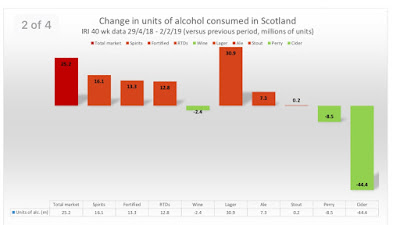
The studies might as well have been written before the policy was implemented. Unable to show an actual decline in consumption, the evaluators at Sheffield and Stirling Universities (for it is they) will have to resort to using a back-of-the-envelope counterfactual which will doubtless conclude that consumption is lower than it would have been in the absence of minimum pricing.
This will then be presented to the media as a decline and the policy will be declared as a success, albeit with the caveat that the unit price should be raised to 60p.
Sheffield and Stirling have yet to report back, but today saw the first attempt to rewrite history. Peter Anderson and friends have published a study in the BMJ claiming that alcohol sales fell by 7.6 per cent in the off trade in the first eight months of minimum pricing.
This is a lie, but if you torture the data enough you can make it confess to anything. Instead of looking at the alcohol sales figures in Scotland, they took a sample of 5,000 Scottish households and made numerous adjustments to the figures based on an unspecified counterfactual.
The number of units of alcohol sold in the off trade in the first nine months of minimum pricing actually rose, as the IRI figures below show. We also know that the number of alcohol-related deaths rose in 2018. These are the hard facts and they are in the process of being deleted. As was inevitable, an alternate history is being constructed in which minimum pricing had a dramatic effect on both alcohol sales and alcohol-related deaths. The media fell for it last week, they fell for it today and they will fall for it again in the near future.

Tuesday, 24 September 2019
'Public health' launches a preemptive strike on Ofcom
UPDATE: Ofcom’s former Principal Economist has been in touch with his own rebuttal to the study discussed below. Read his response here.
On the face of it, this is a pretty odd thing to see published in BMJ Open. Three 'public health' academics looked at every response to a 2006 public consultation on food advertising restrictions, which ultimately led to the UK government banning adverts for 'junk food' (high in fat, sugar or salt or HFSS) during children's television.
The consultation was run by Ofcom, the broadcast regulator. The authors divide the respondents into 'pro-industry and pro-public health groups' (because that is how the world looks from their perspective) and conclude:
Isn't that the point of a consultation?
The authors focus on five key questions in the consultation and look at the responses from the two groups.
Should restrictions apply to all foods?
Both groups agreed that the restrictions should not apply to all food.
Total ban or volume based ban?
A volume based ban was 'nearly universally disliked'.
Restrictions on children’s programming or a pre-9pm watershed ban?
The authors note that: 'Although not included in any of Ofcom’s proposals, one of the consultation questions asked about whether restricting advertising before 9pm would be a suitable measure.' Unsurprisingly, the 'public health' groups leapt at the chance to extend the ban while the 'pro-industry' groups opposed it.
To what ages of children should the restrictions apply?
Ofcom's original proposal was to restrict advertisements targeted at children aged 4–9 years. 'Pro-industry groups' supported this. 'Public health' groups called for the ban to apply to children aged 4-15 years.
When should the restrictions start, ie. how long should the transition period be?
'Public health' groups, being the business experts that they are, said no transition period was necessary. 'Pro-industry groups' said that they needed a transition period.
In line with what both groups supported, the final legislation did not apply to all food and was not volume based. In line with what the 'public health' groups wanted, the age range was extended to 4-15 years. In line with what the 'pro-industry' groups wanted, there was a transition period and the ban was not extended to the 9pm watershed - although the latter was, to repeat, never part of the original proposal.
What does this tell us? According to the authors, it tells us that...
This is true and therefore intolerable from their perspective. They go on...
Really?! Ofcom stuck to its original proposal and capitulated to the 'public health' lobby on the age range. It seems that anything less than total capitulation to the most extreme nanny state voices plus gold-plating would have 'compromised' the legislation in these people's eyes.
They further complain that...
And that, apparently, is a bad thing.
What is the purpose of this bizarre study raking over a 13 year old consultation? There seems to be no reason for it to exist.
Until you remember that the government has recently consulted on extending the ban on food advertising, and the 'public health' lobby is trying to sideline and intimidate Ofcom. Hence the way this study was press released and reported...
Nothing happens in the world of 'public health' research without a reason. Everything is political.
On the face of it, this is a pretty odd thing to see published in BMJ Open. Three 'public health' academics looked at every response to a 2006 public consultation on food advertising restrictions, which ultimately led to the UK government banning adverts for 'junk food' (high in fat, sugar or salt or HFSS) during children's television.
The consultation was run by Ofcom, the broadcast regulator. The authors divide the respondents into 'pro-industry and pro-public health groups' (because that is how the world looks from their perspective) and conclude:
Our paper highlights how, despite the relative transparency of the 2006–2007 consultation, the final policy appeared to be substantially influenced by stakeholders.
Isn't that the point of a consultation?
The authors focus on five key questions in the consultation and look at the responses from the two groups.
Should restrictions apply to all foods?
Both groups agreed that the restrictions should not apply to all food.
Total ban or volume based ban?
A volume based ban was 'nearly universally disliked'.
Restrictions on children’s programming or a pre-9pm watershed ban?
The authors note that: 'Although not included in any of Ofcom’s proposals, one of the consultation questions asked about whether restricting advertising before 9pm would be a suitable measure.' Unsurprisingly, the 'public health' groups leapt at the chance to extend the ban while the 'pro-industry' groups opposed it.
To what ages of children should the restrictions apply?
Ofcom's original proposal was to restrict advertisements targeted at children aged 4–9 years. 'Pro-industry groups' supported this. 'Public health' groups called for the ban to apply to children aged 4-15 years.
When should the restrictions start, ie. how long should the transition period be?
'Public health' groups, being the business experts that they are, said no transition period was necessary. 'Pro-industry groups' said that they needed a transition period.
In line with what both groups supported, the final legislation did not apply to all food and was not volume based. In line with what the 'public health' groups wanted, the age range was extended to 4-15 years. In line with what the 'pro-industry' groups wanted, there was a transition period and the ban was not extended to the 9pm watershed - although the latter was, to repeat, never part of the original proposal.
What does this tell us? According to the authors, it tells us that...
Ofcom’s decision to implement modified package 1 contained concessions to commercial as well as civil society and public health stakeholders.
This is true and therefore intolerable from their perspective. They go on...
However, ultimately, industry arguments appeared to hold more sway, with the main concession to public health groups being expanding restrictions from children aged 4–9 years to those aged 4 –15 years. Ofcom appeared to believe that the commercial impact of the regulation of advertising should carry greatest weight, even when the aim of the regulation was to protect children’s health. As such, Ofcom did not formally consider a pre-9pm ban as part of any of its packages, as had been proposed by public health and civil society stakeholders, although one of the consultation questions did refer to a pre-9pm ban.
Really?! Ofcom stuck to its original proposal and capitulated to the 'public health' lobby on the age range. It seems that anything less than total capitulation to the most extreme nanny state voices plus gold-plating would have 'compromised' the legislation in these people's eyes.
They further complain that...
Ofcom appeared to balance arguments related to commercial and public interests, in terms of jobs and the wider economy, with those relating to public health.
And that, apparently, is a bad thing.
What is the purpose of this bizarre study raking over a 13 year old consultation? There seems to be no reason for it to exist.
Until you remember that the government has recently consulted on extending the ban on food advertising, and the 'public health' lobby is trying to sideline and intimidate Ofcom. Hence the way this study was press released and reported...
Doctors slam broadcasting regulator Ofcom for 'being influenced' by the junk food industry after it turned down a 9pm watershed for adverts in 2009
Doctors say media watchdog Ofcom should no longer be allowed to set rules on junk food adverts.They claim the watchdog is influenced by broadcasters and the food industry, and this may have prevented a 9pm 'watershed' for junk food ads being brought in to protect children.Doctors working in public health looked at the last major regulations on advertising unhealthy food to children, introduced in 2009.They say Ofcom appeared to prioritise commercial considerations over children's health, begging the question of whether its 'duty to protect broadcasting interests' should allow it to lead public health regulation.
Nothing happens in the world of 'public health' research without a reason. Everything is political.
Monday, 23 September 2019
The sugar reduction flop
Public Health England published its second progress report on the sugar reduction scheme on Friday. The agency's press release focused on the amount of sugar taken out of soft drinks, which was understandable given that the 'progress' with food was almost nonexistent.
The plan was for there to be a five per cent reduction across the targeted foods (ie. most food) by 2017 and a 20 per cent reduction by 2020. I have always maintained that the 20 per cent target cannot be met. At the moment, even a five per cent reduction looks ambitious.
As of September 2018, the overall reduction of sugar in shop-bought food amounted to just 2.9 per cent. (The figure for the out of home sector seems bigger but is not weighted by sales so is not comparable.)
 This feeble result has come largely from reformulation of breakfast cereals and yoghurts which have fibre and fat as straightforward substitutes, respectively. For products which are inherently sugary - including biscuits, confectionery, ice cream, lollies and puddings - there has been essentially no change.
The likes of Action on Sugar have seized on these figures to bolster their case for the sugar tax to be extended to food. Their argument, such as it is, is that the sugar levy led to a 29 per cent reduction in sugar in soft drinks and a similar tax on food would lead to similar reductions.
This is faulty logic. Replacing sugar with artificial sweeteners in drinks is a simple process (and also a profitable one, since sugar is relatively expensive). There are no technical limitations. Unlike food, drinks don't require sugar for texture, body or weight. The only barrier is consumer acceptance.
The situation is very different in the case of food, especially for inherently sweet products like, er, sweets. If you look at the table above, you will see that the amount of reformulation is more or less directly proportional to technical feasibility. And although there has been some reformulation in most categories, the industry can't force people to eat the reformulated products, hence the sales weighted averages are virtually unchanged in most cases.
This leads us to the most interesting fact in the report...
A rise in sugar consumption at a time when there has been a concerted anti-sugar campaign and a state-led sugar reduction scheme is a pretty epic fail. These figures do not include sugar in soft drinks or in food from the out of home sector, so we cannot say for sure that overall sugar consumption has risen, but it is an awkward fact that a 2.9 per cent reduction in sugar in a wide range of shop-bought food has coincided with a rise in consumption in sugar from those same foods.
It is a reminder that we still live in a more or less free society in which people can buy whatever food they like in whatever quantities they like. It exposes one of the big flaws in Public Health England's cunning plan. The idea is to reduce the sugar content of food while all else remains constant. It assumes no change in consumer behaviour. But there was no reason to assume that all else would remain constant. The public is not as passive as PHE presume.
They would benefit from reading some Adam Smith:
There are two other points worth making. Firstly, the PHE report provides little information about calories. There is not much point reformulating a product with less sugar if it doesn't reduce the calorie count. Coco Pops slashed the amount of sugar by 30 per cent but only reduced energy intake by one calorie per serving. Reformulation of this kind will count for nothing when the companies are given their next target: reducing overall calories by 20 per cent by 2024.
Of the products that have been reformulated in a non-trivial way, only 14 per cent have managed to reduce the amount of saturated fat and the number of calories.

Secondly, Public Health England is very proud of the 'success' of the sugar levy, as in George Osborne...
But if you look at the PHE report, you'll see how trivial the whole business has been. Yes, there has been a significant decline in the amount of sugar consumed in soft drinks, and a lot of that can be attributed to the sugar tax/reformulation, but drinks with more than 8g of sugar per 100ml barely made up a quarter of the soft drinks market before the tax was introduced.

We can be almost certain that the 'stunning success' of the sugar levy will have no impact on obesity, firstly because sugary drink sales have been declining for fifteen years while obesity has risen and secondly because the drop in sugar consumed in drinks since 2015 has been largely offset by the rise in sugar consumed in the foods targeted for reformulation.
As for being 'progressive', the sugar tax is quite literally regressive. Campaigners try to redefine the term 'regressive' and claim that such taxes are actually progressive because the poorest members of society are the most responsive to price hikes and therefore reap the greatest health benefits. Leaving aside the fact that the health benefits are wholly unproven, the PHE report shows that the poorest people have been the least responsive to the sugar levy and have therefore been hardest hit.

If this is progressive, bring back the reactionaries.
Read Josie Appelton's exposé of the food reformulation scheme here.
The plan was for there to be a five per cent reduction across the targeted foods (ie. most food) by 2017 and a 20 per cent reduction by 2020. I have always maintained that the 20 per cent target cannot be met. At the moment, even a five per cent reduction looks ambitious.
As of September 2018, the overall reduction of sugar in shop-bought food amounted to just 2.9 per cent. (The figure for the out of home sector seems bigger but is not weighted by sales so is not comparable.)

The likes of Action on Sugar have seized on these figures to bolster their case for the sugar tax to be extended to food. Their argument, such as it is, is that the sugar levy led to a 29 per cent reduction in sugar in soft drinks and a similar tax on food would lead to similar reductions.
This is faulty logic. Replacing sugar with artificial sweeteners in drinks is a simple process (and also a profitable one, since sugar is relatively expensive). There are no technical limitations. Unlike food, drinks don't require sugar for texture, body or weight. The only barrier is consumer acceptance.
The situation is very different in the case of food, especially for inherently sweet products like, er, sweets. If you look at the table above, you will see that the amount of reformulation is more or less directly proportional to technical feasibility. And although there has been some reformulation in most categories, the industry can't force people to eat the reformulated products, hence the sales weighted averages are virtually unchanged in most cases.
This leads us to the most interesting fact in the report...
- overall there has been an increase from 722,976 tonnes of sugar sold at baseline [2015] to 741,700 tonnes in year 2 which represents an increase of 2.6%
- as the population of Great Britain increased during this period the increase in sugar represents a 0.5% increase in sugar purchased per person from product categories included in the programme
- the largest increases in tonnes of sugar sold were 16.3% for ice cream, lollies and sorbets, 10.4% for chocolate confectionery, 6.4% for sweet spreads and sauces, 4.9% for sweet confectionery and 3.1% for biscuits
A rise in sugar consumption at a time when there has been a concerted anti-sugar campaign and a state-led sugar reduction scheme is a pretty epic fail. These figures do not include sugar in soft drinks or in food from the out of home sector, so we cannot say for sure that overall sugar consumption has risen, but it is an awkward fact that a 2.9 per cent reduction in sugar in a wide range of shop-bought food has coincided with a rise in consumption in sugar from those same foods.
It is a reminder that we still live in a more or less free society in which people can buy whatever food they like in whatever quantities they like. It exposes one of the big flaws in Public Health England's cunning plan. The idea is to reduce the sugar content of food while all else remains constant. It assumes no change in consumer behaviour. But there was no reason to assume that all else would remain constant. The public is not as passive as PHE presume.
They would benefit from reading some Adam Smith:
'The man of system, on the contrary, is apt to be very wise in his own conceit; and is often so enamoured with the supposed beauty of his own ideal plan of government, that he cannot suffer the smallest deviation from any part of it. He goes on to establish it completely and in all its parts, without any regard either to the great interests, or to the strong prejudices which may oppose it.
He seems to imagine that he can arrange the different members of a great society with as much ease as the hand arranges the different pieces upon a chess-board. He does not consider that the pieces upon the chess-board have no other principle of motion besides that which the hand impresses upon them; but that, in the great chess-board of human society, every single piece has a principle of motion of its own, altogether different from that which the legislature might choose to impress upon it.'
There are two other points worth making. Firstly, the PHE report provides little information about calories. There is not much point reformulating a product with less sugar if it doesn't reduce the calorie count. Coco Pops slashed the amount of sugar by 30 per cent but only reduced energy intake by one calorie per serving. Reformulation of this kind will count for nothing when the companies are given their next target: reducing overall calories by 20 per cent by 2024.
Of the products that have been reformulated in a non-trivial way, only 14 per cent have managed to reduce the amount of saturated fat and the number of calories.

Secondly, Public Health England is very proud of the 'success' of the sugar levy, as in George Osborne...
The sugar tax is a stunning success - and an example of progressive Conservative policy in action. Number 10 should be celebrating it https://t.co/YuhkirjGSi— George Osborne (@George_Osborne) September 20, 2019
But if you look at the PHE report, you'll see how trivial the whole business has been. Yes, there has been a significant decline in the amount of sugar consumed in soft drinks, and a lot of that can be attributed to the sugar tax/reformulation, but drinks with more than 8g of sugar per 100ml barely made up a quarter of the soft drinks market before the tax was introduced.

We can be almost certain that the 'stunning success' of the sugar levy will have no impact on obesity, firstly because sugary drink sales have been declining for fifteen years while obesity has risen and secondly because the drop in sugar consumed in drinks since 2015 has been largely offset by the rise in sugar consumed in the foods targeted for reformulation.
As for being 'progressive', the sugar tax is quite literally regressive. Campaigners try to redefine the term 'regressive' and claim that such taxes are actually progressive because the poorest members of society are the most responsive to price hikes and therefore reap the greatest health benefits. Leaving aside the fact that the health benefits are wholly unproven, the PHE report shows that the poorest people have been the least responsive to the sugar levy and have therefore been hardest hit.

If this is progressive, bring back the reactionaries.
Read Josie Appelton's exposé of the food reformulation scheme here.
Sunday, 22 September 2019
Nicola Sturgeon lies about minimum pricing
Last week, I mentioned the crude cherry-picking that allowed an advocate of minimum pricing to imply that his pet policy was reducing alcohol-related deaths in Scotland. Thanks to a press release and the media's confirmation bias, this became news.
I see that it has also become a 'fact' cited in the Scottish parliament...
This is a lie. Alcohol-related deaths in Scotland rose in 2018. There is, as yet, no evidence whatsoever that the policy is 'saving lives and improving health'.
It brings to mind the ludicrous Helena Miracle reported in 2003 which claimed a 60 per cent fall in heart attack admissions in a small US town after it introduced a smoking ban. As with the minimum pricing factoid, it was announced at a conference and turned out to be the result of shameless cherry-picking.
Closer to home, it is reminiscent of the equally false claim that Scotland's smoking ban led to an immediate 17 per cent decline in heart attacks. That factoid was also cited in parliament, both in Scotland and London.
Through sheer repetition, the cherry-picked figure from Glasgow may now become the best known fact about minimum pricing. The more relevant fact - that deaths rose in the nation as a whole - has still not been reported by any newspaper and may never be brought to the public's attention.
If so, the scoundrels of 'public health' can rub their grubby little hands and together and congratulate themselves for getting away with it again.
I see that it has also become a 'fact' cited in the Scottish parliament...
Clare Adamson Scottish National Party:
The First Minister will be aware of new research showing that there has been a 21.5 per cent decrease in alcohol-related deaths in Glasgow since the introduction of minimum unit pricing. Does the First Minister agree with the British Liver Trust that Parliaments across these islands should get on with the day job and follow Scotland’s lead in the area?
Nicola Sturgeon Scottish National Party:
Yes, I strongly agree with the British Liver Trust. I am proud that the Parliament introduced minimum unit pricing. It is of course early days for that policy, and a full review is built into the legislation. However, all the early indications, including the statistic from Glasgow that Clare Adamson referred to, suggest that the policy is working and is saving lives and improving health for people across the country. I am proud of the policy, and I think that the Parliament should be proud of it. Although it is for others to make their decisions, I encourage other Governments and Parliaments across not just the rest of the UK but the world to look at the policy and consider implementing it in their countries.
This is a lie. Alcohol-related deaths in Scotland rose in 2018. There is, as yet, no evidence whatsoever that the policy is 'saving lives and improving health'.
It brings to mind the ludicrous Helena Miracle reported in 2003 which claimed a 60 per cent fall in heart attack admissions in a small US town after it introduced a smoking ban. As with the minimum pricing factoid, it was announced at a conference and turned out to be the result of shameless cherry-picking.
Closer to home, it is reminiscent of the equally false claim that Scotland's smoking ban led to an immediate 17 per cent decline in heart attacks. That factoid was also cited in parliament, both in Scotland and London.
Through sheer repetition, the cherry-picked figure from Glasgow may now become the best known fact about minimum pricing. The more relevant fact - that deaths rose in the nation as a whole - has still not been reported by any newspaper and may never be brought to the public's attention.
If so, the scoundrels of 'public health' can rub their grubby little hands and together and congratulate themselves for getting away with it again.
Friday, 20 September 2019
Child exploitation in Scotland

This is creepy and disturbing. The Scottish government has formed a 'Children's Parliament' of 9 to 11 year olds. They put these kids in a room with Alison Douglas from the state-funded temperance group Alcohol Focus Scotland and filled their heads with anti-alcohol policies which they then regurgitated on camera and in a report.
As the Scotsman reports...
Members of children’s parliament want alcohol to be made ‘less visible’
Members of Scotland’s Children’s Parliament have called for alcohol to be made less visible and for tougher measures to stop people drinking in public spaces.
A new report published today – compiled with the help of nine members of the Children’s Parliament – used workshops with 90 primary school pupils between the ages of nine and 11.
.. The report concluded alcohol should be made less visible in shops and on TV, as well as calling for the removal of adverts from billboards.
The Children’s Parliament also called for an end to alcohol firms sponsoring events at which children will be present.
Does anyone seriously believe that primary school children came up with these policies off the top of their heads? This is propaganda of the crudest variety.
Alison Douglas, chief executive of Alcohol Focus Scotland, which aided in the research, said:
... “The Scottish Government’s forthcoming consultation on alcohol marketing provides a real opportunity to show we are listening to children and will take action to protect and promote their right to grow up healthy and happy, free from alcohol harm.”
So the Scottish government has a public consultation on alcohol on the way. The government funds its own anti-alcohol lobby groups, of which Alcohol Focus Scotland is one. It convenes a group of children who are, aparently, too young to be exposed to the sight of beer in shops but are old enough to make detailed policy proposals. And their policy proposals are going to be fed into the consultation as not only the views of the public but of the chiiiiiildren.
If this was happening in some benighted dictatorship overseas, we would not hesitate to mock it as the brazzen parody of democracy it is.
Cathy McCulloch, co-director of the Children’s Parliament said: “Children have the right to have their voices heard in matters that affect them and we, as adults, have a responsibility to listen and respond."
Ooh, the children have spoken! We'd better do what they say. Don't want to disrespect the children.
Give me a break.
Public health minister Joe FitzPatrick also supported the work, saying the voice of children should be heard on this issue.
He said: “It is crucial that we seek and listen to the views of children and young people in determining how best to prevent and reduce the impact of alcohol on them.”
Is that, by any chance, because you can get them to say whatever you want to hear?
The recommendations put forward by these little kids (sorry, 'Members of Children Parliament Investigators'), as recorded in the report, include such pearls as:
Investigators recommend that hotel room minibars do not include alcohol and that adults reconsider all-inclusive holiday packages which include alcohol.
And...
Investigators called for alcohol to be sold in adult-only sections of shops, separate rooms in regular shops and supermarkets dedicated to alcohol sales.
I'm not saying that it's impossible for 9-11 year olds to spontaneously come up with ideas like this - ideas which just happen to be Alcohol Focus Scotland policy. I'm just saying that they didn't.
Watch these poor, exploited kids reading the scripts that have been written for them. They are too young to have given meaningful consent to be used like this.
Ridiculous.
Subscribe to:
Posts (Atom)