There's a new Last Orders podcast out. This month we have comedian and author Dominic Frisby on to discuss fixed odds betting terminals, vaping and the meat tax.
It's now a standalone podcast (ie. not part of the Spiked feed) so subscribe on iTunes or whatever. Alternatively, listen here.
Also, I was on the World Service yesterday talking about the furore over the proposed meat tax and angry low carbers. It's available online for the next few weeks. My contributions start at seven minutes and 25 minutes. Listen here.
And, as if that were not enough, I'm on the IEA podcast with Rebecca Lowe and Darren Grimes talking about the Banny State. Listen here on iTunes or here on Podbeam.

Friday, 30 November 2018

Thursday, 29 November 2018
A feeble defence of the nanny state
I have never been a huge fan of the term 'nanny state' because it implies a degree of care and compassion that is largely absent from the spiteful 'public health' lobby. Nevertheless, it has the advantage of being readily understood by the public. It has an immediacy and efficiency that more accurate terms like 'coercive paternalistic lifestyle regulation' lack.
It also has the advantage of really annoying people in 'public health' and that alone is a good reason to use it. Every few years one of them tries to discredit or reclaim it. I wrote about one such effort in 2015. One of their journals dedicated a whole issue to it in the same year.
The problem with these critiques is that their authors are unable to pass the Ideological Turing Test. They don't seem to understand the arguments of their opponents and, as John Stuart Mill said, he who knows only his own side of the case knows little of that.
For example, the distinction between banning something that harms other people and banning people from doing things that only harm themselves is pretty fundamental. It is the difference between nanny state regulation and plain old regulation. But it is amazing how often defenders of the nanny state conflate the two. When Simon Chapman listed his 'One hundred and fifty ways the nanny state is good for us' in 2013, most of his examples were laws that protect individuals from other people, such as building regulations, speed limits and killing mosquitoes.
To be fair, Chapman is an imbecile whereas the latest contender - John Coggan, a professor of law at Bristol University - may not be. His essay was published by the Faculty of Public Health yesterday and it shares many of the shortcomings that undermined its predecessors. In particular, it prefers to attack straw man versions of the libertarian and economic arguments rather than addressing the real objections.
I don't know whether this is conscious misrepresentation or a simple failure to understand the arguments against his position, but it is a big problem for a critique. Coggan considers there to be three basic arguments against nanny statism. One of them is that 'health is an entirely subjective concept' and that the government therefore has no business getting involved. I have never met anyone who believes this so I will leave it to one side.
The other arguments seem more familiar at first glance. He describes them as 'Philosophical Libertarianism' and 'Economic Libertarianism'.
He defines Philosophical Libertarianism as follows:
This is his full description and it is quite inadequate. It suggests that Philosophical Libertarianism is little more than an assertion that the government should leave people alone. There is, of course, a lot more to it than that. John Stuart Mill wrote a whole book about it but Coggan never refers to Mill or his arguments. There is no hint here that the philosophical argument is consequentialist. It is not that libertarians think that free speech, free association and free trade are self-evidently human rights. It is that individuals and society are better off with them than without them.
I would concede to Coggan that the theory of natural rights is just a bald assertion and can be dismissed as much, but there are philosophical and practical arguments for limited government and individual liberty that go far beyond natural rights. Coggan doesn't discuss them but they are mostly covered by what he calls Economic Libertarianism, which he sees as a separate category.
I'm not sure they are separate categories. The line between philosophy and economics is blurred. Mill was both a philosopher and an economist, and economics started as a branch of philosophy. The view in economics that society is best served by free markets unless there are market failures is very similar to the philosophical view that society is best served by individuals being free unless they cause harm to others. But economics is more explicit in its focus on wellbeing (utility) and so I regard it as more useful in explaining why coercive paternalism is harmful.
Unfortunately, Coggan ignores most of the economic arguments and gets the rest of them wrong. He claims that:
No they don't! They claim that wellbeing is best achieved without government interventions in self-regarding activities.
He describes his version of Economic Libertarianism at greater length on page 23. This is what he says (in full):
If the libertarian objection to the nanny state was that it makes people less healthy, it would indeed be easy to rebut. But it isn't. If you want to know what the real economic/libertarian objectives to paternalistic lifestyle regulation are, read Killjoys.
It also has the advantage of really annoying people in 'public health' and that alone is a good reason to use it. Every few years one of them tries to discredit or reclaim it. I wrote about one such effort in 2015. One of their journals dedicated a whole issue to it in the same year.
The problem with these critiques is that their authors are unable to pass the Ideological Turing Test. They don't seem to understand the arguments of their opponents and, as John Stuart Mill said, he who knows only his own side of the case knows little of that.
For example, the distinction between banning something that harms other people and banning people from doing things that only harm themselves is pretty fundamental. It is the difference between nanny state regulation and plain old regulation. But it is amazing how often defenders of the nanny state conflate the two. When Simon Chapman listed his 'One hundred and fifty ways the nanny state is good for us' in 2013, most of his examples were laws that protect individuals from other people, such as building regulations, speed limits and killing mosquitoes.
To be fair, Chapman is an imbecile whereas the latest contender - John Coggan, a professor of law at Bristol University - may not be. His essay was published by the Faculty of Public Health yesterday and it shares many of the shortcomings that undermined its predecessors. In particular, it prefers to attack straw man versions of the libertarian and economic arguments rather than addressing the real objections.
I don't know whether this is conscious misrepresentation or a simple failure to understand the arguments against his position, but it is a big problem for a critique. Coggan considers there to be three basic arguments against nanny statism. One of them is that 'health is an entirely subjective concept' and that the government therefore has no business getting involved. I have never met anyone who believes this so I will leave it to one side.
The other arguments seem more familiar at first glance. He describes them as 'Philosophical Libertarianism' and 'Economic Libertarianism'.
He defines Philosophical Libertarianism as follows:
... it may be claimed that to respect persons as moral agents the government must always respect their rights to make their own decisions for themselves unless their choices cause unjustified harm to other people or other people’s property. This holds where a person’s decision seems unwise to other people, or even where a person’s decision seems unwise on her own terms (for example when a person prioritises short-term interests over long-term happiness and security, such as by opting out of a pension scheme that she wants to be in).If we accept philosophical libertarianism, we hold that the government and public health community have no right to interfere with people’s right to smoke cigarettes, to treat activities such as gambling as public health concerns, or more generally to prioritise values other than autonomy (or liberty/freedom).On this view, the great majority of public health activities and agendas are nannying because, regardless of whether in fact they promote better health, they are unjustifiably paternalistic: people have a natural right (on some counts even a duty) to make their own choices without the influence of the state or the public health community.
This is his full description and it is quite inadequate. It suggests that Philosophical Libertarianism is little more than an assertion that the government should leave people alone. There is, of course, a lot more to it than that. John Stuart Mill wrote a whole book about it but Coggan never refers to Mill or his arguments. There is no hint here that the philosophical argument is consequentialist. It is not that libertarians think that free speech, free association and free trade are self-evidently human rights. It is that individuals and society are better off with them than without them.
I would concede to Coggan that the theory of natural rights is just a bald assertion and can be dismissed as much, but there are philosophical and practical arguments for limited government and individual liberty that go far beyond natural rights. Coggan doesn't discuss them but they are mostly covered by what he calls Economic Libertarianism, which he sees as a separate category.
I'm not sure they are separate categories. The line between philosophy and economics is blurred. Mill was both a philosopher and an economist, and economics started as a branch of philosophy. The view in economics that society is best served by free markets unless there are market failures is very similar to the philosophical view that society is best served by individuals being free unless they cause harm to others. But economics is more explicit in its focus on wellbeing (utility) and so I regard it as more useful in explaining why coercive paternalism is harmful.
Unfortunately, Coggan ignores most of the economic arguments and gets the rest of them wrong. He claims that:
Economic libertarians do not (of necessity) claim that health is unimportant; rather, they claim that health is best achieved without public health interventions.
No they don't! They claim that wellbeing is best achieved without government interventions in self-regarding activities.
He describes his version of Economic Libertarianism at greater length on page 23. This is what he says (in full):
One category of argument against the nanny state holds that, as a matter of practical reality, health outcomes and opportunities are best realised through market freedoms and individual choice.On this reasoning, most public health measures are economically inefficient. Furthermore, such arguments may hold that health promotion measures and campaigns (for example the provision of a publicly-funded healthcare system; anti-obesity programmes) are harmful to population health as they reduce personal responsibility for health: by providing a ‘safety net’, it is suggested, such policies encourage people to become less healthy by incentivising unhealthy behaviours and attitudes.From the perspective of economic libertarianism, health protection and promotion are nannying because they infantilise: they leave people who would in fact be able best to take care of their health unable to do so.
This is almost entirely wrong. Very few people, if any, claim that health will be maximised by leaving people to their own devices, although it is true that some 'public health' policies have led to worse health (hello, snus ban!). The claim of economic libertarians is that wellbeing will
be maximised.
Wellbeing is the most important thing and health is
only one component of it. There are trade-offs between risk and
reward and between health and enjoyment. Maximising health requires
sacrificing pleasure and bearing unwanted costs, such as turning away
the dessert trolley and going to the gym. Different individuals place
different values on the costs and benefits. Some people are more risk averse than others. Some people enjoy going to
the gym and some people hate the taste of tobacco. Other people feel
quite the opposite.
It is because people value different things differently that individuals need to make their own
trade offs to suit their tastes and preferences. Almost nobody values
health and longevity to the exclusion of all other concerns. Maximising health would lead to sub-optimal wellbeing for almost everybody because the sacrifices would be too extreme. As such,
coercive policies that are fundamentally rooted in the presumption that
health is the most important concern can only do damage - not
necessarily to everybody, but to a large number of people.
Why does Coggan think that economic libertarians believe that freedom maximises health? He refers to the idea that people would take better care of themselves if they had to pay for their own healthcare. I have heard people say this on occasion but the evidence for it is weak and it is a side issue at best. It is certainly not the central argument for economic libertarian, as Coggan implies. The real issue is human welfare and utility, which Coggan completely ignores.
In response to his straw man, he writes:
In response to his straw man, he writes:
The arguments here rest on empirical claims; arguments (putatively) based on facts about the world. Responding to them therefore relies on evidence-based public health.This is where members of the public health community likely feel most comfortable responding to nanny state arguments. Arguments devised in response to economic libertarian accusations of nanny statism should be guided by the best interpretation of the scientific evidence: where public health science (e.g. on commercial, political, or social determinants of health) shows that interventions would (likely) improve health or reduce health inequalities, this will rebut economic libertarian arguments.
If the libertarian objection to the nanny state was that it makes people less healthy, it would indeed be easy to rebut. But it isn't. If you want to know what the real economic/libertarian objectives to paternalistic lifestyle regulation are, read Killjoys.
Wednesday, 28 November 2018
The facts according to ASH
It must be a nice feeling to know that you can get away with saying whatever you want no matter how untrue it is. That's been Deborah Arnott's fortunate position as the head of ASH for many years now. The facts are whatever she wants them to be.
At the moment she wants Scotland to ban smoking in prisons. This has been a disastrous policy in England and Wales so, writing in The Sun, she simply changes the facts.
 In particular, she says...
Eh? What about the massive riot at HMP Birmingham last year in which prisoners set fire to large parts of the prison while demanding tobacco?
Or the nine hour riot at HMP Haverigg a month earlier?
Or the riot at Drake Hall Women’s Prison the month before that?
Or the riot at HMP Erlestoke? All of them directly caused by banning smoking.
As for assaults and self-harm going down after smoking was banned in the long roll-out between 2015 and 2018, where to begin? In the year to March 2018 there was a 16 per cent rise in both self-harm and assaults, including a nine per cent rise in serious assaults and a 26 per cent rise in assaults on staff.
Self-harm and assaults are both at a record high in prisons in England and Wales, according to the Ministry of Justice, with rates rising rapidly after 2015.


This has all been widely reported in the press. You may even recall the prisons minister pledging to resign if he doesn't get a grip on the problem.
Nobody would claim that the smoking ban is the sole cause of rising rates of violence and self-harm but to claim that rates have fallen since smoking was banned is as insane as claiming that the ban hasn't led to riots.
At the moment she wants Scotland to ban smoking in prisons. This has been a disastrous policy in England and Wales so, writing in The Sun, she simply changes the facts.

Fears of riots and unrest were unfounded, and after prisons went smoke-free the level of assaults and self-harm went down, not up, in prisons.
Eh? What about the massive riot at HMP Birmingham last year in which prisoners set fire to large parts of the prison while demanding tobacco?
Or the nine hour riot at HMP Haverigg a month earlier?
Or the riot at Drake Hall Women’s Prison the month before that?
Or the riot at HMP Erlestoke? All of them directly caused by banning smoking.
As for assaults and self-harm going down after smoking was banned in the long roll-out between 2015 and 2018, where to begin? In the year to March 2018 there was a 16 per cent rise in both self-harm and assaults, including a nine per cent rise in serious assaults and a 26 per cent rise in assaults on staff.
Self-harm and assaults are both at a record high in prisons in England and Wales, according to the Ministry of Justice, with rates rising rapidly after 2015.


This has all been widely reported in the press. You may even recall the prisons minister pledging to resign if he doesn't get a grip on the problem.
Nobody would claim that the smoking ban is the sole cause of rising rates of violence and self-harm but to claim that rates have fallen since smoking was banned is as insane as claiming that the ban hasn't led to riots.
Caught red-handed
I spotted this tweet by a chap called Nason Maasi yesterday. He works with Mark Petticrew and Martin McKee at the LSHTM and his view of business is informed by their conspiratorial, Marxist way of thinking.
PMI is Philip Morris International, the tobacco company. And yes, it would be an astonishing thing for them to say if it was 1972.
But it is 2018 and regular readers know that the people who are most likely to economical with the truth are unaccountable, stop-at-nothing, ends-justify-the-means zealots in 'public health'.
To illustrate my point, meet Lindsay Robertson. She is a tobacco control activist-academic from New Zealand who recently made the following claim about PMI's heated tobacco product IQOS...
And now meet Moira Gilchrist, vice-president of PMI, who notes that the video evidence does not support Robertson's claim...
As Nason Maani would say, wow.
The title of this piece is: "It's time for the government to stop withholding the truth from smokers". Let us all pause for a moment and consider that it's PMI tweeting about this. Wow. https://t.co/KdDKFbHLQS— Nason Maani (@spidermaani) November 26, 2018
PMI is Philip Morris International, the tobacco company. And yes, it would be an astonishing thing for them to say if it was 1972.
But it is 2018 and regular readers know that the people who are most likely to economical with the truth are unaccountable, stop-at-nothing, ends-justify-the-means zealots in 'public health'.
To illustrate my point, meet Lindsay Robertson. She is a tobacco control activist-academic from New Zealand who recently made the following claim about PMI's heated tobacco product IQOS...
Visited the IQOS store in Seoul today. It was conveyed as a high-end fashion item. Tobacco unmentioned. No age restrictions. I told sales-person I was a non-smoker. She was still happy to sell to me, despite the two signs claiming IQOS is only for smokers. pic.twitter.com/AUPlksvbNW— Lindsay Robertson (@dr_lindsaybells) November 25, 2018
And now meet Moira Gilchrist, vice-president of PMI, who notes that the video evidence does not support Robertson's claim...
Here are the practices we apply in stores. CCTV footage shows staff followed them when interacting with you. They refused to sell to you. We take our responsibility in marketing & sales of our products seriously. Happy to discuss ways that we can further improve @InsidePMI pic.twitter.com/Xd2mnmwRWi— Dr. Moira Gilchrist (@MoiraGilchrist1) November 26, 2018
As Nason Maani would say, wow.
Thursday, 22 November 2018
The Golden Nannies 2018
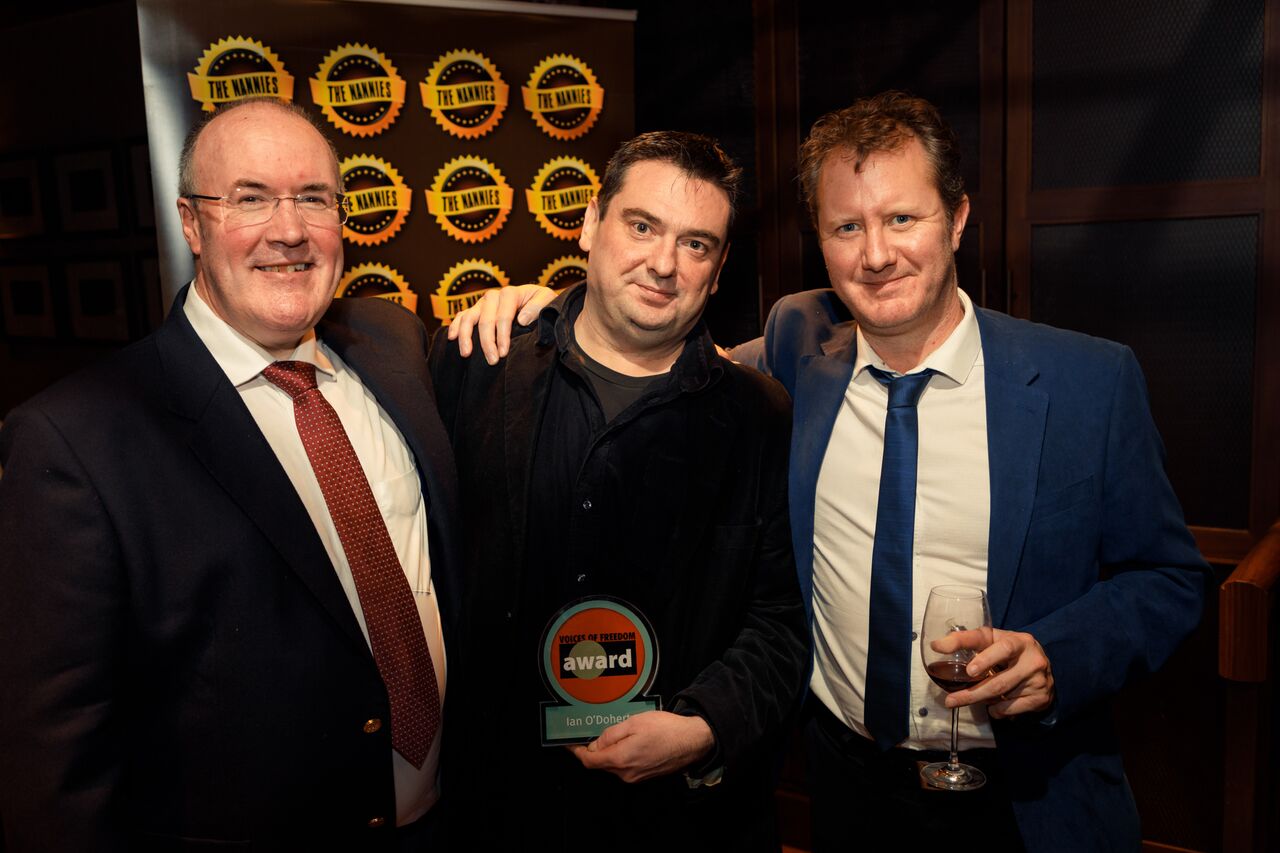 |
| (l-r) Simon Clark, Ian O'Doherty and me good self |
I gave the opening speech. This is what I said...
Nannies, killjoys, wowsers, curtain-twitching puritans, po-faced poobahs, puritanical prodnoses, lemon-sucking busybodies, meddlesome ratbags, hatchet-faced prohibitionists, fun sponges, health fascists, pocket dictators, little Hitlers, nicotine Nazis, gambling Gestapo, sugar Stasi, tobacco Taliban, interfering, hateful, miserable, little bossy boots whose very existence is a curse on humanity. They suck the light out of the room. The grass withers beneath their feet.Those are just some of the things people say about the nominees for tonight’s prestigious award, just because they try to stamp out the small pleasures that make life bearable. I think this is unfair. What a lot of people forget is that interfering in other people’s lives is the only pleasure these people get. So in a way, it’s Forest that are the killjoys.You won’t be hearing any childish name-calling or vulgar abuse from me tonight. I come here in the spirit of friendship. I am British, you are Irish. Rather than fight amongst ourselves, we should unit against our common enemy: Finland. As you may know, I compile the Nanny State Index. It’s fairly self-explanatory; it’s a league table of the most meddling, paternalistic, busybody countries in the EU. Ireland is at number 3, the UK is at number 2.Finland is at number one. And despite the best efforts of our respective governments, neither of our great nations can get close to Finland which has come top of the table in both editions and looks certain to win again next year.So the big question for us tonight is what can we do to knock Finland off its perch? At the moment it seems invincible. Its alcohol shops are a state monopoly. It has a ban on liquorice being advertised if it shaped like a pipe. It regulates e-cigarettes like tobacco. You can't even advertise vape juice that doesn't have nicotine in it, in other words: basically water. It doesn't just tax sugary drinks, it taxes non-sugary drinks. It has the highest taxes on beer and wine in Europe and the second highest tax on spirits. It’s illegal to buy a round of drinks in a pub and it's illegal to buy any drinks with a credit card.And it’s not just Finland we have to worry about. If some of the Eastern European countries carry on like they are, we’ll be lucky to hang on to our bronze and silver medals when the next Nanny State Index comes out. Earlier this year, Lithuania closed the off licences at 8pm and raised the drinking age to 20, making it the only country in Europe where the legal age for buying alcohol isn’t 18 or less. Last year, Estonia slapped a tax on e-cigarette fluid, a tax on all soft drinks - whether they contain sugar or not - hiked up wine duty by a third and doubled the tax on beer.These countries mean business - and they have decades of experience under totalitarian governments to draw on.Achieving a podium finish next year, let alone taking Finland's crown, seems a hopeless task but I’m here to tell you to keep your chin up. There are two reasons for Ireland to be optimistic.Take Estonia. Yes, they doubled the beer tax, but the result was that Estonians went over the border to Latvia to buy their booze, and people from Finland, who had previously being going to Estonia for their beer, went elsewhere. And so the Estonian government lost €90 million in revenue and cancelled their plans for further alcohol tax rises next year.They bottled it! At the first sign of trouble, they gave up. Ireland would never do that. If there’s one thing the Irish government has proven over the years it’s that no amount of cross-border trade, smuggling and black market activity is going to get in the way of its campaign to stop poor people enjoying themselves.The second reason is that, as hard as it is to be a genuine world beater in the field of puritanical lifestyle regulation, if anyone can do it, it is the people nominated for this prestigious honour this evening. Although we are only trying to honour the biggest nanny statist in Ireland tonight, it’s difficult to imagine the list of nominees looking much different if it was a global award. We are talking créme de la créme.There is Simon Harris, who recently celebrated the introduction of minimum pricing as if it was the Emancipation Proclamation.There is last year's winner Catherine Noone who wants to regulate the amount of sugar that can be put in sweets and wants to regulate the chimes of ice cream vans because, she says, they lure children towards deadly ice creams and lollies.There’s Marcella Corcoran Kennedy, champion of the sugar tax, who neatly summarised the role of politicians in Irish society, saying - “basically, you’re the mammy.” That’s the spirit!There’s Donal O’Shea who says “I am not in favour of a nanny state”. This would hinder of his chances of lifting the trophy tonight if it were true, but fortunately it isn’t. He lobbied for the sugar tax and, having achieved that, now wants to tax chocolate and other tasty food. He has said: “The food and drinks industry hides behind kids and uses them as human shields”. Just a normal guy saying normal things.This year he was in the papers crusading against the perils of Easter Eggs. As it happens, I had the pleasure of meeting him this morning when we were on the radio together. He was keen to assure me that he had been misquoted on this issue. He hadn’t said that Easter Eggs should be restricted to one per household. He said they should be restricted to one per child. I’m happy to set the record straight.Then there’s Adrian Cummins from the Restaurants Association of Ireland, a man who only takes his foot out of his mouth to shoot it. He said “we were one of the major supporters of the no smoking ban when it first came in. Publicans were opposed to it, we supported it.” He has since called for a ban on smoking outdoors and a ban on vaping indoors. It is only a matter of time before he calls for a ban on consuming food and alcohol in restaurants.Speaking of smoking bans, no list of Irish nanny statists would be complete without the legendary James Reilly who is surely due a lifetime achievement award. It was largely thanks to James’ tireless efforts that, in 2004, Ireland became the first country in the world to discover the incredible smells that tobacco smoke had been masking in pubs all those years.But the politicians couldn’t do it without the help of the front groups that they fund with taxpayers’ money to lobby for their own policies, so I was delighted to see not one but two nominations for the tireless workers behind Alcohol Action Ireland, a charity that gets 0.07 per cent of its funding from voluntary donations. The rest comes from the unwitting taxpayer. It took state-funded activism to new heights in 2015 when it set up another group - the Alcohol Health Alliance - specifically to lobby for the Public Health (Alcohol) Bill. The rest is history.Last but by no means least is Patrick Doorley from that other state-funded pressure group, ASH. He’s always busy. He’s a busy body. This year, he complained to RTE and the Broadcasting Authority of Ireland when a character in a television programme was shown smoking. He’s also been busy trying to get smoking banned on university campuses. And just smoking, vaping too, because he’s not at all keen on vaping and actively discourages smokers from switching to it. The government has capitulated to every ASH demand in recent years - graphic warnings, the display ban, plain packaging, massive tax hikes - and the results speak for themselves. Since 2012 the smoking rate has plummeted from 23% all the way down to 22%. Clearly, this guy knows what he’s doing. If this progress continues, Ireland will have achieved its goal of getting the smoking rate below 5% in the year 2107. Admittedly that is 82 years later than planned - Ireland is supposed to be “tobacco free” by 2025 - but let that take nothing away from these evidence-based, peer-reviewed policies.Good luck to all the nominees. It’s going to be tough to pick a winner and in a way it’s a shame there has to be winner. To me, they are all losers.It’s been a pleasure speaking you tonight in perhaps the only country in the world where the term nanny statist is taken as such a compliment that you can get them to come to an event which is aimed at taking the piss out of them.For those of you who are capable of having a good time, I hope you have one tonight.
Wednesday, 21 November 2018
Has problem gambling amongst children quadrupled?
The Gambling Commission published its annual figures on gambling amongst 11-16 year olds today. The media have understandably picked up on one particular statistic.
From the BBC...
Anti-gambling campaigners have been quick to blame this apparent rise on advertising and online gaming. However, as I explained in a post earlier this year, participation in online gambling is almost non-existent in this age group - not surprising given how difficult it is for a child to set up an account. Insofar as 11-16 year olds use the internet for gambling, it is mostly to buy lottery tickets with their parents' consent.
The most common forms of gambling by children are private bets with friends, wagers on private card games, Category D amusement games (with stake limits of 10p) and the National Lottery. Everything else has a prevalence rate of one per cent or less.
Nevertheless, a quadrupling of problem gambling - from 0.4 per cent to 1.7 per cent - is striking. So striking that it almost defies belief. It is rare for anything to quadruple in two years without a change in methodology. Sure enough, the methodology of the survey that supplies the statistics has been changed significantly.
You have to read the technical report to see what's happened and that report isn't easy to find (I had to ask the Gambling Commission for it). Strangely, it does not mention one of the most important methodological changes which is that the 2016 figure (0.4%) was based on 11-15 year olds whereas the 2018 figure (1.7%) is based on 11-16 year olds.
This makes a big difference because 16 year olds have the highest rate, as you can see by comparing the two charts below.
2016...

2018...

The Gambling Commission may have decided to not bother mentioning this because the switch to 11-16 year olds happened last year, not in 2018. The change probably explains why the rate appeared to rise from 0.4 per cent in 2016 to 0.9 per cent in 2017, but it cannot explain the apparent rise to 1.7 per cent this year.
But there have been other changes in 2018 which have led to a bigger number. Significantly, the 2018 survey is the first in which the children were given the option of completing the survey online. Previously it had been a written survey only, but this year the schools which participated were given a choice between paper and online - and 70 per cent opted for online.
This doesn't sound like it should make much difference but it does. As the report explains...
Only those who gamble are given the problem gambling questions. This year, many more children were given these questions because gamblers were screened on the basis of whether they had gambled in the past year rather than - as before - in the past week. The rate of problem gambling is obviously higher among gamblers than among the entire cohort and, again, the online survey produced much higher numbers than the paper survey.
It is not entirely clear why the online version elicits higher rates, nor is it clear which version produces the more accurate responses. The Gambling Commission says that 'respondents are more likely to give responses indicating problematic or socially undesirable behaviour when answering a survey online rather than on paper' and cites this study as evidence.
Whatever the reason, the results from the 2018 survey are simply not comparable to the 2017 survey, let alone the 2016 survey. The 2016 survey was paper only and used a younger cohort.
The 2017 survey had the same age group but it was all paper whereas this year's study was mostly online. The difference this makes becomes crystal clear on page 10 of the technical report. If you compare the paper responses in 2018 to the paper responses in 2017, the rate of problem gambling has actually declined! I've circled the relevant figures below - click to enlarge. The apparent rise is due solely to the online responses.

It is fair to say that the Gambling Commission could have done more to flag up the apples and oranges problem here. They have a section in the technical report titled 'The impact of moving the survey online' but the technical report is not available from their webpage and is only briefly referenced on page 32 of the main report. I doubt any journalists would have read it.
Even if they had, few journalists would pass up the chance to report a quadrupling of problem gambling in the space of just two years. It must have seemed almost too good to be true. As it happens, it isn't true.
From the BBC...
Number of child gamblers quadruples in just two years
The number of children classed as having a gambling problem has quadrupled to more than 50,000 in just two years, a report has claimed.
Anti-gambling campaigners have been quick to blame this apparent rise on advertising and online gaming. However, as I explained in a post earlier this year, participation in online gambling is almost non-existent in this age group - not surprising given how difficult it is for a child to set up an account. Insofar as 11-16 year olds use the internet for gambling, it is mostly to buy lottery tickets with their parents' consent.
The most common forms of gambling by children are private bets with friends, wagers on private card games, Category D amusement games (with stake limits of 10p) and the National Lottery. Everything else has a prevalence rate of one per cent or less.
Nevertheless, a quadrupling of problem gambling - from 0.4 per cent to 1.7 per cent - is striking. So striking that it almost defies belief. It is rare for anything to quadruple in two years without a change in methodology. Sure enough, the methodology of the survey that supplies the statistics has been changed significantly.
You have to read the technical report to see what's happened and that report isn't easy to find (I had to ask the Gambling Commission for it). Strangely, it does not mention one of the most important methodological changes which is that the 2016 figure (0.4%) was based on 11-15 year olds whereas the 2018 figure (1.7%) is based on 11-16 year olds.
This makes a big difference because 16 year olds have the highest rate, as you can see by comparing the two charts below.
2016...

2018...

The Gambling Commission may have decided to not bother mentioning this because the switch to 11-16 year olds happened last year, not in 2018. The change probably explains why the rate appeared to rise from 0.4 per cent in 2016 to 0.9 per cent in 2017, but it cannot explain the apparent rise to 1.7 per cent this year.
But there have been other changes in 2018 which have led to a bigger number. Significantly, the 2018 survey is the first in which the children were given the option of completing the survey online. Previously it had been a written survey only, but this year the schools which participated were given a choice between paper and online - and 70 per cent opted for online.
This doesn't sound like it should make much difference but it does. As the report explains...
One of the key metrics captured in the Gambling Commission’s study is the proportion of young people who are ‘problem’ or ‘at risk’ gamblers, as measured by the DSM-MR-IV-J, a screen consisting of 9 domains (see Chapter 3 for more about the screen). Responses across these domains are aggregated to form an overall score; respondents scoring 4 or more are classified as ‘problem gamblers’ and those scoring 2-3 are ‘at risk’ gamblers. The problem gambling rate among those answering on paper is in line with rates in 2017, while the aggregate 2018 rate (including the online and paper samples) is higher than 2017.
Only those who gamble are given the problem gambling questions. This year, many more children were given these questions because gamblers were screened on the basis of whether they had gambled in the past year rather than - as before - in the past week. The rate of problem gambling is obviously higher among gamblers than among the entire cohort and, again, the online survey produced much higher numbers than the paper survey.
.. the proportion of those screened who were classified as problem gamblers was higher among those responding online (5.6%) than on paper (1.6%), despite similar screening rates (35% and 34%, respectively). This is because online respondents were more likely to indicate problematic behaviour at 7 of the 9 domains on the screen. As such, it appears that differences by mode as well as the improved screening rate are factors in the increased problem gambling rate seen in 2018.
It is not entirely clear why the online version elicits higher rates, nor is it clear which version produces the more accurate responses. The Gambling Commission says that 'respondents are more likely to give responses indicating problematic or socially undesirable behaviour when answering a survey online rather than on paper' and cites this study as evidence.
Whatever the reason, the results from the 2018 survey are simply not comparable to the 2017 survey, let alone the 2016 survey. The 2016 survey was paper only and used a younger cohort.
The 2017 survey had the same age group but it was all paper whereas this year's study was mostly online. The difference this makes becomes crystal clear on page 10 of the technical report. If you compare the paper responses in 2018 to the paper responses in 2017, the rate of problem gambling has actually declined! I've circled the relevant figures below - click to enlarge. The apparent rise is due solely to the online responses.

It is fair to say that the Gambling Commission could have done more to flag up the apples and oranges problem here. They have a section in the technical report titled 'The impact of moving the survey online' but the technical report is not available from their webpage and is only briefly referenced on page 32 of the main report. I doubt any journalists would have read it.
Even if they had, few journalists would pass up the chance to report a quadrupling of problem gambling in the space of just two years. It must have seemed almost too good to be true. As it happens, it isn't true.
Monday, 19 November 2018
Teetotallers still dying too young
In April, the Lancet published one of those 'no safe level' studies about alcohol. It was garbage but it got the kind of media coverage its authors doubtless anticipated, with the Guardian declaring that ‘Drinking is as harmful as smoking’ and the BBC asserting that ‘One drink a day “can shorten life”‘. Interestingly, the BBC headline has since been changed to the more credible 'Regular excess drinking can take years off your life' but the damage has been done.
It's all part of the drip-drip campaign to erase the health benefits of alcohol consumption. Lies like this travel the world while the truth is getting its shoes on. Last week, I mentioned the article by Alexandra Freeman and David Spiegelhalter criticising a similar study that was published in August. It did not receive the same level of interest from the media as the original, to put it mildly.
Nor did the letters in Friday's Lancet criticising the April study so I will flag them up here. The trick employed in that study was fiendishly simple. The authors simply removed non-drinkers from the analysis, leaving graphs that imply no health benefits from moderate drinking...

If you put the never-drinkers and ex-drinkers in, the usual J-Curve emerges. Drinkers have to consume quite a lot of booze before their health risks exceed those of teetotallers.

I don't know why it has taken seven months for a rebuttal to this deeply misleading study be published in the Lancet, but two have now come along at once. As the first letter says:
The second letter makes a similar point...
The authors have replied to these criticisms but are unable to credibly defend the decision to exclude non-drinkers - who are, after all, the only relevant control group if you're going to encourage total abstinence. They don't deny that non-drinkers have higher rates of mortality than moderate drinkers, nor do they deny controlling for every conceivable confounding factors. Instead they make vague assertions about non-drinkers possibly being unhealthy for reasons nobody can think of.
Well, they might. Just as heavy drinkers might be more likely to get liver cirrhosis for reasons that have nothing do with drinking, but since every alternative explanation has been studied and found wanting, we would reject this notion as desperate straw-clutching. Same rules apply.
NB. I wrote about this study at the time for Spectator Health.
It's all part of the drip-drip campaign to erase the health benefits of alcohol consumption. Lies like this travel the world while the truth is getting its shoes on. Last week, I mentioned the article by Alexandra Freeman and David Spiegelhalter criticising a similar study that was published in August. It did not receive the same level of interest from the media as the original, to put it mildly.
Nor did the letters in Friday's Lancet criticising the April study so I will flag them up here. The trick employed in that study was fiendishly simple. The authors simply removed non-drinkers from the analysis, leaving graphs that imply no health benefits from moderate drinking...

If you put the never-drinkers and ex-drinkers in, the usual J-Curve emerges. Drinkers have to consume quite a lot of booze before their health risks exceed those of teetotallers.

I don't know why it has taken seven months for a rebuttal to this deeply misleading study be published in the Lancet, but two have now come along at once. As the first letter says:
Taking out the non-drinkers as a reference group is the only novelty in this study compared with existing scientific literature, and causes the complete elimination of the left rising arm of the J curve (as shown in the figure and in the Article's appendix, p 31). This is also not the first time a study has suggested that the mortality curve bends at a drink per day or less. By removing the non-drinkers, Wood and colleagues make it difficult to establish whether any amount of moderate alcohol consumption has a different effect to abstaining. Thus, we believe that the study has little to add to existing scientific literature and cannot contribute to public health advice.
Over the past decades, observational studies have taught us a lot about the relation between alcohol consumption and health. The effects of alcohol on health are now understood to differ depending on the amount of alcohol consumed, the age and gender of the consumer,1 and the various endpoints studied. Most studies find that individuals who abstain entirely from alcohol consumption might be worse off than moderate drinkers, and virtually none have reported a beneficial effect of abstention on mortality compared with moderate consumption... By disregarding ex-drinkers and never-drinkers and the differing effects patterns of alcohol consumption had on mortality, the main message emerged that less alcohol consumption was better. A more informative message based on the findings hidden in the appendix could have been that the study added further evidence to support a beneficial effect of moderate alcohol consumption (especially wine) on mortality. The headlines might have then resembled those of just a year ago: “A glass of wine or pint of beer a day can help people to live longer, according to new research”.
The authors have replied to these criticisms but are unable to credibly defend the decision to exclude non-drinkers - who are, after all, the only relevant control group if you're going to encourage total abstinence. They don't deny that non-drinkers have higher rates of mortality than moderate drinkers, nor do they deny controlling for every conceivable confounding factors. Instead they make vague assertions about non-drinkers possibly being unhealthy for reasons nobody can think of.
...never-drinkers might differ systematically from drinkers in ways that are difficult to measure, but might be relevant to disease causation.
Well, they might. Just as heavy drinkers might be more likely to get liver cirrhosis for reasons that have nothing do with drinking, but since every alternative explanation has been studied and found wanting, we would reject this notion as desperate straw-clutching. Same rules apply.
NB. I wrote about this study at the time for Spectator Health.
Subscribe to:
Posts (Atom)