Thanks to the Freedom of Information Act and this bundle of government documents, I have been able to see how Public Health England engineered the change to the drinking guidelines. Neither PHE nor the Sheffield University modellers come out of it well. If nothing else, it puts the lie to the notion that government-funded research is 'independent'.
Read the full story at Spectator Health. It's not pretty but it is important.
See also this report in yesterday's Sunday Times.

Monday, 30 October 2017

Thursday, 26 October 2017
Denying healthcare to smokers and fat people
I wrote this last week about the latest attempt by an NHS trust to defraud its customers...
In 1948, the minister for health, Aneurin Bevan, outlined the three guiding principles of the NHS: that it meets the needs of everybody, that it is free at the point of delivery and that it is based on clinical need, not ability to pay.
There was no footnote saying ‘…but only if you lead a state-approved lifestyle’. Bevan’s vision for the NHS could not have been clearer and yet a growing number of NHS trusts have been flying the kite of discrimination against smokers and the overweight. Hospital mandarins in North Yorkshire toyed with the idea of refusing surgery to incorrigible smokers and obese people last year. Clinical commissioning groups in Hertfordshire raised it again this week. Both sets of bureaucrats said that they would make an exemption for life-saving surgery, which was nice of them, but if patients are merely suffering from chronic pain, they will have to stop smoking and lose weight.
It is true that some operations will be more successful if the patient is slim and doesn’t smoke, although these benefits are not as great as some NHS bosses imply. But the risk is to the individual and it is the individual who is going under the knife. More importantly, it is the individual who has paid for the treatment.
The per capita cost of the NHS to every man, woman and child in Britain amounts to £2,000 per annum. If the average citizen had to write a cheque out for this amount every year, we might more fully appreciate the fact that the NHS is not a ‘free’ service that our masters can ration out to us if they approve of our lifestyles. It is an industry. We are the customers and those who work in it are our servants. Too many people at the top of the NHS hierarchy seem to have forgotten this. Increasingly, they see it as a tool of social control.
Some years ago, the NHS made a television advert which ended with the slogan ‘If you smoke, you stink’. It is difficult to imagine a private enterprise wilfully insulting a quarter of its clients in such a way. The demonisation of smokers and, more recently, fat people has given the NHS two groups of scapegoats to blame for its own shortcomings. We are routinely told that obesity threatens to bankrupt the NHS. This would be nonsense even if it were possible for the NHS to go bust, which it isn’t. The figures do not add up. Nor do the sums add up for smoking and drinking, neither of which are a ‘burden on the NHS’. Tax revenues from tobacco and alcohol amounted to £24 billion last year, vastly exceeding any associated costs to the health service.
If the NHS no longer wishes to treat smokers then it is only fair that they be given a refund, starting with all the tobacco duty they have paid over a lifetime. This alone would be enough for them to afford world class healthcare, with the added bonus that they would no longer have to pay for their own vilification.
Bevan understood that there is a basic social contract at the heart of the NHS. Because we are not allowed to opt out of paying for socialised medicine, doctors are not allowed to opt out of giving us it. No taxation without medication. If you’re going to start making patients go without treatment or pay privately just because they did not go everything they could to avoid their ailments, you might as well have a healthcare insurance system.
Such systems work well in the rest of Europe and I would not be opposed to borrowing a few ideas from places where health services produce better outcomes. The people who should really be concerned about the move towards NHS rationing are those who want to preserve ‘our NHS’ because they mistakenly believe that it is the envy of the world. Such a fundamentally political project cannot survive without consent. If it is going to start defrauding its customers - what else can you call refusing to deliver a service that has been paid for? - it is bound to lose public support.
If we set down this path, there is no obvious end to it. There are thousands of avoidable risk factors for diseases, accidents and injuries. Should we deny treatment to all those who fail to avoid them? Perhaps the NHS should simply adopt a policy of only treating healthy people. After all, if it wasn’t for the patients, the system would work perfectly.
In 1948, the minister for health, Aneurin Bevan, outlined the three guiding principles of the NHS: that it meets the needs of everybody, that it is free at the point of delivery and that it is based on clinical need, not ability to pay.
There was no footnote saying ‘…but only if you lead a state-approved lifestyle’. Bevan’s vision for the NHS could not have been clearer and yet a growing number of NHS trusts have been flying the kite of discrimination against smokers and the overweight. Hospital mandarins in North Yorkshire toyed with the idea of refusing surgery to incorrigible smokers and obese people last year. Clinical commissioning groups in Hertfordshire raised it again this week. Both sets of bureaucrats said that they would make an exemption for life-saving surgery, which was nice of them, but if patients are merely suffering from chronic pain, they will have to stop smoking and lose weight.
It is true that some operations will be more successful if the patient is slim and doesn’t smoke, although these benefits are not as great as some NHS bosses imply. But the risk is to the individual and it is the individual who is going under the knife. More importantly, it is the individual who has paid for the treatment.
The per capita cost of the NHS to every man, woman and child in Britain amounts to £2,000 per annum. If the average citizen had to write a cheque out for this amount every year, we might more fully appreciate the fact that the NHS is not a ‘free’ service that our masters can ration out to us if they approve of our lifestyles. It is an industry. We are the customers and those who work in it are our servants. Too many people at the top of the NHS hierarchy seem to have forgotten this. Increasingly, they see it as a tool of social control.
Some years ago, the NHS made a television advert which ended with the slogan ‘If you smoke, you stink’. It is difficult to imagine a private enterprise wilfully insulting a quarter of its clients in such a way. The demonisation of smokers and, more recently, fat people has given the NHS two groups of scapegoats to blame for its own shortcomings. We are routinely told that obesity threatens to bankrupt the NHS. This would be nonsense even if it were possible for the NHS to go bust, which it isn’t. The figures do not add up. Nor do the sums add up for smoking and drinking, neither of which are a ‘burden on the NHS’. Tax revenues from tobacco and alcohol amounted to £24 billion last year, vastly exceeding any associated costs to the health service.
If the NHS no longer wishes to treat smokers then it is only fair that they be given a refund, starting with all the tobacco duty they have paid over a lifetime. This alone would be enough for them to afford world class healthcare, with the added bonus that they would no longer have to pay for their own vilification.
Bevan understood that there is a basic social contract at the heart of the NHS. Because we are not allowed to opt out of paying for socialised medicine, doctors are not allowed to opt out of giving us it. No taxation without medication. If you’re going to start making patients go without treatment or pay privately just because they did not go everything they could to avoid their ailments, you might as well have a healthcare insurance system.
Such systems work well in the rest of Europe and I would not be opposed to borrowing a few ideas from places where health services produce better outcomes. The people who should really be concerned about the move towards NHS rationing are those who want to preserve ‘our NHS’ because they mistakenly believe that it is the envy of the world. Such a fundamentally political project cannot survive without consent. If it is going to start defrauding its customers - what else can you call refusing to deliver a service that has been paid for? - it is bound to lose public support.
If we set down this path, there is no obvious end to it. There are thousands of avoidable risk factors for diseases, accidents and injuries. Should we deny treatment to all those who fail to avoid them? Perhaps the NHS should simply adopt a policy of only treating healthy people. After all, if it wasn’t for the patients, the system would work perfectly.
Wednesday, 25 October 2017
Nationalising the pubs
At a conference in 2015, I suggested that the government had screwed over the pub trade in so many ways that it was only a matter of time before it had to be nationalised...
This was hyperbole. I was speaking partly in jest, but only partly. My colleague Kristian Niemietz also had his tongue in his cheek the other day when he looked forward to a socialist dystopia...
But the respected beer writer Phil Mellows has now made the case in earnest in Jacobin.
The government certainly has experience in running loss-making industries. Thanks to the policies of successive governments, the pub trade is on the brink of becoming one of these.
Needless to say, I do not think that nationalisation is the answer. It would not address the industry's underlying problems and would lead to people who don't go to pubs having to subsidise those who do.
Industries come and go as people's tastes change, but there is nothing natural about the way demand for pubs has fallen in the last ten years. As I said in Closing Time, the industry has been crippled with high taxes and excessive regulation. Pubs do not need to be treated as charity cases. They do not need even more regulation and they certainly do not need state ownership. They just need to be given what the Australians call a fair go.
“Intervention upon intervention will lead to failure,” [Snowdon] said. “If we distort the market so much there will be no market left and the only people who can look after pubs will be politicians.”
“This is what I mean when I say that by 2020 we could be on our way to some kind of state-ownership of pubs; if they are regulated in such a way they are not able to be run by viable businesses.”
... The outspoken libertarian expressed his belief that politicians weren’t really concerned about the existence of the traditional British pub, saying if they were “genuinely committed” to the continued existence of the pub trade “they could and should halve alcohol duty and amend the smoking ban” and permit landlords to have one smoking room.
This was hyperbole. I was speaking partly in jest, but only partly. My colleague Kristian Niemietz also had his tongue in his cheek the other day when he looked forward to a socialist dystopia...
On my way home, I stopped at a People's Pub, which used to be a Wetherspoon before the Great Nationalisation.— Kristian Niemietz (@K_Niemietz) June 28, 2017
-"A pint of People's, please."
But the respected beer writer Phil Mellows has now made the case in earnest in Jacobin.
Recession, smoking bans, and changing lifestyles, plus an industry structure that has sucked profits towards major chains, mean that despite all the innovation, pubs at the heart of their communities have struggled to keep beating....Sometimes only the state is big and bold enough to save an industry. Given its record of success, it is long past time for the nationalization of pubs to return to the political agenda. It may sound far-fetched — but so, at one time, did Prime Minister Jeremy Corbyn.
The government certainly has experience in running loss-making industries. Thanks to the policies of successive governments, the pub trade is on the brink of becoming one of these.
Needless to say, I do not think that nationalisation is the answer. It would not address the industry's underlying problems and would lead to people who don't go to pubs having to subsidise those who do.
Industries come and go as people's tastes change, but there is nothing natural about the way demand for pubs has fallen in the last ten years. As I said in Closing Time, the industry has been crippled with high taxes and excessive regulation. Pubs do not need to be treated as charity cases. They do not need even more regulation and they certainly do not need state ownership. They just need to be given what the Australians call a fair go.
Tuesday, 24 October 2017
'Pretty neutral on the debate'
The Welsh Assembly formally announced its plan to put a minimum price on alcohol yesterday. A figure of 50p per unit was bandied around by the media but that has not been decided. Depending on what Scotland does, I suspect that it could be 60p (which is what the 'public health' racket have been demanding since 2009). Either way, the minimum price will go up and up.
We have been hearing the usual lies about how minimum pricing will have little effect on moderate drinkers. This is based - as always - on fantasy modelling from the Sheffield Alcohol Research Group who define a moderate drinker as someone who drinks 5.5 units a week (they do this by including all the light and occasional drinkers and then averaging out their reported intake - which is less than they actually drink anyway).
Figures in the BBC report show how implausible is the claim that only heavy drinkers will be affected. The majority of off-trade alcohol will become more expensive under a 50p unit.
So let's debunk the myth that minimum pricing will only affect the very cheapest, super-strong alcohol. It will affect most of us while effectively exempting the rich. If the policy is introduced in Wales, the prices will be noticeably higher than in England and a booming cross-border trade is inevitable. Perhaps the Welsh will blame the English when the policy is seen to fail.
There is still the small matter of EU law to get around first. The UK supreme court is expected to deliver its verdict by the end of the year. The BBC's (anonymous) reporter revealed his or her bias in this now-deleted paragraph..
Speaking of the BBC, I was approached about going on BBC Breakfast yesterday to debate the policy. The programme is based in Salford and they prefer guests to be in the studio so I wasn't very surprised to get a text from their researcher saying that I wouldn't be needed because they'd 'got someone who is coming into Salford who is pretty neutral on the debate. They just look at the likely impact of various policies...'
However, I was extremely surprised when I found out that this 'neutral' policy analyst was none other than Colin Angus of the Sheffield Alcohol Research Group who is personally and professionally invested in minimum pricing and has been advocating for the policy for the best part of a decade. He is, to all intents and purposes, an activist. If you want to see how 'neutral' he is, here's a reminder of the time he started howling at the moon when the charity Prostate Cancer UK refused to believe some junk science from Tim Stockwell.
Aside from a brief video clip of an ex-alcoholic saying that minimum pricing would have had no effect of him, there was nobody to challenge Angus and so he was free to make the entirely false claim that minimum pricing in Canada led to a fall in alcohol-related deaths and hospital admissions (an easily debunked myth that can be traced back to Stockwell again).

You can see his performance here but if you want to hear an actual debate about the policy, you can listen to me and someone from Alcohol Concern on BBC Wales yesterday here (from 37 minutes).
We have been hearing the usual lies about how minimum pricing will have little effect on moderate drinkers. This is based - as always - on fantasy modelling from the Sheffield Alcohol Research Group who define a moderate drinker as someone who drinks 5.5 units a week (they do this by including all the light and occasional drinkers and then averaging out their reported intake - which is less than they actually drink anyway).
Figures in the BBC report show how implausible is the claim that only heavy drinkers will be affected. The majority of off-trade alcohol will become more expensive under a 50p unit.
Alcohol sold below 50p per unit makes up 72% of the beer sales in Welsh shops and supermarkets, 78% of the cider sales, 42% of the wine and 66% of the spirits.
So let's debunk the myth that minimum pricing will only affect the very cheapest, super-strong alcohol. It will affect most of us while effectively exempting the rich. If the policy is introduced in Wales, the prices will be noticeably higher than in England and a booming cross-border trade is inevitable. Perhaps the Welsh will blame the English when the policy is seen to fail.
There is still the small matter of EU law to get around first. The UK supreme court is expected to deliver its verdict by the end of the year. The BBC's (anonymous) reporter revealed his or her bias in this now-deleted paragraph..
The Supreme Court is expected to give its judgement within weeks to an attempt to block Scotland's minimum price legislation from being introduced.
However, if all goes well, ministers in Wales hope it would become law by summer 2018.
Speaking of the BBC, I was approached about going on BBC Breakfast yesterday to debate the policy. The programme is based in Salford and they prefer guests to be in the studio so I wasn't very surprised to get a text from their researcher saying that I wouldn't be needed because they'd 'got someone who is coming into Salford who is pretty neutral on the debate. They just look at the likely impact of various policies...'
However, I was extremely surprised when I found out that this 'neutral' policy analyst was none other than Colin Angus of the Sheffield Alcohol Research Group who is personally and professionally invested in minimum pricing and has been advocating for the policy for the best part of a decade. He is, to all intents and purposes, an activist. If you want to see how 'neutral' he is, here's a reminder of the time he started howling at the moon when the charity Prostate Cancer UK refused to believe some junk science from Tim Stockwell.
Aside from a brief video clip of an ex-alcoholic saying that minimum pricing would have had no effect of him, there was nobody to challenge Angus and so he was free to make the entirely false claim that minimum pricing in Canada led to a fall in alcohol-related deaths and hospital admissions (an easily debunked myth that can be traced back to Stockwell again).

You can see his performance here but if you want to hear an actual debate about the policy, you can listen to me and someone from Alcohol Concern on BBC Wales yesterday here (from 37 minutes).
Friday, 20 October 2017
Money for old rope with Jolyon Maugham
Anti-Brexit campaigner Jolyon Maugham has been getting thousands of retweets with what he claims are secret government forecasts of what will happen if Britain leaves the EU without a deal and has to 'fall back' on WTO rules.
Maugham doesn't provide a link to the 'major newspaper' but the document he is talking about is probably the one referred to by the Independent and others back in March. Maugham has said that the document was produced 'shortly before the referendum'. It is almost certainly an early draft of the Treasury's notorious 'Project Fear' report that was published 18 months ago and is available online to anyone who wants to read it.
The Treasury also predicted an immediate recession if Britain voted to Leave. Obviously that didn't happen and the National Audit Office has admitted that some of the Treasury's assumptions were wrong. That doesn't make the rest of their predictions wrong, but it gives pause for thought.
So is it possible to get people excited about some predictions made 18 months ago when some of them have already been shown to be wrong? If your audience is one of diehard Remainers, the answer is yes, of course. Any scrap is hungrily devoured if it makes it look like as if the UK cannot become a normal, self-governing country.
Maugham's big 'headline' from his secret document is that every household will be £5,200 poorer under WTO rules.

Big news, eh? Except that is exactly what the Treasury publicly stated in May 2016, as you will see if you turn to page 122...
But there's more...

This is highly debatable but, regardless of its merits, the same claim was made, almost word-for-word, on page 12 of the published report...
And on page 10...
What other scoops has Maugham got for us?

Man! On page 98 of the published report, the Treasury mentions 'the food industry, worth almost £20 billion, over 370,000 jobs and selling almost 55% of exports to Europe'. It then gives exactly the same numbers that has got Maugham excited on page 96...
The rest of Maugham's thread simply explains what WTO rules are and how could work, albeit with a bias towards pessimism. Everything in it has all been in the public domain for ages, mostly in the published report. For example...

This is discussed at greater length in the published report, particularly on pages 92 and 93, with the same conclusion. Woah!
Not exactly the Rosetta Stone, is it? It's kind of sad to see so many people getting hot and bothered about what is, at best, a shorter draft of a publicly available document. The idea that the Treasury had misgivings about leaving the EU but buried them in a secret report is ludicrous. The Treasury quite obviously wanted to remain and it published a 200 page report explaining why.
Some of the replies are hilarious.
Man!
So a wee bird has dropped into my inbox what a major newspaper has described as a report from HM Treasury. THREAD— Jo Maugham QC (@JolyonMaugham) October 19, 2017
Maugham doesn't provide a link to the 'major newspaper' but the document he is talking about is probably the one referred to by the Independent and others back in March. Maugham has said that the document was produced 'shortly before the referendum'. It is almost certainly an early draft of the Treasury's notorious 'Project Fear' report that was published 18 months ago and is available online to anyone who wants to read it.
The Treasury also predicted an immediate recession if Britain voted to Leave. Obviously that didn't happen and the National Audit Office has admitted that some of the Treasury's assumptions were wrong. That doesn't make the rest of their predictions wrong, but it gives pause for thought.
So is it possible to get people excited about some predictions made 18 months ago when some of them have already been shown to be wrong? If your audience is one of diehard Remainers, the answer is yes, of course. Any scrap is hungrily devoured if it makes it look like as if the UK cannot become a normal, self-governing country.
Maugham's big 'headline' from his secret document is that every household will be £5,200 poorer under WTO rules.

Big news, eh? Except that is exactly what the Treasury publicly stated in May 2016, as you will see if you turn to page 122...
After 15 years, the UK is estimated to be between 5.4% and 9.5% of GDP better off inside the EU than adopting WTO rules. In 2015 terms, leaving the EU and relying on the WTO rules would mean a long-term loss of GDP of £5,200 a year for each household in the UK...
The net impact on receipts would be £20 billion a year in the central case of the EEA, £36 billion a year in the case of the negotiated bilateral agreement, and £45 billion a year in the case of the WTO.
But there's more...

This is highly debatable but, regardless of its merits, the same claim was made, almost word-for-word, on page 12 of the published report...
Relying solely on the WTO rules would result in a significant reduction in the openness of the UK economy to the outside world. It would be the alternative with the most negative long-term impact.
And on page 10...
WTO membership would amount to a significant closing of the UK’s access to global markets and would likely see the introduction of a much broader range of tariff and non-tariff barriers.
What other scoops has Maugham got for us?
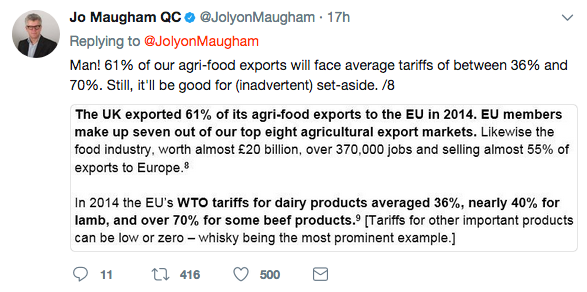
Man! On page 98 of the published report, the Treasury mentions 'the food industry, worth almost £20 billion, over 370,000 jobs and selling almost 55% of exports to Europe'. It then gives exactly the same numbers that has got Maugham excited on page 96...
In 2014 for dairy products these tariffs averaged 36% with a very broad range of duties applied. This is significant because the EU accounted for 61% of UK agri-food exports in 2014, with EU member states accounting for 7 of the UK’s top 8 agricultural export markets.
The rest of Maugham's thread simply explains what WTO rules are and how could work, albeit with a bias towards pessimism. Everything in it has all been in the public domain for ages, mostly in the published report. For example...

This is discussed at greater length in the published report, particularly on pages 92 and 93, with the same conclusion. Woah!
Not exactly the Rosetta Stone, is it? It's kind of sad to see so many people getting hot and bothered about what is, at best, a shorter draft of a publicly available document. The idea that the Treasury had misgivings about leaving the EU but buried them in a secret report is ludicrous. The Treasury quite obviously wanted to remain and it published a 200 page report explaining why.
Some of the replies are hilarious.
Great work. Those privy to this HMT assessment who are still peddling hard #Brexit should be prosecuted. No two ways about it— Fabio Cosenza (@fabiocosenza76) October 19, 2017
So the Report dates to before the Referendum. Why weren't we told!— P J (@Pamper48) October 19, 2017
I guess this is the information the #remainers failed to tell us about.— Free@Last, Free@Last (@mrverypicky) October 19, 2017
They ran a pathetic campaign & so a lotta people voted OUT.
Just upload the thing already, should've been advisory information prior 2 referendum. Instead we got Legatum Institute's plan as policy :(— penrar (@penrardj) October 19, 2017
— John McCarthy (@JohnDMC17) October 19, 2017
in a normal world this would be THE thread that kills Brexit
I feel quite sick. This is everything we have been saying and they have been denying for two years. They absolutely know & are aiming for it— Angela Marston (@AngelaMarston) October 19, 2017
Man!
Tuesday, 17 October 2017
Jamie Oliver's sugar tax 'success'
The evidence that taxing sugary drinks has any effect on obesity is - to put it mildly - poor. The great success story is supposed to be Mexico but we now know that per capita consumption of sugary drinks was essentially the same after that tax was introduced (in 2014) as it was before.
The other success story is supposed to be Berkeley, California, where sugary drink sales fell by 9.6 per cent after a soda tax was introduced in March 2015. But as I mentioned last week, you only have to read the study to see what really happened. Sales fell by 0.8 fluid ounces per transaction in Berkeley but they rose by 0.7 fluid ounces per transaction in neighbouring areas. People simply went out of town to do their shopping.


Since the quantities of sugary drinks consumed didn't change after the soda taxes were introduced in Mexico and Berkeley, it is inconceivable that they could have any effect on obesity. The authors of the Berkeley study (who include soda tax fanatic Barry Popkin) admitted that there was no statistically significant change in calorie intake from sugary drinks and that 'caloric intake of untaxed beverages (milk and other diary-based [sic] beverages) increased.' Yes, that's right: calorie consumption increased.
Things are not looking good for advocates of these taxes, especially after the taxpayers' revolt in Chicago. An element of desperation is creeping in, hence this today...
Jamie knows a thing or two about losing sales. He's been closing restaurants left, right and centre this year. However, the study looks at soft drink sales per customer so should not be affected by the general decline of Oliver's businesses. So what's the story?
The price elasticity of sugary drinks is generally though to be around 0.8-1.2, meaning that a 10 per cent increase in price leads to a fall in demand of roughly 10 per cent. Jamie Oliver's drinks are so expensive - at £2.60 to £3.25 - that a 10p 'tax' only increases the price by 3.5 per cent.
A decline in sales of 9.3 per cent as a result of a 3.5 per cent price rise is implausible. It would imply a price elasticity of about 3.0, ie. three times higher than has been observed elsewhere.
To their credit, the researchers admit that this is not very likely...
It's worth remembering that Jamie introduced his 'tax' after presenting a ridiculous documentary on Channel 4 that portrayed sugary drinks as something akin to asbestos. This is likely to have had an effect on the kind of morons who admire the man and go to his restaurants. By the same token, it is likely that people who enjoy sugary drinks and don't want to be lectured by a fat-tongued Essex pea-brain would have been less likely to go to his restaurants after Oliver got on his high horse.
In other words, the people who visited his poxy restaurants after he introduced this gimmick were not necessarily the same people who visited before.
This is an important point. The most interesting thing about sugary drinks taxes is seeing what substitution effects take place. The Guardian doesn't give the figures, but the study says that there was a 22 per cent rise in the sale of fruit juice (which has about the same amount of sugar as a fizzy drink), although fruit juice orders from the children's menu fell. Sales of off-menu mixers went up slightly, but sales of diet cola and bottled water went down (by 6-7 per cent).
In fact, the sale of nearly every type of drink went down. It is not clear what, if anything, people were switching to. The authors don't have figures for alcohol sales for some reason, but the rise in the sale of mixers suggests that the sale of spirits may have increased. Alternatively, people could have switched to tap water. Either way, it left Oliver out of pocket.
Actually, there is a very good reason. Drink sales are an important revenue stream for restaurants and Oliver seems to have lost them overall. It speaks volumes about 'public health' researchers that Cummins doesn't think this would play a part in a restaurateur's planning.
This study doesn't tell us anything useful about the impact of sugary drink taxes as a government policy. I'll leave it to Kevin McConway, emeritus professor of applied statistics at the Open University, to have the last word:
Quite so.
The other success story is supposed to be Berkeley, California, where sugary drink sales fell by 9.6 per cent after a soda tax was introduced in March 2015. But as I mentioned last week, you only have to read the study to see what really happened. Sales fell by 0.8 fluid ounces per transaction in Berkeley but they rose by 0.7 fluid ounces per transaction in neighbouring areas. People simply went out of town to do their shopping.


Since the quantities of sugary drinks consumed didn't change after the soda taxes were introduced in Mexico and Berkeley, it is inconceivable that they could have any effect on obesity. The authors of the Berkeley study (who include soda tax fanatic Barry Popkin) admitted that there was no statistically significant change in calorie intake from sugary drinks and that 'caloric intake of untaxed beverages (milk and other diary-based [sic] beverages) increased.' Yes, that's right: calorie consumption increased.
Things are not looking good for advocates of these taxes, especially after the taxpayers' revolt in Chicago. An element of desperation is creeping in, hence this today...
Jamie Oliver’s 10p tax on sugary drinks sold in his Italian restaurants has resulted in a significant drop in sales, a study has found.
Jamie knows a thing or two about losing sales. He's been closing restaurants left, right and centre this year. However, the study looks at soft drink sales per customer so should not be affected by the general decline of Oliver's businesses. So what's the story?
A study of the effects of the levy, published in the Journal of Epidemiology & Community Health, has found that sales of sugar-sweetened drinks such as colas and lemonades fell by 11% in the first 12 weeks. At the end of six months, sales were 9.3% lower than they had been before the levy was introduced.
The price elasticity of sugary drinks is generally though to be around 0.8-1.2, meaning that a 10 per cent increase in price leads to a fall in demand of roughly 10 per cent. Jamie Oliver's drinks are so expensive - at £2.60 to £3.25 - that a 10p 'tax' only increases the price by 3.5 per cent.
A decline in sales of 9.3 per cent as a result of a 3.5 per cent price rise is implausible. It would imply a price elasticity of about 3.0, ie. three times higher than has been observed elsewhere.
To their credit, the researchers admit that this is not very likely...
Prof Steven Cummins of the department of social and environmental health research at the London School of Hygiene and Tropical Medicine, who carried out the study, acknowledged that the clientele of Oliver’s restaurants tended to be affluent, and that the price hike on a drink costing between £2.60 and £3.25 might not make a lot of difference to them.
“I don’t think the financial element of it is a massive disincentive,” he said. But he likened it to the plastic bag charge, which prompts people to think about having one.
It's worth remembering that Jamie introduced his 'tax' after presenting a ridiculous documentary on Channel 4 that portrayed sugary drinks as something akin to asbestos. This is likely to have had an effect on the kind of morons who admire the man and go to his restaurants. By the same token, it is likely that people who enjoy sugary drinks and don't want to be lectured by a fat-tongued Essex pea-brain would have been less likely to go to his restaurants after Oliver got on his high horse.
In other words, the people who visited his poxy restaurants after he introduced this gimmick were not necessarily the same people who visited before.
The drop in sales at six months of 9.3% was only in the restaurants that previously had higher levels of sales of sweetened drinks. There was a general drop in sales on non-alcoholic beverages, except for fruit juices, which went up.
This is an important point. The most interesting thing about sugary drinks taxes is seeing what substitution effects take place. The Guardian doesn't give the figures, but the study says that there was a 22 per cent rise in the sale of fruit juice (which has about the same amount of sugar as a fizzy drink), although fruit juice orders from the children's menu fell. Sales of off-menu mixers went up slightly, but sales of diet cola and bottled water went down (by 6-7 per cent).
In fact, the sale of nearly every type of drink went down. It is not clear what, if anything, people were switching to. The authors don't have figures for alcohol sales for some reason, but the rise in the sale of mixers suggests that the sale of spirits may have increased. Alternatively, people could have switched to tap water. Either way, it left Oliver out of pocket.
He [Cummins] said he thought the effect was “entirely transferable” to other less expensive chains. “There is no reason why other restaurants couldn’t do exactly the same,” he said.
Actually, there is a very good reason. Drink sales are an important revenue stream for restaurants and Oliver seems to have lost them overall. It speaks volumes about 'public health' researchers that Cummins doesn't think this would play a part in a restaurateur's planning.
This study doesn't tell us anything useful about the impact of sugary drink taxes as a government policy. I'll leave it to Kevin McConway, emeritus professor of applied statistics at the Open University, to have the last word:
“The menu was redesigned: it explained that the proceeds of the levy would go to the Children’s Health Fund, new drink products were introduced, and Jamie himself appeared in a television programme about sugar. So we certainly can’t be sure that the fall in consumption of sugary drinks was entirely, or even mainly, caused by the extra 10p.
“The researchers do provide some circumstantial evidence that the 10p played a role in the reduction in consumption, but they (rightly) make it clear that a study like this can’t prove what caused what. Actually, it doesn’t even establish that any of the specific changes at Jamie’s Italian restaurants had anything to do with the lower consumption – for instance, the researchers had no data from any other restaurants, and maybe consumption fell there as well"
“It’s interesting that, in this study, the consumption of fruit juice from the children’s menu fell as well – indeed it fell by rather more than the consumption of the sugar-sweetened drinks, while consumption of fruit juice from the main menu went up. Maybe the numbers of children going to the restaurants changed, relative to the numbers of adults – the researchers couldn’t tell because they had no data on whether customers were adults or children. Maybe things would have been clearer if they had had data over a full year after the change, rather than just from September to February.
Quite so.
Monday, 16 October 2017
Problem gambling figures misrepresented yet again
Back in May, I wondered why Phillip Blond had suddenly taken an interest in fixed odds betting terminals. It now transpires that his think tank, Respublica, had been commissioned by the Campaign for Fairer Gambling to write a report about them. It was published today and you won't be surprised to hear that it supports Derek Webb's longstanding goal to reduce the stakes to an unplayable £2.
I wouldn't bother mentioning it here if it weren't for the fact that it does what so many anti-FOBT campaigners do and lies about the problem gambling statistics...
Respublica provide two references for this: a Gambling Commission report about England and Scotland with statistics from 2012 and a Gambling Commission report about England, Scotland and Wales with statistics from 2015.
Respublica don't mention the fact that the latter report has an extra four million people in it (three million people live in Wales, plus UK population growth of around one million). In fact, they explicitly claim that both reports only look at England and Scotland. They then claim that there was a rising in problem gambling in these three years 'of over 50 per cent'.
This is implausible on the face of it and it is untrue. The 2012 report gives an estimate of the number of problem gamblers under the two usual measures:
And the 2015 report says:
The figures from 2015 are higher, but there is not a statistically significant difference. All these estimates tell us is that there is a 95% probability that the real figure lies somewhere between the confidence intervals.
Even a naive reading of the stats does not imply a 50 per cent increase, however, and the Gambling Commission's most recent (absolute) number is 320,000 people, not 430,000 people.
If you look at the figures from 2010 you will see that they are higher than in either of the subsequent reports, being 0.7%-1.2% under the DSM-IV estimate and 0.5%-1.0% for the PGSI estimate. (The 2010 report didn't combine the two to come up with a third estimate.)
And the 2010 figures were slightly higher than the 2007 figures. So it goes. These estimates have wide confidence intervals and they fluctuate a bit but there is no visible trend in either direction. (See here for more details about this.)
There was not a significant increase between 2012 and 2015, just as there was not a significant decline between 2010 and 2015. Every problem gambling survey since 1999 has been consistent with the hypothesis that problem gambling prevalence has held steady at around 0.7%.
As I have said before, you can only pretend that there is a trend if you cherry-pick your reports and ignore the confidence intervals. That's why rates of problem gambling have appeared to be doubling and doubling in the last decade, if you believe the media, without the number of problem gamblers ever getting larger.
There isn't much else in the Respublica report to discuss because it doesn't provide much in the way of evidence, but a dishonourable mention should go The Times for making this howler in its coverage...
£1.7 billion divided by 1.5 million people is £1,133, not £12,000. The Times is out by a factor of ten.
I wouldn't bother mentioning it here if it weren't for the fact that it does what so many anti-FOBT campaigners do and lies about the problem gambling statistics...
The latest available research has found that the number of problem gamblers has surged – from 280,000 in 2012 to 430,000 in 2015.
Respublica provide two references for this: a Gambling Commission report about England and Scotland with statistics from 2012 and a Gambling Commission report about England, Scotland and Wales with statistics from 2015.
Respublica don't mention the fact that the latter report has an extra four million people in it (three million people live in Wales, plus UK population growth of around one million). In fact, they explicitly claim that both reports only look at England and Scotland. They then claim that there was a rising in problem gambling in these three years 'of over 50 per cent'.
This is implausible on the face of it and it is untrue. The 2012 report gives an estimate of the number of problem gamblers under the two usual measures:
The confidence interval for the DSM-IV estimate was 0.3%–0.7%, for the PGSI estimate 0.2%–0.6% and for either screen 0.4%–0.9%.
And the 2015 report says:
The confidence interval for the DSM-IV estimate was 0.5% to 1.0%, for the PGSI estimate 0.4% to 0.9% and for either screen 0.6 % to 1.1%.
The figures from 2015 are higher, but there is not a statistically significant difference. All these estimates tell us is that there is a 95% probability that the real figure lies somewhere between the confidence intervals.
Even a naive reading of the stats does not imply a 50 per cent increase, however, and the Gambling Commission's most recent (absolute) number is 320,000 people, not 430,000 people.
If you look at the figures from 2010 you will see that they are higher than in either of the subsequent reports, being 0.7%-1.2% under the DSM-IV estimate and 0.5%-1.0% for the PGSI estimate. (The 2010 report didn't combine the two to come up with a third estimate.)
And the 2010 figures were slightly higher than the 2007 figures. So it goes. These estimates have wide confidence intervals and they fluctuate a bit but there is no visible trend in either direction. (See here for more details about this.)
There was not a significant increase between 2012 and 2015, just as there was not a significant decline between 2010 and 2015. Every problem gambling survey since 1999 has been consistent with the hypothesis that problem gambling prevalence has held steady at around 0.7%.
As I have said before, you can only pretend that there is a trend if you cherry-pick your reports and ignore the confidence intervals. That's why rates of problem gambling have appeared to be doubling and doubling in the last decade, if you believe the media, without the number of problem gamblers ever getting larger.
There isn't much else in the Respublica report to discuss because it doesn't provide much in the way of evidence, but a dishonourable mention should go The Times for making this howler in its coverage...
In total about 1.5 million people play the machines, collectively losing more than £1.7 billion last year, almost £12,000 each on average.
£1.7 billion divided by 1.5 million people is £1,133, not £12,000. The Times is out by a factor of ten.
Subscribe to:
Posts (Atom)