Tuesday, 13 November 2012

Illicit tobacco to be eliminated

In any group of enthusiasts, there is always one who goes too far. The schoolgirl who is just a little too keen on the latest boyband, the football fan who gets a little too caught up in his team. It is only by being around normal people that fanatics are forced to acknowledge their peculiarities and moderate their behaviour. But if they surround themselves only with those of like mind, they spiral further towards extremism, with each member of the group set on proving that they are the most committed to the cause. Isolated from normality, it is only a matter of time before one of them gets a facial tattoo.

This unfortunate state of affairs is very common in the "public health community" for two reasons. Firstly, since funding comes from the state to meet perceived health crises, there is an incentive to be hysterical. Secondly, fanaticism breeds fanaticism. When reasonable objectives have been achieved, reasonable people leave the movement. This leaves the fanatics to pursue more fanatical objectives which, in turn, attract new fanatics to the movement.

With life expectancy soaring, infectious diseases plummetting and people enjoying better health, working conditions and diets than ever before, you might expect the health lobby's wailing to subside somewhat. This has not happened, of course, least of all in tobacco control—a faction of public health which has won victory after victory for decades and yet only gets more anguished and hyperbolic. Take this comment about smoking from one Dr Seffrin who, according to the Independent, "leads the US national society dedicated to eliminating [!] cancer".

"It killed 100 million in the last century and we thought that was outrageous, but this will be the biggest public health disaster in the history of the world, bar none. It all could be avoided if we could prevent the terroristic tactics of the tobacco industry in marketing its products to children."

There are a number of things to be said about this statement. One might, for example, cite malaria, smallpox and bubonic plague as just three diseases which have been greater public health disasters than cigarette smoking, not least because they killed people at a much younger age and were not the result of taking a risky, but freely made, decision. One might also ask exactly in what ways the tobacco industry markets its products to children in 2012. Is this the "glitzy pack" argument? If so, does Dr Seffrin seriously believe that "the biggest public health disaster in the history of the world ... all could be avoided" by changing a red pack into a green pack?

But never mind all that. What is this stuff about terrorism? Even to a man who thinks he can eliminate cancer, that is a stupid thing to say. Alas, the fanatics are in too deep to understand why such a comment is risible and offensive. Let us remember that ASH (New Zealand) thought nothing of issuing this advert a few years ago...


This is what comes from spending years in the tobacco control bubble. One's sense of proportion goes out of the window. Flying an aeroplane full of innocent people into a building full of innocent people starts to seem commensurate with selling a legal product covered with health warnings which, if consumed many times a day for decades, increases the risk of developing a potentially deadly disease in old age. What next? Are they going to compare the tobacco industry with paedophiles? Oh no, they already did that...


I have described this phenomenon of escalating hyperbole as "bullshit inflation" (one of the leading causes of "bullshit fatigue"). You can expect to hear a lot of it this week because yet another anti-smoking conference is taking place. This time it's in South Korea ("Join tobacco control—See the world!"). It's the Fifth session of the Conference of the Parties to the WHO Framework Convention on Tobacco Control which means that it has some legislative muscle (you can read the agenda here). It kicked off with Margaret Chan, director general of the WHO, coming up with another silly simile...

Tobacco use is the epidemiological equivalent of a drive-by shooting – it hurts the innocent bystanders, as well as those held captive by an addiction that damages their health.

Chan played to the gallery by using military metaphors about the tobacco industry. "This is how we hem in the enemy," she said. "It is a ruthless industry that quite literally cannot afford to lose. It behaves like a corrosive substance that can eat and slip through any cracks or fissures in the armour of our defences." She was using similar rhetoric earlier in the year when she said: "We have an enemy, a ruthless and devious enemy, to unite us... The enemy, the tobacco industry, has changed its face and its tactics. The wolf is no longer in sheep's clothing, and its teeth are bared." Etc., etc.

This kind of banter is all well and good for the average street preacher, but it's a little sad to see the head of a once-distinguished UN body resort to tub-thumping. It really is reminiscent of the rants against the 'liquor trust' which prohibitionists like Richmond P. Hobson delivered in the early part of the twentieth century. I guess it's more comforting to think that you're at war with an industry than it is to admit you're demonising, impoverishing and harassing hundreds of millions of ordinary people who happen to enjoy tobacco. Better to imagine yourself at war with terrorists and drive-by shooters.

I can see the appeal of the us-versus-them conceit. If you're a government pencil-pusher it must feel very exciting to think you're at war. I don't care if people want to talk like this, I just don't think we should have to pay for it with our taxes (and, as Dick Puddlecote recently reported, delegates at this WHO meeting are discussing levying an international tax on tobacco to fund—guess WHO?) And yet, Chan constantly talks about the anti-tobacco industry as if it were "civil society". For example...

Members of civil society,

We need you, now more than ever.

Experience has shown that, when government political resolve falters or weakens under industry pressure, coalitions of civil society can take up the slack and carry the day. We need this kind of outcry, this kind of rage.

I'm all in favour of civil society and voluntary action. All I ask is that it be genuinely voluntary. Get rid of the taxpayer funding for these groups and let's see how many of these people are prepared to "take up the slack" and attend week long conferences in South Korea.

Here's an interesting fact about these 'Conference of the Parties (COP)' shindigs. It won't surprise you to hear that the tobacco industry is not invited to participate, but they are apparently not even allowed to observe proceedings from the spectator's gallery. These are—I say again—publicly funded conferences. Refusing to allow the relevant industry to even hear what is being said strikes me as peculiarly paranoid—as if tobacco execs are so powerful that they can transmit pro-tobacco messages by just being in the same room.

Predictably enough, the (taxpayer funded) anti-booze brigade wants the alcohol industry excluded from (taxpayer funded) discussions about alcohol.

Eurocare strongly recommended exclusion of the alcohol industry as a stakeholder, similarly as it is being done with the tobacco industry.

Of course prohibitionists want their "enemy" excluded from the discussion. If they let their opponents speak, they might undermine their paper-thin arguments. But it gets worse. As if it wasn't crazy enough not to allow the industry to see what goes on in these meetings, the fanatics have now banned Interpol (yes, that Interpol) from attending. Why? Because the tobacco company Philip Morris recently gave Interpol 15 million euros "to support the agency’s global initiative to combat trans-border crime involving illicit goods, including tobacco products".

This is madness. Is there any organisation these maniacs do not suspect are 'front groups' for Big Backy? The real issue here is not allowing the industry—or Interpol—to engage, it is that no opposing views are allowed whatsoever. I don't imagine that the industry necessarily represents the views of its customers, but they represent them better than the people who hate the customers, hate the industry and hate the product. Ideally, I'd like to see the tobacco control "community" invite smokers to their conferences and ask them how they feel about higher taxes and outdoor smoking bans, but they never do. I can't think why.

The result of excluding everybody except fellow fanatics is that you end up with retarded and delusional policies which only make sense at two in the morning when they are being discussed by monomaniacs in the hotel bar. It seems obvious, for example, that the tobacco industry could make common cause with the anti-tobacco industry—not to mention Interpol—on the issue of counterfeit cigarettes where both parties stand to lose. No dice, say the anti-smokers. Instead, we get a pompous announcement of monumental hubris...

The Protocol to Eliminate Illicit Trade in Tobacco Products

That's right, folks. They're going to eliminate illicit tobacco. Just like they eliminated illicit drugs.

"The elimination of all forms of illicit trade in tobacco products, including smuggling and illegal manufacturing, is an essential component of tobacco control," says Ambassador Ricardo Varela, President of the Conference of the Parties (COP) to the WHO FCTC.

If winning an unwinnable war is an essential part of your plan, it's time to rethink the plan. The tragedy is that it really is essential to their plan. It won't happen—prohibition never works—but they won't let anyone into the circle of trust to bring them to their senses.


To read about what the WHO should be talking about this week—if the 'H' in it still meant anything—read Clive Bates' open letter to COP-5.


UPDATE

Reading the full text of Chan's speech, it looks like the knives are out for snus and e-cigarettes:

You have before you state-of-the art reports on recommended responses to smokeless tobacco products and electronic nicotine delivery systems. Again, industry is seeping through the cracks.

Sounds like these "state-of-the-art reports" have been written by the usual quit-or-die merchants.

Friday, 9 November 2012

Bunker mentality

A most amusing Downfall parody from Jay (Nannying Tyrants)...


Friday, 2 November 2012

How the slippery slope works

A year ago this month, the Australian parliament passed the plain packaging law. Critics of the legislation warned that it would set a dangerous precedent and that zealots of every hue would demand the same rules applied to whatever 'vice' obsessed them. The sage of Sydney, Simon Fenton Chapman, assured us that this would not happen.

"Look, if the slope is slippery, it's the most unslippery slippery dip I've ever seen in my life."

This, of course, was a Chapmanism, ie. a fib. It's instructive to look at the chronology to see how swiftly anti-smoking extremism is applied to other activities. In February, three months after the plain packaging bill was made law, evangelical anti-gambling campaigners had already latched onto the idea. This is from the Reverend Bill Crews on 6 February. Although it reads like a parody, it's real.

Now, with the exception of a trial in the ACT, pokie reform has been kicked down the road – past the next election. And that means more lives will be destroyed.

Something has to be done, so how about this for an idea… it’s similar to what's happening with cigarettes. How about the equivalent of plain paper packaging, but for pokies. How about we turn off all the flashing lights. How about we turn off all whistling sound effects and the bells. How about we make the screen a simple black-and-white display with no fancy graphics or icons. In other words, plain packaging for pokies.

We know the lights and the whistles and the bells are what lures in the problem gamblers. It stands to reason then that if we got rid of them we’d go a long way to solving the problem.

Notice the 'something must be done' dog whistle and the bone-headed assumption that bright colours have a Pied Piper effect on feckless Australians. But nothing takes off faster Down Under than new nanny state ideas and, sure enough, the following month...

THE Baillieu Government [in the state of Victoria] has ordered pubs and clubs to install "plain packaging" betting signs in a bid to curb pokies losses.

... Signs promoting Tatts Pokies or Tabaret must be replaced by plain versions, which will simply say "pokies" in white text on a single colour background.

The rules even specify the plain font to be used - Helvetica, Arial or similar.

... The rules ban "decorative ridges or illumination, embossing, bulges or other irregularities". Also prohibited are "words, numbers, symbols or pictures" associated with pokies.

This is simply the cigarette law rewritten verbatim. By April, the Tasmanian Green Party was crusading for the same measure, citing the anti-smoking campaign as their direct inspiration.

TASMANIAN Greens gaming spokesman Kim Booth yesterday called for the Treasurer to urgently trial plain packaging on pokies machines.

Mr Booth said that while waiting for the federal mandatory pre-commitment reforms, the lure of pokies' bells, whistles, dollar signs, gold mines and treasure chests needed to be removed, and it was a possible first step to a solution to problem pokies gambling.

"Plain packaging works for anti-smoking* so it should be investigated to see if it would be equally effective against pokies," Mr Booth said.

The Greens' anti-gambling bill was tabled in parliament this week. At least the Greens are upfront about their prohibitionist agenda and admit that this is just Stage One.

“Tasmanians lose more than $200 per year to poker machines, which is why the Greens support a $1 bet limit, plain packaging for pokies and mandatory pre-commitment, as temporary measures leading to an eventual ban.”

Not bad work in the space of twelve months. Imagine what could be done in the space of twelve years.

It's the same old story. The anti-smoking zealots lead the way and the crusaders against alcohol, food and gambling follow in their footsteps. It has been witnessed time and again around the world for donkey's years. Anyone who claims that there is no slippery slope is not engaging in debate or making a reasoned argument—they are brazenly and knowingly lying.


* Er, actually it hasn't been tried yet.


Thursday, 1 November 2012

A scoop of sugar


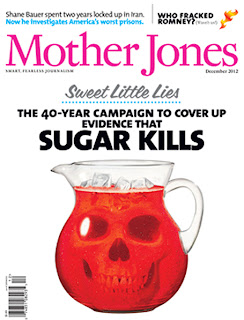
The "liberal" US magazine Mother Jones is running an article that purports to be a scoop about 'Big Sugar' (yes, they do use that term). For those who have an interest in how the anti-tobacco blueprint is rolled out to other products, it makes for morbidly fascinating reading.

Gary Taubes, who has written various diet and diet-related books, has found 1,500 old documents from defunct sugar companies which he thinks expose the practices of this evil industry. He is taking his cue from the Big Tobacco Mr Butts' documents, of course.

They show how Big Sugar used Big Tobacco-style tactics to ensure that government agencies would dismiss troubling health claims against their products.

Except they didn't. They commissioned research which found that sugar is, as the FDA have classed it, 'generally recognised as safe'. Which it is.

With the jury still out on sugar's health effects, producers simply needed to make sure that the uncertainty lingered.

What is this supposed to mean? If the jury is out, uncertainty is only appropriate reaction. Taubes does not claim that there is damning evidence against sugar—he says that "science will ultimately settle the matter". It seems, therefore, that Big Sugar's crime is to have failed to come up with compelling evidence to indict its own product, despite nobody else having done so either. Taubes only briefly acknowledges that this may be because sugar is not actually a dangerous substance, but even this caveat is given in the most slanted way...

Like the tobacco industry before it, the sugar industry may be facing the inexorable exposure of its product as a killer—science will ultimately settle the matter one way or the other—but as Big Tobacco learned a long time ago, even the inexorable can be held up for a very long time.

The words "may" and "inexorable" do not belong in the same sentence. Either there is sound science to condemn sugar as a health hazard or there isn't, and since Taubes' case for the prosecution rests on the ramblings of the cranky puritans at the Center for Science in the Public Interest and the batty and deceitful fruit-hater Robert Lustig, I'm going for the latter.


Wednesday, 31 October 2012

Is that a fact?

The big lie has returned. From NPR:

When smoking is banned in bars and workplaces, the number of people who suffer heart attacks and die drops within months, according to two new studies.

They found benefits not only in saving lives, but in lowering the cost of medical care for heart attacks, stroke and other smoking-related illnesses. It's the best evidence yet demonstrating big, swift health improvements when secondhand smoke is banished.

"We should now accept this as fact," says Richard Hurt, a professor of medicine at the Mayo Clinic who led one of the studies. Tobacco industry arguments that secondhand smoke isn't a major risk factor for heart disease, he says, are "just nonsense," because the only risk factor that changed in those 18 months was secondhand smoke. People's cholesterol and blood pressure stayed the same, and obesity rates increased.

And the man who invented this fraudulent field of pseudoscience is on hand for a comment of his own:

"It's just a gigantic effect," says Stanton Glantz, director of the Center for Tobacco Control Research and Education at UCSF, and a leader on the study. "There's nothing else you can do that's going to have that big an effect that fast."

Forgive my scepticism, Stanton, it's just that every time hospital admissions data are publicly available, they show these 'heart miracle' studies to be castles made of sand.

The latest effort focuses on Olmstead County, Minnesota, where the heart attack rate fell by 33 per cent between 2001 and 2009. All the ingredients of a heart miracle scam are in place.

Yes, these—ahem—'findings' were published by press release a year ago.

Yes, it's another small locality.

Yes, there's no control group to compare it to.

Yes, the timeframe studied is peculiar (the smoking ban was enacted in 2007).

Yes, heart attack rates have been falling all around the world with or without smoking bans (in the UK, for example, the heart attack rate fell by 50 per cent between 2002 and 2010.)

And yes, once again, the hospital admissions data make a mockery of the claim that the smoking ban 'caused' the fall in heart attacks. As Michael Siegel showed yesterday, the heart attack 'plunged' by a similar rate in the rest of Minnesota. And today, he has found data which show that the heart attack mortality rate which was falling steeply before the ban and then rose after it. Oh dear.

Thus, it is clear that the observed 33% reduction in heart attacks in Olmsted County during the study period is not attributable to the smoking ban.

Note that even if one looks only at hospital admissions for heart attacks in Minnesota, there was a 23% decline in these admissions between 2001 and 2006 alone (the data is not provided by HCUP past 2006). However, if one extrapolates to the year 2009 based on the secular rate of decline in the 2001-2006 period, the estimated number of hospital admissions for heart attacks in 2009 represents a drop of 34% from 2001.

In other words, in the absence of a smoking ban, heart attack admissions in Olmsted County would have been expected to drop by 34%. In the presence of the smoking ban, heart attack rates dropped by 33%.

Thus, it appears that the observed decline in heart attacks in Olmsted County is roughly representative of the overall trend in heart attacks in the state as a whole. In this light, the present study hardly supports a conclusion that the Olmsted County smoking bans produced a 33% decline in heart attacks.

If these are "definitive" results, I'd hate to see what "tentative" results look like.

Quite. Frankly, this is getting boring. It's the same crude trick again and again. Stop it.


Monday, 29 October 2012

First plain packs arrive in Oz

I'm grateful to an Australian reader for sending me photos of what the new 'plain' packaged cigarettes look like. The cigarettes below are the same brand, albeit different sized packs.


Note the near-meaningless lettering on the cigarettes themselves. The legislation forbids the stamp to have any relation to the brand—God knows why—and, as mentioned in the previous post, the loons are already complaining that this arbitrary rule is somehow being breached.


This is pretty underwhelming stuff. It beggars belief that millions of dollars have been spent battling for this makeover. Presumably somebody out there thinks that if the health warning has a yellow background, people will suddenly notice that smoking is not good for them?

Despite the protestations of the pro-plain pack campaigners, it seems quite obvious that the new packs are considerably easier to counterfeit. Nothing is embossed, only a few colours are used and the fonts are basic. The absence of branding on the cigarettes themselves mean that counterfeiters can stick the same batch of cigarettes in any box. I also see that the gold stripe at the filter has also been banned—that should save the black marketeers a few bucks. The whole plain pack ruse might as well be designed to help the illicit market. What fools these people are.

Meanwhile, to nobody's great surprise, plain packs are already giving retailers a headache.

Hughes IGA supermarket owner Michael Makas said he had sold a few of the new packets, which are required by law to be plain, except for health warnings and brand names. He said selling the new packets was already a "logistical nightmare" because his staff had problems distinguishing between brands.

Surely not!

7-Eleven worker Reece Cheng told The Age the plain packets create confusion for shop owners and customers alike.

"About 30 to 40 per cent of the cigarettes have already moved to the new packaging. It's very confusing I have to say because the new packaging is all the same. "Normally we memorise the whole display by the colours because people always ask for the colours."

This cannot be true, of course, for there is [cough] peer-reviewed evidence which proves that making dozens of cigarette brands virtually indistinguishable will make life easier for retailers. Like this, from the black-is-white quasi-journal Tobacco Control:

Conclusion: Rather than plain packaging requiring an additional 45 s per transaction, our results suggest that it will, if anything, modestly decrease transaction times and selection errors.

So that's that cleared up then (see Dick Puddlecote for more details about that particular piece of 'research'). Onwards and upwards!


Friday, 26 October 2012

The idiots have won

Build a spaceship folks. The idiots have won.


Exhibit A

In New Zealand, anti-smoking groups have broadened the definition of 'advertising' to include any form of speech by the tobacco industry on any issue.

A tobacco giant is being accused of illegally advertising cigarettes under the guise of a "public awareness campaign".

The Health Ministry has received 14 complaints against British American Tobacco New Zealand's "agree/disagree" campaign opposing plain packaging.


Here's an example of one of BAT's anti-plain packs ads. It nicely parodies the intolerance and bossiness of public health cranks who think that industry should be literally silenced in any policy debate. What it quite obviously doesn't do—as any sane observer will confirm—is advertise cigarettes.


Apparently, one of the people who complained about this campaign said it was "an attack on the sovereignty of political discourse in New Zealand".

Words fail me.


Exhibit B

The World "Health" Organisation is urging countries to crack down on e-cigarettes because they, er, look a bit like cigarettes.

"ENDS [electronic cigarettes] are products resembling cigarettes and could therefore undermine the denormalization of tobacco use upheld by the WHO FCTC... Parties are therefore invited to consider that a ban of ENDS as already undertaken by some Parties would contribute to changing the social norms regarding the consumption of tobacco products."

E-cigarettes are quite simply the biggest breakthrough in smoking cessation ever. The WHO is a disgrace which has betrayed its mission in developing countries and is more interested in dictating "social norms" than they are in saving lives. The whole rotten organisation should be investigated and shut down.


Exhibit C

Australian anti-smoking fruitcakes—led, inevitably, by that twisted old narcissist Simon Chapman—have complained that cigarette companies are breaching plain packaging rules because....well, I really don't know...watch the video and see if you can work it out. It seems to come down to the fact that the tobacco industry is allowed to stamp a few letters on the cigarettes for purposes of identification (how very liberal!) and so they have.

In one instance, Benson & Hedges cigarettes are labelled with "LDN"; in another case Winfield cigarettes are stamped with "AUS".

Yes. So. What?

Under the plain packaging regulations, cigarettes are allowed to be branded with an alphanumeric code but it must not represent or in any way be related to the brand or variant of the cigarette.

Professor Simon Chapman from Sydney University says the potential breach does not surprise him.

"They're probably just testing the waters here to see what they can get away with in the early stages of the new legislation," he said.

Professor Chapman says tobacco companies will do anything to create a sense of "intrigue" about their products.

Ooh, sense the intrigue!

I would like to comment on this, I really would, but the nutters have finally gone beyond the point at which I can even understand their arguments. My nearest guess would be that they think people will be 'lured' into taking up the smoking habit by seeing the letters 'LDN' on a cigarette. That is so stark-staringly, fetch-the-tranquiliser-gun insane that I can only assume that there is another layer of wibble that I've missed. On the other hand, we're dealing with people who think a BAT anti-plain packs campaign is a form of cigarette marketing so all bets are off.

Truly, the lunatics have taken over the asylum.