Showing posts sorted by date for query stockwell. Sort by relevance Show all posts

Friday, 11 September 2026

The nanny state newsletter

I've started doing a nanny state newsletter for my Substack subscribers (free). There's no particular schedule but they've been coming out every two weeks so far. If you don't subscribe, head on over and sign up. Here's a sample...


Belgium’s slippery slope

The Belgian government passed a law in May to put warnings on alcohol advertisements saying ‘Alcohol is harmful to health’. Not ‘Alcohol can be harmful to health’ or ‘Excessive drinking is harmful to health’, but ‘Alcohol is harmful to health’.

Belgian Brewers, a trade association, has now published an open letter with more than 1,000 signatures opposing the measure. The Flemish Centre of Expertise on Alcohol and Other Drugs has been lobbying for the new warnings (the phrase ‘alcohol and other drugs’ is a massive red flag for prohibitionism). Its director, Kathleen Peleman, said:

“The core of this message is that alcohol is damaging to your health,” Peleman adds. “Not just for the small group that struggles with addiction, but for everyone who drinks.”

That is indeed the message and it is clearly untrue. The anti-alcohol lobby are copying the anti-tobacco blueprint again. They want to portray alcohol as harmful at any level. That is why activist-academics such as Tim Stockwell devote to much energy to torturing the evidence to erase the health benefits of moderate drinking. This is not an arcane academic dispute. ‘No safe level’ is a crucial rhetorical device for taking alcohol down tobacco road.

The government wants to force the Belgian booze industry to put information on their adverts that is misleading at best and a lie at worst. It will not end there. The industry should take legal action before this gets out of hand.

HMRC tries to get real

HMRC is finally trying to do something about its hopeless estimates of the size of the illicit tobacco market. The title of a document that has not yet been made public - The Tobacco Tax Gap: Improving Tax Gap Statistics Through Wastewater Analysis - indicates that it intends to follow Australia’s lead and look for nicotine in sewage. When the Australian Bureau for Statistics did this, it estimated that 80% of tobacco sold Down Under was illicit. In the House of Commons, the health minister James Murray was asked how the study will differentiate nicotine from tobacco and nicotine from vapes (or pouches or heated tobacco or patches, etc.). He replied:

The methodology will distinguish between tobacco and nicotine consumption by analysing different chemical metabolites present in wastewater samples.

Specifically, tobacco consumption will be measured using the metabolites anabasine and anatabine, while nicotine consumption will be measured using cotinine and its metabolite 3-hydroxycotinine.

It’s a nice methodology. Meanwhile, the Co-op supermarket - which is losing out to the illicit trade - has found that 36 per cent of UK smokers have bought illicit cigarettes, rising to 49 per cent among those aged 35-44. Time is running out for the black market deniers.


Monday, 27 January 2025

Moderate drinking midwittery in the Economist

The Economist ran an article about moderate drinking a couple of weeks ago. Tediously and predictably, it revived the 'sick quitter' zombie argument and quoted Tim Stockwell as if he were the arbiter of this fake controversy. I sent a letter which has been published in the current issue. Bored of explaining the epidemiology, I thought I would mention some real science that the likes of Stockwell prefer not to discuss.
 

You suggested that moderate drinkers live longer than teetotallers because some teetotallers are “sick quitters” who wrecked their health with booze in the past (“Hard-liquor truths”, January 11th). This argument was first made in the 1980s and has been repeatedly disproved, most recently in a wide-ranging review from the National Academies of Sciences, Engineering and Medicine that found moderate drinkers have a 16% lower rate of all-cause mortality than lifetime abstainers, which you mentioned in your leader.

One does not need to have blind faith in observational epidemiology to accept the truth of this. The review notes that randomised controlled trials have shown that “moderate drinking favourably affects HDL cholesterol, low density lipoprotein (LDL) cholesterol, and apolipoprotein A-1”. It would be remarkable if this did not lead to lower heart disease and stroke risk, and it is this that explains most of the longevity gains enjoyed by moderate drinkers.


I've noticed the Economist descending into lower-midwittery recently. I can tolerate its relentless centrism and bed-wetting about 'populism' and Brexit, but I expect better from it than credulous reporting of Chris van Tulleken's claims about 'ultra-processed food' and the silly Texas sharpshooter theory about Lucy Letby. The magazine that identifies as a newspaper costs £9.99 now. Must try harder.


Wednesday, 18 December 2024

Moderate drinking continues to be good for you

Ongoing attempts to erase the health benefits of moderate drinking have suffered a setback in the USA. The National Academies of Sciences, Engineering, and Medicine has published a 230 page report to feed into the latest deliberations around the Dietary Guidelines for Americans 2025.

As (Bloomberg-funded) Stat News reports:
 

A major report on alcohol’s health effects — which will inform the 2025 Dietary Guidelines for Americans — found moderate drinkers had lower all-cause mortality, and a lower risk of death from cardiovascular disease, than those who never drank. The findings are sure to cause a stir, especially once a separate panel of experts releases its own alcohol report in coming weeks.

 
We can expect the anti-alcohol academics on that panel to come out swinging with the usual cherry-picked studies (hello, Tim Stockwell!) and merchant of doubt rhetoric. But for now, we have the actual evidence...
 
According to its meta-analysis, the committee found those who consumed moderate levels of alcohol had a 16% lower risk of all-cause mortality than those who never drank. This conclusion was graded as being of moderate certainty, meaning there was enough evidence to determine the health effects, but there are limitations due to the quality of the evidence. Future data could change the conclusion.
Meta-analyses the committee reviewed found moderate drinking was associated with a lower risk of heart attack, stroke and cardiovascular disease mortality as compared to never drinking.
 
This much we have known for decades. These associations have had everything thrown at them. There is probably no finding in epidemiology that has been subjected to so much rigorous examination. The reason for that is obvious: a lot of people in 'public health' don't want it to be true. 

And yet here we are.

You can read the full report here.


Thursday, 15 August 2024

Tim Stockwell in the Sunday Telegraph

The Sunday Telegraph ran a good article at the weekend about Tim Stockwell's obsessive crusade against the health benefits of moderate drinking. It includes some quotes from me. Here's a taster...
 

But many of Dr Stockwell’s respected peers say it is far from settled science and have cast doubt on his research. They question his motives and accuse him of being a front for a worldwide temperance lobby that is secretly attempting to ban alcohol.

Dr Stockwell denies this. Speaking to The Telegraph, he in turn accused his detractors of being funded by the alcohol lobby and said his links to temperance societies were fleeting. He was the president of the Kettil Bruun Society (a think tank born out of what was the international temperance congresses) and he has been reimbursed for addressing temperance movements and admits attending their meetings, but, he says, not as a member.

... “I have attended a meeting funded by the Swedish Temperance Organisation and I’ve written material that they have published,” he said. “I’ve had connections with the International Order of Good Templars. I’ve attended some of their meetings, but I’m not a member.”

On a practical level, drinkers will almost certainly be unaware of the explosive row Dr Stockwell’s research has generated in academia. But there is a very high chance they will have read one of the many stories his work has generated, and potentially modified their behaviour, reluctantly popping the cork back into the wine bottle or leaving the beer unbought on the supermarket shelf.

Now experts warn that the anti-drinking lobby – a “neo-temperance movement” – has the US and UK’s drinking guidelines in its sights.

“Dr Stockwell has never conducted any primary research into this as far as I’m aware,” Christopher Snowdon, head of lifestyle economics at the Institute of Economic Affairs, told The Telegraph. “He just keeps creating systematic reviews with the aim of trying to obscure the J-curve and the benefits of drinking. 

“You have what I think you can fairly describe as a neo-temperance movement operating quite effectively in Britain and around the world.

"A lot of these academics take the view that everybody needs to drink less. They’re very keen on being able to say there’s no safe level because then they could treat alcohol very similar to tobacco."
 
It's good to see the media digging a bit deeper into this.


Sunday, 28 July 2024

Tim Stockwell's cherry-picking goes into overdrive

He started with 3,248 relevant studies of which 3,125 were immediately discarded. This left 123 cohort studies to which he added 87 relatively recent cohort studies. By the time he had finished, he had whittled them down to just five - and then he had the nerve to published an article titled 'Why Do Only Some Cohort Studies Find Health Benefits From Low-Volume Alcohol Use?' The media lapped it up, as usual.

Yes, it's Tim Stockwell. Read all about it on my Substack.


Monday, 15 April 2024

Tim Stockwell's relationship with evidence

Tim Stockwell, who has been running a one man crusade against the benefits of moderate drinking for 20 years, has been on a bit of a media tour recently. He got a feature in the New York Times two weeks ago and is currently in Scotland where he is gearing up for a talk at the Royal College of Physicians on Wednesday. The talk has been organised by the state-funded Scottish Health Action on Alcohol Problems (SHAAP) and the anti-alcohol Institute of Alcohol Studies. As the Herald reports...
 

Prof Stockwell's talk in Edinburgh on Wednesday is also expected to coincide with MSPs voting on a motion to increase Scotland's minimum unit price (MUP) levy from 50 to 65 pence.

 
How fortuitous! 

Stockwell's longstanding approach has been to clog up the search engines with meta-analyses that either cherry-pick the data or retrospectively adjust it to diminish the benefits of moderate drinking - I wrote about his most recent effort last year. In an interview with the Herald this weekend, he was still banging on about the sick quitter hypothesis which has repeatedly been shown to not explain the alcohol J-Curve. 

He then turns to minimum pricing, which he keenly supports. You may recall that Stockwell conjured up some evidence for this policy back in the day, claiming that a 10% increase in the minimum price of alcohol in a Canadian province led to a 32% reduction in alcohol-related deaths. This would be a remarkably large effect if true but, as data from his own research group showed, it was not remotely true.

Stockwell's approach to matters related to alcohol is refreshingly simple. If he wants something to be true, he says it is true, regardless of what the evidence says. Since most journalists are not familiar with the evidence and trust anyone who sounds like they might be a doctor (Stockwell's degree was in psychology and philosophy), this is more effective than you might think.

For example, there is good evidence from both the official evaluation and independent research that minimum pricing in Scotland did not make heavy drinkers reduce their alcohol consumption. A study in BMJ Open found that the heaviest drinking 5% of men drank more after minimum pricing was introduced. Even the people at Sheffield University who did the modelling for minimum pricing in the first place had to admit that "the introduction of MUP in Scotland did not lead to a decline in the proportion of adult drinkers consuming alcohol at harmful levels".
 
Stockwell doesn't believe this therefore he says that it ain't so.

He said he is confident that MUP has made a difference to heavy drinkers, despite some surveys suggesting they had not cut down. 

He said: "If you look at total sales data: 50% of the alcohol sold is consumed by heavy drinkers.

"You don't get population level reductions - a 3% total reduction in consumption compared to England and Wales - unless heavy drinkers are cutting down. It's mathematically impossible."

 
I don't wish to insult your intelligence, dear reader, but it is definitely not mathematically impossible.  
 

"All the surveys done, however good they seem, are observational studies - not control studies."


Control studies? Does he mean randomised controlled trials? How could you even design an RCT to measure this? Nearly everything we know about the risks of drinking comes from observational studies. Isn't it funny how Stockwell accepts these when they show risks but not benefits and demands an impossible burden of proof when the results don't suit his agenda.

"So it really has worked, especially in people with heavy alcohol use."

 
OK, bud.


Friday, 28 July 2023

The long tentacles of temperance in Canada

You know your country is in trouble when the most sensible part of it is French, but that's the sad position Canada finds itself in. After the Canadian Center on Substance Use proposed the loony tunes drinking guideline of two drinks per week, there was much less mockery than there should have been. 

But this week the Quebec newspaper Le Devoir published an article (English translation here) taking a long overdue look at the people who led the review. Our old friend Tim Stockwell features heavily, as does his neo-temperance colleague Tim Naimi. It's no great surprise to hear that they've been working pro bono for the full on gospel temperance outfit that now goes by the name of Movendi.
 

The CCSA study, titled Canadian Landmarks on Alcohol and Health, was featured on the Movendi International website  less than 48 hours after publication, as are the work of some of its authors regularly. This nongovernmental organization — formerly known as the Independent Order of Good Templars, its website says  — actively promotes a completely alcohol-free life.

Researchers Tim Stockwell, Timothy Naimi and Adam Sherk state in CCSA's conflict of interest statement that they are "members of an independent group of scholars who volunteer their time to prepare research reports on various topics related to alcohol and health”. It is specified, in brackets, that this group is Movendi International.

Stockwell and Naimi even took a trip to northern Europe at Movendi's expense. The organization, based in Sweden, paid for their travel and accommodation costs. The two men also participated in the Movendi podcast, a production resolutely committed to raising awareness of the evils of alcohol consumption.

According to the statutes of the Independent Order of Good Templars, which date from 2006 and which are accessible on the Movendi website , its members must make a promise: "accept the obligation not to consume alcohol and not to non-therapeutic use of other addictive drugs, as well as fostering public acceptance of this principle”.

 
The worrying thing is not so much that people like Stockwell are pals with a nineteenth century prohibitionist organisation but that Movendi are official partners with the World Health Organisation. 

"I consider that there are issues of conflicts of interest," says Jean-Sébastien Fallu, associate professor at the School of Psychoeducation at the University of Montreal.

The addiction specialist is very critical of the CCSA report. According to him, the study makes generalizations about occasional drinkers and ignores the beneficial aspect for overall health that drinking with friends can represent. He believes that such recommendations can confuse the public and harm the work of stakeholders in the field.

“There are areas of research that are more subject to subjectivity, to politicization. The issue of substances, in general, is one. There is a lot of ideology. And the choices that were made [in the CCSA study] are ideological choices in many ways,” he adds.

 
In the McCarthyite world of 'public health' it would certainly be seen as a conflict of interest to have your expenses paid by a booze company. I don't see how having them paid for by a bunch of teetotal lobbyists is any different.
 
The article doesn't mention the Kettil Bruun Society, another organisation that keeps the flag of temperance flying. Tim Stockwell was its president back in 2005-07. Its current president is none other than Petra Meier of the notorious Sheffield Alcohol Research Group which provides supposedly unbiased modelling to governments on such policies as minimum pricing and tax rises, and was at the centre of the UK's drinking guidelines scandal.
 
Birds of a feather flock together, don't they?


Wednesday, 26 April 2023

Association Between Daily Alcohol Intake and Risk of All-Cause Mortality - a critique

Last month, I wrote about the latest attempt by Tim Stockwell and colleagues to erase the health benefits of moderate alcohol consumption (Zhao et al. 2023). There is now an expert review that is worth reading from the International Scientific Forum on Alcohol Research.

They discuss Stockwell's track record...
 

The current paper by Zhao J., Stockwell T., Naimi T., Churchill S., Clay J., Sherk A., (2023) is a follow-up paper to two published previously by this group trying to undermine the well-established J-shaped association between moderate alcohol consumption, cardiovascular disease and all-cause mortality. The first paper written by Filmore et al. (Fillmore et al., 2007) re-iterated the old and already falsified hypothesis that the J-curve would be generated by “sick quitters” or badly categorized moderate drinkers. The “sick quitters” hypothesis was duly discredited by reanalysis of the studies (Klatsky and Udaltsova, 2007). Also repeat studies adjusting for the claimed bias still showed a cardioprotective effect for regular light to moderate alcohol consumption (Di Castelnuovo et al., 2006, Ronksley et al., 2011).

The second paper written by Stockwell et al. (2016) was previously critically reviewed by ISFAR. Forum members noted that the authors were very selective in choosing papers to include in their new analyses: they identified 2,575 studies on the subject, analysed 87, but then found some reason to exclude almost all of these studies to reach a conclusion that “ . . . there was no significant protection of all-cause mortality for low-volume drinkers (RR = 1.04, 95% CI [0.95, 1.15]) ” based on what is apparently only six (6!) remaining studies. Their new analysis markedly distorted the accumulated scientific evidence on alcohol and CVD and mortality. As stated by one Forum member, “The biased selection of studies that are included undermines the value of the paper, but more importantly promulgates misinformation in the name of appropriate scientific method. Failure to acknowledge the robust body of knowledge that supports the opposite conclusion, and disqualification of extensive studies that offer plausible biologic explanation of observed benefits, is unconscionable.”

 
They also notice something in the supplementary material which undermines Stockwell's conclusion, even if you accept his cherry-picking of studies and the vast number of adjustments he makes to the data.
 
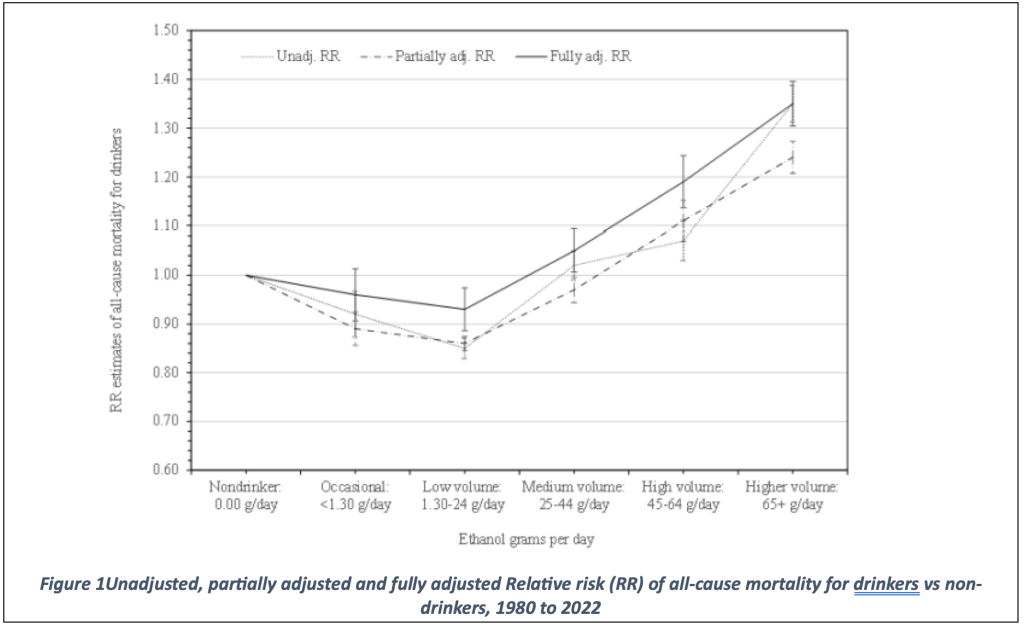
The unadjusted relative risks showed the classical J-shape. Surprisingly, even the fully adjusted relative risk showed a J-shaped curve as well: a significantly reduced relative risk for all-cause mortality for those drinking a ‘low volume’, namely 1.30-24 g/day. The authors, however, state that in their fully adjusted model “daily low or moderate alcohol intake was not significantly associated with all-cause mortality risk” and provide a risk estimate of 0.93 (CI: 0.85-1.01). This discrepancy between figure and text is not addressed by the authors. It is amazing that this discrepancy has not been noted by the reviewers and editors of JAMA Network Open. One wonders if reviewers and editors have read this paper in detail, a first task of reviewers would be to check whether the data support the conclusions. The editors have missed the fact that data and procedures, which were essential to derive at their conclusions have been transferred to the supplemental materials. This makes it impossible to grasp the authors approach from what was written in the original JAMA paper. 


The graph above comes from Stockwell's supplementary material. It shows overall lower mortality risk at up to 24 grams a day. 24 grams is three units. 
 
The authors have many criticisms of the meta-analysis, but the summary is this:

The key features that clearly demonstrate bias in the present paper are:

1.       This is the third attempt by the same group of researchers to disprove the beneficial relationship between light to moderate alcohol consumption and cardiovascular health. The first attempt (Fillmore et al, in 2006) was discredited by reanalysis of the studies. Reanalysis showed that after adjusting for the claimed bias the cardioprotective effect for regular light to moderate alcohol consumption was still apparent.

2.       Numerous meta-analyses have been undertaken over the past 15 years that have adjusted for this proposed bias and they have consistently shown that there is a cardioprotective effect for regular light to moderate alcohol consumption.

3.       In this new paper, Zhao et al., (2023) have again biased their meta-analysis by ‘cherry picking’ a small number of studies for their meta-analysis – they discarded 3230 studies and analysed only 107. The 107 studies selected did relate consumption to disease and all-cause mortality but the authors carefully avoided hundreds of validated studies that showed reduced disease risk among light to moderate drinkers.

4.       Countless animal and human studies over the past four decades have provided extensive evidence for the biological mechanisms supporting the findings that light to moderate alcohol consumption is cardioprotective. Zhao et al., (2023) seem to have deliberately pretended that they do not exist.


Friday, 21 April 2023

The WHO's guide to journalism

The incompetent and corrupt World Health Organisation has produced a ‘guide for journalists’ to help hacks report on issues related to alcohol accurately. Not entirely unpredictably, it is a catalogue of anti-drinking tropes, half-truths and brazen lies. The very first words are ‘No amount of alcohol is safe to drink’ and it doesn’t get any better thereafter.

The health benefits of moderate alcohol consumption really stick in the craw of the neo-temperance lobby and so that is where the WHO starts:

Isn’t drinking some alcohol good for your health?

No, there is no evidence for the common belief that drinking alcohol in moderate amounts can help people live longer by decreasing their risk of heart disease, diabetes, stroke or other conditions.

No evidence?! Even a casual follower of the science knows that there is at least some evidence. Those who are more familiar with the literature know that there is a huge amount of evidence built up over decades, tested and re-examined from every angle precisely because so many people in ‘public health’ don’t want to believe it.

It is inaccurate to say that “experts are divided” on whether there is no amount of healthy alcohol drinking. The scientific consensus is that any level of alcohol consumption, regardless of the amount, increases risks to health.

This is just a lie. That is not the consensus, and the only reason there isn’t unanimous agreement that moderate drinking is beneficial to health is that anti-alcohol academics such as Tim Stockwell have made it their life’s work to cast doubt on the evidence.

While several past studies did suggest that moderate consumption could, on average, promote health benefits…

Note that this immediately contradicts the claim that there is no evidence.

… newer research (1) shows that those studies used limited methodologies and that many of them were funded by the alcohol industry (2).

The first reference is a short commentary by some WHO staffers which doesn’t discuss methodologies at all. The second reference is a study which found that only 5.4 per cent of research papers in this area were funded by the alcohol industry and concluded that ‘the association between moderate alcohol consumption and different health outcomes does not seem to be related to funding source.’

The WHO must hold journalists in low esteem if it thinks they won’t check up the citations like this.

The dicussion [sic] about possible so-called protective effects of alcohol diverts attention from the bigger picture of alcohol harm; for example, even though it is well established that alcohol can cause cancer, this fact is still not widely known to the public in most countries (3).

The ‘bigger picture’ is overall mortality. When all the risks are taken into account, including the small risks from a few rare cancers, do moderate drinkers live longer than teetotallers? Yes. Yes, they do.

But what about reports that a daily glass of red wine is good for your heart?

There is no good evidence for the pervasive myth that consuming red wine helps prevent heart attacks.

Note that they’ve shifted from ‘no evidence’ to ‘no good evidence’. It seems that no evidence is good unless it shows that drinking at any level is a killer.

The main reason that moderate alcohol consumption reduces overall mortality is that it substantially reduces the risk of cardiovascular disease. The evidence for this is not just ‘good’. It is overwhelming. For example, this meta-analysis of 84 studies concluded that: ‘Light to moderate alcohol consumption is associated with a reduced risk of multiple cardiovascular outcomes.’ The risk of cardiovascular disease mortality was 25 per cent lower than among non-drinkers.

Since red wine is a form of alcohol, it would be very odd if drinking a moderate quantity of it wasn’t good for the heart. All the evidence shows that it is, and there are some reasons to think that it might be even better than other forms of alcohol in this respect.

Why are national drinking guidelines different from WHO recommendations?

Many countries have issued low-risk guidelines, usually recommending no more than 10 standard drinks per week. WHO does not set particular limits because the evidence shows that the ideal situation for health is not to drink alcohol at all.

Again, this is simply a lie.

Doesn’t most alcohol harm come from a minority group of heavy drinkers?

The common perception is that a small fraction of the population causes most of the harm linked to alcohol consumption. But alcohol-related cancers, accidents, injuries and violence are widely distributed across the population (8), including among those who drink moderately. Even though heavy drinkers are undoubtedly at high risk of alcohol-related harm, they contribute only a minority to the total alcohol casualties. In this “prevention paradox”, most alcohol-related harm occurs among low-to-moderate risk drinkers simply because they are more numerous in the population.

This is a reference to one of the ideas of Geoffrey Rose who argued that there are more deaths from a large number of people exposed to a low risk than from a small number of people exposed to a large risk. While this could be true of some risk factors in certain circumstances, it is not a general rule and it is particularly poorly suited to alcohol because the risk of low to moderate consumption is negative, i.e. it is beneficial.

‘Alcohol-related cancers’ are relatively rare and mostly affect heavy drinkers. It is reasonable to assume that most drink-related ‘accidents, injuries and violence’ also involve heavy/binge drinkers. The prevention paradox just doesn’t apply to alcohol and Rose never claimed it did. Some academics have tried to claim otherwise, but they have had to narrow their scope to a limited range of ‘harms’ and portray people who get drunk as moderate drinkers to do so.

The real reason why organisations like the WHO are so keen to pretend that everybody is at risk from alcohol harm and there is no safe level of drinking is that it can be used to justify population-wide policies such as minimum pricing (which the WHO’s new report wrongly describes as ‘effective’). They say this in so many words in the summary:

Takeaway

Alcohol consumption causes considerable harm to millions of people across the world, not just the heaviest users, which is why strong global action that protects the entire population is needed.

Why, you may ask, is the WHO taking such a hard line on this that it is prepared to lie to our faces? Preaching total abstinence is a departure for the WHO. It is not what most of its member states expect of it and it is out of line with its previous messaging.

Part of the reason is that some member states do support total abstinence. You have to remember that alcohol prohibition is still a reality in some countries. Several other countries, such as India and Turkey, allow the sale of alcohol but strongly discourage it. Russia and some of the Baltic states have been clamping down on alcohol in a big way in recent years. The WHO has to represent all these interests.

The bigger and more important reason is that anti-alcohol activists have weaseled their way into the WHO in growing numbers. A lot of WHO reports are written anonymously. This one isn’t, and its list of contributors is very revealing. They include:

  • Phil Cain, European Alcohol Policy Alliance (Eurocare)

  • Florence Berteletti, Eurocare

Phil Cain is a former BBC journalist who has been tweeting about alcohol for years and has become increasingly fanatical. I didn’t know he was now at Eurocare but it makes sense. Eurocare is an EU-funded temperance pressure group formed in 1990 by the Methodist teetotaller Derek Rutherford.

  • Maik Dünnbier, Movendi International

The International Order of Good Templars is a gospel temperance group formed in the mid-19th century. A few years ago they realised that their name sounded a bit too religious/masonic so they changed it to Movendi. Their agenda of total abstinence remains the same. It is now an official partner of the WHO.

  • Øystein Bakke, Global Alcohol Policy Alliance and FORUT

The Global Alcohol Policy Alliance is another temperance group set up by Derek Rutherford. Notice the trend of temperance groups giving themselves bland names so they can slot themselves into the field of ‘public health’. Formed in 2000, Derek Rutherford said its priority was to “make the most of the opportunities provided by the development of the WHO Global Alcohol Strategy and the focus on non-communicable diseases.” It is certainly doing that.

  • Adam Knobel, Foundation for Alcohol Research and Education (FARE)

FARE is a state-funded anti-alcohol organisation set up by the Australian government with a $115 million grant. It says that it spends 50 per cent of its income on ‘policy and advocacy’ and 15 per cent on ‘leading change’. In other words, it is a pressure group.

  • Nason Maani, London School of Hygiene and Tropical Medicine

Maani is an activist-academic who has co-authored many hilariously bad articles with Mark Petticrew about the alcohol industry.

  • David Jernigan, Boston University School of Public Health

Jernigan is also on the board of the Global Alcohol Policy Alliance and speaks at their mad conferences.

Finally, there is Juan Tello. Listed as co-editor of the guide for journalists, he is in charge of the WHO’s Less Alcohol Unit. He recently gave an interview in which he complained about the ‘normalisation’ of alcohol and wibbled on about the ‘commercial determinants of health’. He makes no secret of ‘pursuing a no alcohol environment’.

His interview did contain one bit of good news, however.

Juan Tello: We give countries five recommendations that are cost effective to implement, especially in middle-income countries: increase pricing, particularly through taxation; ban marketing and sponsorships advertising alcohol; decrease the physical availability of alcohol outlets; enforce checks and control of blood alcohol concentration; and treatment. We are well positioned to do this when countries are willing to move forward. 

Think Global Health: What’s the level of interest from countries?  

Juan Tello: The uptake is low. It’s truly low.

Excellent. Let’s hope it stays that way. In the meantime, if journalists are looking for a story about alcohol, may I suggest an article about WHO reports being written by anti-alcohol activists?


Friday, 31 March 2023

Tim Stockwell is at it again

The campaign to make people believe that moderate drinking is bad for their health resumed today with a study in JAMA Network Open. Those who follow such things closely will be unsurprised to hear that it was produced by Tim Stockwell and his colleagues at the Canadian Institute for Substance Use Research.

Stockwell has waged a one man crusade against the benefits of drinking for over a decade. He is past president of the neo-temperance Kettil Bruun Society and was involved - and heavily cited - in the process that lowered the UK drinking guidelines for no good reason. Along with his colleague Tim Naimi, he has since been at the helm of efforts to reduce Canada’s guidelines to two drinks per week. Despite being slapped down by experts in the field, he continues to produce countless journal articles casting doubt on the benefits of moderate drinking. Today’s publication is his third attempt at making a meta-analysis that erases the J-Curve.

The J-Curve shows the well established finding that the health risks of drinking fall and then rise in proportion to consumption. Temperance activists hate it because it shows that drinking nothing is worse for you than drinking a bit.

The copium response to this is to say that some non-drinkers are ex-drinkers who used to drink a lot and wrecked their health. This possibility was first raised in the 1980s and has been comprehensively dealt with by numerous studies that exclude former drinkers and only compare drinkers to lifetime abstainers. The J-Curve holds.

Stockwell’s new study concludes:

This updated meta-analysis did not find significantly reduced risk of all-cause mortality associated with low-volume alcohol consumption after adjusting for potential confounding effects of influential study characteristics.

This conclusion will come as a shock to anyone who follows alcohol research. Barely a month goes by without a new study confirming the health benefits of moderate drinking. Stockwell says his meta-analysis uses ‘fully adjusted, prespecified models that accounted for effects of sampling, between-study variation, and potential confounding from former drinker bias and other study-level covariates’. Whatever this entails (he doesn’t go into detail), it results in a meta-analysis that bears no resemblance to the evidence it is supposed to be summarising.

He says:

Drinker misclassification errors were common. Of 107 studies identified [out of over 2,000 available - CJS], 86 included former drinkers and/or occasional drinkers in the abstainer reference group, and only 21 were free of both these abstainer biases.

Cool, let’s just look at those 21 studies then, shall we? Here they are in alphabetical order…

Bergmann et al. (2013) - Supports the J-Curve. Found that ‘light to moderate alcohol consumption’ was associated with a significantly lower risk of cardiovascular disease. The study includes a J-Curve graph.

Cullen et al. (1993) - Supports the J-Curve. Found that the ‘adjusted relative risk of cardiovascular disease death among moderate drinkers was 0.68 (95% CI 0.51-0.91), and that of coronary heart disease death was 0.66 (95% CI 0.45-0.98).’, i.e the risk for moderate drinkers fell by a third.

Daya et al. (2020) - Supports the J-Curve. Found that: ‘Those who reported drinking ≤1 to 7 drinks/wk had the lowest all-cause mortality rate’.

Friesema et al. (2007) - Supports the J-Curve. Found that non-drinkers tend to rate their health worse than drinkers but that ‘these differences in health do not seem to explain the observed U-shaped curve between alcohol intake and cardiovascular events and only partially explain the U-shaped curve between alcohol intake and all-cause mortality’.

Jankhotkaew et al. (2020) - Doesn’t support the J-Curve. Study from Thailand didn’t find a J-Curve.

Kapiro et al. (2019) - Supports the J-Curve. Finnish study found ‘the lowest age-sex adjusted mortality was found for those drinking 1 drink per week on average, while consistent abstainers (HR 1.27,95%CI 1.09 to 1.49) and those consuming more had significantly elevated risks.’

Kunzmann et al. (2018) - Supports the J-Curve. US study ‘supports a J-shaped association between alcohol and mortality in older adults, which remains after adjustment for cancer risk’. It contains a familiar graph.

Kono et al. (1986) - Supports the J-Curve. Found higher rates of mortality among men who drank heavily, but lower rates of heart attack mortality among moderate drinkers.

Makela et al. (2005) - Supports the J-Curve. ‘Moderate drinking is associated with a lower risk of IHD [ischemic heart disease], whereas drinking in a heavy episodic manner (often referred to as "binge drinking") is not.’ Women who drank moderately had lower rates of all cause mortality but this was not statistically significant among men.

Nakaya et al. (2004) - Doesn’t support the J-Curve. This study from Japan found a linear increase in all cause mortality risk as people drank more. The associations were not statistically significant.

Ortola et al. (2019) - Doesn’t support the J-Curve. This Spanish study didn’t find a J-Curve after making lots of adjustments.

Pednekar et al. (2012) - Doesn’t support the J-Curve. This study from India found that all cause mortality risk was higher among drinkers, regardless of quantity consumed, although this included diseases like tuberculosis which are not caused by alcohol.

Perreault et al. (2006) - Supports the J-Curve. British study found that ‘occasional drinkers’ had lower all cause mortality.

Rehm et al. (2001) - Supports the J-Curve. US study found ‘a significant influence of drinking alcohol on mortality with a J-shaped association for males and an insignificant relation of the same shape for females’.

Sadakane et al. (2009) - Supports the J-Curve. Study from Japan found ‘a near J-shaped association was identified between alcohol consumption and all-cause mortality’.

Sempos et al. (2003) - Doesn’t support the J-Curve. Study of African Americans found no J-Curve. The authors say this ‘may be the result of the more detrimental drinking patterns in this ethnicity and consequently the lack of protective effects of alcohol on coronary heart disease’.

Sun et al. (2009) - Supports the J-Curve. Study from Hong Kong found that ‘both occasional and moderate types of alcohol use were associated with lower mortality compared to never-drinkers’.

Thun et al. (1997) - Supports the J-Curve. This US study involving 490,000 people found that heart disease mortality was 30-40% lower among people who had at least one drink a day and that ‘overall death rates were lowest among men and women reporting about one drink daily’.

Tsubono et al. (1993) - Supports the J-Curve. Study from Japan found lower rates of mortality among people who drank up to 3 drinks a day.

Zaridze et al. (2014) - Insufficient evidence either way. This study from Russia found all cause mortality higher among vodka drinkers although ‘there were too few deaths to determine reliably whether a little vodka consumption provided a slight protective effect or a slight hazard.’ A ‘moderate drinker’ in this study was someone who drank up to half a litre of vodka a week.

Stockwell also includes Almeida et al. (2017) in the list of studies that were ‘free from abstainer bias’ but it is a Mendelian Randomisation study and so there is no way of knowing whether the people, who were only represented by their genes, abstained or not. I have explained before why MR studies are useless at identifying risks from voluntary activities.

If you skipped all that, the bottom line is that three-quarters of these studies, which Stockwell portrays as the gold standard, support the existence of the J-Curve. I don’t have time to go through the other 86 studies but I am familiar enough with the literature to know that they are not go to change the overall picture.

God knows what statistical jiggery-pokery he and his team engaged in to take this evidence and draw the conclusion that there are no health benefits from drinking moderately. Either you can believe that the original researchers knew what they were doing or you can believe that a neo-temperance campaigner with a bee in his bonnet can make appropriate adjustments to studies for which he doesn’t have the original data. Amongst other tricks, he seems to have reclassified occassional drinkers as teetotallers.

In the limitations section, he writes:

A major limitation involves imperfect measurement of alcohol consumption in most included studies, and the fact that consumption in many studies was assessed at only 1 point in time. Self-reported alcohol consumption is underreported in most epidemiological studies … If this is the case, the risks of various levels of alcohol consumption relative to presumed lifetime abstainers are underestimates.

This is true but he does not linger on the implications of it. People only report around 50% of what they drink (we know this because we know how much alcohol is sold). Under-reporting also means that an ‘occasional drinker’ drinks rather more often than you might think.

Therefore, if observational epidemiology shows that a risk from a certain disease begins to increase when people are drinking 20 units a week, for example, they are actually drinking 40 units a week. If we see benefits from drinking up to 10 units a week, the benefits actually apply to people who are drinking up to 20 units a week.

The effect of systematic under-reporting is to make alcohol look significantly more dangerous than it is. There has been very little effort by epidemiologists to account for this well known problem in their work.

Stockwell’s previous meta-analysis was accused of cherry-picking studies. I have my doubts about his selection process in his new meta-analysis too. He tells us that he has included all the studies published since his last effort in 2016, but I can think of several that are missing. For instance…

The National FINRISK Study of Härkänen et al. (2020) found that:

As many other observational cohort studies, also the FINRISK Study shows a J-shaped association with alcohol consumption and mortality, with moderate drinking associating to lower hazard than non-drinking.

Xi et al. (2017) studied 333,247 US adults and found that:

‘Compared with lifetime abstainers, those who were light or moderate alcohol consumers were at a reduced risk of mortality for all causes’.

Van den Brandt and Brandts (2020) looked at the odds of living to old age and found ‘the highest probability of reaching 90 was found in those consuming 5- < 15 g/d alcohol, with RR = 1.36 (95% CI, 1.20-1.55) when compared with abstainers’.

Li et al. (2020) also found that moderate alcohol consumption was associated with lower mortality, although you have to read the study carefully to see that.

The fact of the matter is that high quality studies comparing moderate drinkers to lifetime abstainers just keep on coming and they keep on finding the same thing. If this was any other field of research, scientists wouldn’t even bother studying it any more. The case would have been closed years ago.

Instead, we have a fake ‘controversy’ stirred up by people like Tim Stockwell who want to be able to claim that there is ‘no safe level’ of alcohol. The reasons for this are political and ideological. They have nothing to do with science. Studies like the one published today are not aimed at the scientific community. They are aimed at the media and, ultimately, policy-makers.


Cross-posted from the Snowdon Substack.


Thursday, 19 January 2023

Canada's clown world drinking guidelines

Canada is on the brink of making itself an international laughing stock by cutting its drinking guidelines from two drinks a day to two drinks a week. The previous guidelines were only set in 2011 so Canadian drinkers can be forgiven for being suspicious about this dramatic change. The evidence base has not significantly changed in the interim. The evidence for the health benefits of moderate drinking has continued to pile up. 

The only thing that has really changed is that neo-temperance zealots like Tim Stockwell have tightened their grip on alcohol research. Stockwell and his 'no safe level' pal Tim Naimi both live in Canada and are both authors of the report that has made the ludicrous new recommendations.

I have been saying for over a decade that the 'public health' plan is to get the guidelines down to zero so they can start regulating alcohol like tobacco. The evidence does not support this fundamentally ideological campaign and so the evidence has been dropped in favour of fantasy modelling and cherry-picking.


There is a continuum of risk associated with weekly alcohol use where the risk of harm is:

  • 0 drinks per week — Not drinking has benefits, such as better health, and better sleep.
  • 2 standard drinks or less per week — You are likely to avoid alcohol-related consequences for yourself or others at this level.
 
"Likely"!? How about certain? 
 
  • 3–6 standard drinks per week — Your risk of developing several types of cancer, including breast and colon cancer, increases at this level.
 
The only source given for the claim about colon cancer is this meta-analysis which claimed that 10 grams of alcohol per day was associated with a seven per cent increase in colon cancer risk. This is a smaller risk than having a portion of red meat a day. It found no statistically significant increase in risk in studies which had data on what happens when people have one 'drink' a day.

A Canadian 'standard drink' contains 13.45 grams of alcohol. Three standard drinks equals 40 grams. Four standard drinks equals 53 grams. The meta-analysis has no data on people who drink so little, so the claim that colon cancer risk increases at three or more standard drinks is not supported even by the authors' own preferred source.

As for breast cancer, which can only affect half the population and is partly why most countries have different guidelines for men and women, the report cites this meta-analysis of 22 studies, 13 of which found no statistically significant association with drinking. It pooled the studies and reported a 10 per cent increase in risk for people drinking 10 grams of alcohol a day. As with the colon cancer study, this was the minimum quantity studied so it tells us nothing about Canadians who drink 3-5 standard drinks.

In terms of mortality, another meta-analysis found that light drinking was not positively associated with any form of cancer, including breast cancer, and was negatively associated with cancer in a couple of instances:

.. light drinking reduced the mortality of female stomach cancer (RR, 0.65; 95% CI, 0.44 to 0.98; n=1) and male lung cancer (RR, 0.79; 95% CI, 0.70 to 0.87; I2=0.0%; n=5). There was no significant association between light drinking and the mortality of oropharyngeal cancer, esophageal cancer, larynx cancer, colorectal cancer, liver cancer, female gallbladder cancer, pancreatic cancer, breast cancer, cervical cancer, prostate cancer, and hematologic malignancy.
 
As with all this evidence, we should remember that people under-report the amount of alcohol they consume by around 50 per cent, so when a study says 10 grams a day it probably refers to 20 grams a day. This is an important point that anti-alcohol researchers are well aware of but only mention when it suits them.
 
  • 7 standard drinks or more per week — Your risk of heart disease or stroke increases significantly at this level.
 
This is just a flat out lie. As countless studies have shown, heart disease and stroke risk is substantially reduced among light and moderate drinkers. For example, a meta-analysis of prospective cohort studies (which track people’s drinking habits and health status over a number of years and are the most reliable studies in observational epidemiology) found that drinkers were 25 per cent less likely to die from coronary heart disease than teetotallers. The evidence for strokes is similar.
 
 
This is main reason why life expectancy is longer for moderate drinkers and the relationship between alcohol consumption and mortality is J-shaped.


The authors of the Canadian report essentially ignore all this evidence and instead focus on a cherry-picked meta-analysis written by Stockwell, Naimi and pals which massively adjusted the figures to arrive at their desired conclusion. This is inexcusable.
 
  • Each additional standard drink radically increases the risk of alcohol-related consequences.
 
"Radically"! Be careful out there!
 
The whole thing's a joke and I suspect the public will see it as such. There is a legitimate debate about whether low levels of alcohol consumption slightly increase cancer risk, but this has to put within the context of the reduction in risk for cardiovascular disease. The fact remains that the positive effects of moderate drinking on heart disease and other conditions exceed and outweigh the negative effects on cancer risk. 
 
People want to know what the overall risks of light, moderate and heavy alcohol consumption are. This is what drinking guidelines should tell us. Focusing on small and unproven cancer risks at very low levels of consumption while ignoring the benefits is lying by omission. 


Thursday, 23 June 2022

Minimum pricing continues to go wrong

"Minimum pricing is one of the stronger policies the Scottish Government has come up with"

 
Minimum pricing in Ireland has very predictably led to people driving to Northern Ireland to buy booze, as the Irish Times reports.... 

In the car park of Seamus McNamee’s off-licence, First and Last, located just minutes north of the Border, are vehicles from all over the country.

The customers, some of whom have travelled from the likes of Carlow, Wexford and Roscommon specifically, reflect the surge in business the Jonesborough retailer has experienced from the South of Ireland, following the introduction of minimum unit pricing (MUP) in the Republic.

“Since the Irish Government introduced MUP, it’s just been gradually crazy with people from southern Ireland. Since March, and then the last bank holiday weekend, it’s just been crazy. We’re run off our feet,” Mr McNamee said.

“It’s hard to quantify the increase because of the pandemic, but I’d say it’s jumped up another 30 to 40 per cent.”

Slabs of beer are the most popular for those travelling cross-Border, Mr McNamee said, as they have been most affected by the new law.

“It used to take us maybe three or four weeks to sell a pallet. Now, since MUP, we would be doing three to four pallets of Coors or Bud per week.”

Consumers are buying in bulk, too, and buying for four or five members of the one family at a time.

“They’re coming with a list and getting their bits and pieces here. You can get a spend of between €200 to €400, up to maybe €2,000 or €3,000.”

 
Meanwhile in Scotland, where the case for minimum pricing is in tatters, a 'public health expert' is doing an impression of Comical Ali.
 

A PUBLIC health expert has rubbished a Tory MSP's claim that minimum alcohol pricing isn’t working in Scotland.

In May 2018, Scotland became the first country in the world to set a base price for each unit of alcohol sold - driving up the price of cheaper booze.

Dr Sandesh Gulhane, Tory MSP for Glasgow region, claimed during a meeting of the health committee in Holyrood that the scheme was failing and that the most vulnerable were cutting back on food to afford the high prices. 

 
Indeed. Here is what the report concluded:

The introduction of a £0.50 MUP in Scotland led to a marked increase in the prices paid for alcohol by people with alcohol dependence. There is no clear evidence that this led to reduced alcohol consumption or levels of alcohol dependence among people drinking at harmful levels. 
 
... People who struggled to afford the higher prices arising from MUP coped by using, and often intensifying, strategies they were familiar with from previous periods when alcohol was unaffordable for them. These strategies typically included obtaining more money by reducing spending on food and utility bills, increasing borrowing from sources such as family, friends or pawnbrokers, running down savings or other capital, and using foodbanks or other charities. In line with this, the policy increased the financial strain felt by a significant minority of people with alcohol dependence.
 
Nevertheless....

However, Professor Petra Meier told MSPs that she didn’t agree with his assessment of the policy and said it was one of the “stronger policies” the Scottish Government has come up with without full control of tax powers and alcohol duties. 

... Meier, director of the SIPHER Consortium which analyses the long term impact of health policies, said that she didn’t agree with Gulhane’s assessment.

She added: “It's working on the whole. There are some very heavy drinkers who may not have the opportunity to cut down their drinking who then substitute for food spending. I don't think that's a problem of the price you put on alcohol, I think it's a problem on the health services that haven't been available." [what?! - CJS]

... Meier added that for very dependent drinkers the policy “hasn't had many detrimental effects, but there has been some substitution with big purchases”.

 
This is delusional stuff. There is literally no evidence that minimum pricing is working. The evaluations looking at heavy drinkers, crime and hospital activity all found no evidence of any benefits. 

Nowhere in the article is it mentioned that Petra Meier was the head of the Sheffield University group that did all the modelling for minimum pricing. This modelling was virtually the only 'evidence' that the policy would work and it turned out to be deeply flawed. 
 
Long time readers may recall that Meier had no experience in the field of alcohol research (or modelling, as far as I can see) until she spotted a gap in the market for government-commissioned minimum pricing modelling. Having expressed an interest in alcohol research, she was immediately embraced by neo-temperance activist-academics like Robin Room and Tim Stockwell. 
 
She has done rather well out of it. She is now a professor and, in 2019, received £5 million from the unwitting taxpayer to set up her SIPHER outfit which employs many of her chums. Last year, she received the ultimate accolade from the temperance lobby when she was made president of the weirdo cult anti-drinking organisation, the Kettil Bruun Society (named after the godfather of the ridiculous 'whole population approach'). 

It must stick in the craw that some of her old Sheffield colleagues co-authored the Public Health Scotland evaluation that delivered such a blow to the cause two weeks ago, and it must be hard to admit that the work upon which your reputation rests was worthless junk, but that's just the way it goes sometimes.


Thursday, 3 February 2022

Getting the facts right with Tim Stockwell

Neo-temperance activist-academic Tim Stockwell has been talking to the Irish media about minimum pricing...

Everyone in the alcohol research and epidemiology world pretty much agrees that MUP is probably the single most effective strategy to reduce drinking with the least downsides. In Scotland, which brought it in in 2018, alcohol consumption and deaths have already gone down.

So whatever people feel about it, I think it’s really good to get the facts straight because they’re very well researched.

 
Yes, it is very important to get the facts straight. Facts like Scotland's rate of alcohol-related mortality being at a nine year high, for example.  


Could more expensive booze lead to people drinking cheaper liquids, like hand sanitizer or rubbing alcohol?

The studies we’ve done with people with severe alcohol use disorders show “non-beverage” is their absolute last resort. Mostly, they avoid it like the plague.

The proof in the pudding is this – you wouldn’t get the decrease in liver cirrhosis rates we see if they were just shifting their drinking.

 
What decrease in liver cirrhosis rates would this be? The link (which I assume Stockwell gave the journalist to insert) goes to a study from 2014, four years before minimum pricing was tried anywhere. Its lead author is MUP campaigner Nick Sheron and all it did was look at how much some heavy drinkers who had liver cirrhosis spent on alcohol and work out how much more they would spend under minimum pricing. It didn't even model the impact on liver cirrhosis rates. 
 
Facts, eh?


Monday, 16 August 2021

The drinking guidelines were set by temperance zealots

First published by Spectator Health in February 2016 


I've been reading the minutes of the meetings held by the committee that reviewed the alcohol guidelines recently. You may recall that this was the first full review since 1995 and led to the Chief Medical Officer (CMO), Sally Davies, lowering the recommendations for men from 21 to 14 units a week. The female guidelines were left at 14 units. She also claimed that the health benefits derived from moderate drinking were an ‘old wives’ tale’ and claimed that there was ‘no safe level of alcohol’.

The most striking difference between the 1995 review and the 2016 review is the make-up of the panels. Whereas the 1995 committee was dominated by civil servants who had no obvious prejudices for or against alcohol, the meetings held from March 2013 to discuss alcohol guidance were dominated by activist academics and temperance campaigners.

The Institute of Alcohol Studies (IAS), a small but hardline anti-alcohol organisation, was heavily represented on the committee. The IAS was formed in the 1980s as a direct successor to the UK Temperance Alliance which, in turn, had been formed out of the ashes of the UK Alliance for the Suppression of the Traffic of All Intoxicating Liquors, a prohibitionist pressure group. The IAS receives 99 per cent of its income from the Alliance House Foundation whose official charitable objective is ‘to spread the principles of total abstinence from alcoholic drinks’. Its director, Katherine Brown, was on the CMO’s panel, as was its ‘expert adviser’ Gerard Hastings, although he failed to disclose his IAS role in his declaration of interests.

The IAS’s scientific adviser Petra Meier was also on the committee and was joined by her Sheffield University colleague John Holmes. Holmes and Meier are both strong advocates for minimum pricing and helped develop a computer model which has been repeatedly used to promote minimum pricing by producing estimates of the number of lives that will supposedly be saved by the policy.

Another staunch anti-alcohol campaigner, Ian Gilmore (chairman of the Alcohol Health Alliance, of which the IAS is a key member), was unable to attend the first meeting but was involved thereafter. Gilmore has campaigned for many years for higher alcohol taxes, minimum pricing and a total ban on alcohol advertising.

Other members of the committee may have been less strident than Gilmore and the IAS but there was no doubt where their biases lay. Mark Bellis wrote an article for the British Medical Journal in 2011 complaining that existing alcohol guidance was too generous and ‘read more like an alcohol promotion slogan’. Mark Petticrew and Theresa Marteau are both strong advocates of a range of heavily interventionist ‘public health’ policies, including sugar taxes, plain packaging and minimum pricing.

Of those who attended the initial meetings in 2013, only three did not explicitly advocate stricter alcohol control: the health economist Martin Buxton, the health sociologist Sally Macintyre, and the epidemiologist Valerie Beral. The latter appears to have been selected because of her research linking alcohol to breast cancer, which would become a crucial element in the ‘no safe level’ narrative.

The minutes of a meeting in June 2013 indicate that the path towards dismissing the benefits of moderate alcohol consumption was mapped out from an early stage. Mark Petticrew told his new colleagues: ‘The beneficial effects of alcohol consumption, where they are evidenced, are limited to a low consumption level of half a drink per day.’ Moreover, he said, ‘The population cohort who experiences any beneficial health effect from alcohol is very small. Given these limitations, there is an argument that beneficial effects could be considered not to be relevant in the context of an overall population message, advice or guidance.’

These bald assertions were based on private meetings held between Petticrew and two alcohol researchers, Jurgen Rehm and Tim Stockwell, a fortnight earlier. As a result of this information, the minutes of the 25 June meeting state that the group ‘agreed that a key message from the Rehm/Stockwell discussion is that the evidence shows that any amount of alcohol increases the risk of cancer. Therefore it cannot be said that there is such thing as a “safe” limit.’

Here were the two central messages that would be transmitted, almost word for word, to the British public two and half years later — that the benefits of moderate consumption had been much exaggerated and there is no safe level of drinking. This new narrative appears to have arisen from nothing more than a private meeting with two researchers. Rehm has strong views on alcohol policy (he advises governments to ‘treat alcohol like tobacco’) and he is a respected alcohol researcher but his views, as ventriloquised by Petticrew, bear little relationship to what he told the BBC after the guidelines were announced. On BBC Radio 4’s More or Less programme, he made it clear that there was good evidence that moderate alcohol consumption reduced the risk of heart disease and other diseases. Rehm’s own research concluded that the protective effect of alcohol on heart disease was ‘hard to deny’ and not just for those who consume ‘half a drink a day’, as Petticrew claimed, but for larger quantities too. Rehm’s 2012 systematic review found that heart disease risk was at its lowest for men drinking around four units a day, with a lower optimal level for women.

While Rehm’s views may have been misreported by Petticrew, those of Tim Stockwell were not. Stockwell is the world’s most persistent and prominent critic of the evidence showing that moderate alcohol consumption saves lives. His various letters, editorials and studies casting doubt on the benefits of drinking were given a hugely disproportionate prominence in the 2016 guidance. It is telling that Petticrew’s first act was to approach Stockwell and allow his controversial opinion to frame the debate.

The other striking difference between the 1995 review and the 2016 review is the range of evidence put before the respective committees. Whereas the 1995 panel received dozens of submissions, the minutes of a March 2013 meeting show Sally Davies’s team explicitly rejecting a call for evidence, preferring instead to rely on their own wisdom. Several new reports were commissioned, but all were co-authored by members of the committee.

Most of these were commissioned from the Centre for Public Health at Liverpool John Moores University and co-written by Mark Bellis. One of them, entitled ‘A summary of the evidence of the health and social impacts of alcohol consumption’, did its utmost to cast doubt on the benefits of alcohol consumption.

Sceptics such as Stockwell often claim that non-drinkers have a lower life expectancy than moderate drinkers because many of them are unhealthy former drinkers. Despite many studies showing that moderate drinkers also live longer than lifetime abstainers, this zombie argument continues to be made and it reappeared in Bellis’s report for the committee. He was, however, forced to admit that studies which have controlled for this potential confounder still found a protective effect. The draft document concedes: ‘A few meta-analyses have sought to account for such bias, and based on the extent to which this misclassification error can be accounted for, compared with lifetime abstainers a protective association appears to remain for type-2 diabetes, ischaemic heart disease, and ischaemic stroke.’

This was undoubtedly true. The Liverpool report included a summary of epidemiological studies showing that risk from several major diseases is lowest for people drinking between 1.5 and 8.5 units a day and that risk only reverts to that of an abstainer at a level of at least 4 units a day (or 28 units a week). The authors did not dwell on this evidence. Instead, they immediately suggested that there were ‘further reasons to suggest that the beneficial effects of alcohol consumption may currently be overestimated’, a vague claim for which the only citation was an opinion piece by Tim Stockwell.

The Liverpool document has since been made available to the public but the published version has been edited to further obfuscate the benefits of drinking. Whereas it previously acknowledged the evidence that moderate drinking reduces the risk of type-2 diabetes, ischaemic stroke and heart disease, it now only mentions heart disease and Stockwell’s opinion is given added prominence. The passage quoted above has been replaced by the following: ‘A few meta-analyses have sought to account for such bias; for example a recent meta-analysis, which reported that light to moderate alcohol consumption was associated with a reduced risk of cardiovascular outcomes, included lifetime abstainers as a reference category in sensitivity analyses. However, Stockwell et al question the robustness of the conclusions generated from this literature…’

By November 2013, Mark Petticrew had already drafted the committee’s conclusions. He acknowledged that many studies have found a ‘J-shaped relationship between alcohol consumption and total mortality’ but after considering evidence from Liverpool John Moores University and his conversations with Rehm and Stockwell (no other evidence was mentioned) he claimed that the ‘estimates of the size of this protective [effect] are likely to be biased’. Petticrew had no such concerns about flaws in the epidemiology of cancer, however: ‘For cancers there is clear and consistent evidence of a linear relationship. Alcohol is carcinogenic with no safe lower limit.’

The draft guidelines concluded that the benefits of alcohol consumption, such as they were, mainly affected people over the age of 50 and only related to heart disease. The latter is untrue (the evidence before the committee clearly showed a protective effect for other diseases) and the former is largely irrelevant (heart disease is rare among people under 50). Despite portraying the benefits as only applying to older people, Petticrew advised against telling them to drink alcohol. ‘Discussion at previous meetings,’ he wrote, ‘was along the lines of: if someone >65 is not currently drinking, then the evidence is not strong enough to recommend them to start; however if they are currently drinking more than the lower limit, then they should reduce their consumption.’

It was becoming clear that the bar for what constituted good evidence was being set much higher for benefits than it was for risks. The idea that the government should recommend moderate alcohol consumption to people who did not drink was regarded as unthinkable, regardless of the health benefits.

When a second draft of the guidelines was written at the end of January 2014, an even harder line was taken and a new argument had been found. Having whittled away the benefits of drinking until they applied only at a low level to a single disease among one section of the population, Petticrew explained that heart disease in Britain was not the killer it once was and, therefore, ‘irrespective of whether any protective effect is real or artefactual, any positive impact on total mortality is likely to decline as mortality from IHD [ischaemic heart disease] continues to decline’. No one seems to have raised the possibility that heart disease rates have declined in the last 50 years partly as a result of rising alcohol consumption, nor was it pointed out that heart disease — declining though it may be — still kills more people than all the ‘alcohol-related’ cancers combined.

At this stage, however, there was little to suggest that the male drinking guidelines would be reduced to bring them in line with those of women. The Liverpool report had shown clear differences in risk for men and women, and a presentation viewed by the committee on 10 September 2013 showed different J-curves for both sexes. The draft conclusions of November 2013 noted that alcohol’s ‘cardioprotective effect on total mortality is observed at a much lower level of consumption for women’ and almost every country in the world has higher guidelines for men.

This began to change after the committee, via Public Health England (PHE), commissioned some computer modelling to help formulate the final guidelines. In the minutes of a September 2014 meeting it was noted that ‘the PHE tender exercise had resulted in just one bid and that the bidder would be interviewed in early October to explore their proposals’. We must presume that the lone bidder was Petra Meier and John Holmes’s team at Sheffield University since it was they who won the contract.

It remains puzzling why a theoretical model was deemed necessary when so much epidemiological data exists to show the effect on morbidity and mortality from different levels of alcohol consumption. We may never know how the model was put together — the published Sheffield report does not provide enough data to allow independent replication — but one thing is clear: its risk curves bear no relationship to any risk curves in the published epidemiological literature. Whereas observational epidemiology shows lower rates of mortality for people drinking up to 4-8 units per day, the Sheffield model suggests that drinkers’ mortality risk is lower than abstainers only at very low intakes and exceeds that of abstainers at around two units per day. Moreover, while epidemiological studies find that men can drink more than women before assuming the same risk as a teetotaller, the Sheffield report finds similar limits for both sexes.

It is not even clear what the Sheffield report is measuring. The key criterion for gauging a safe drinking level is the risk of death, ie mortality risk, but the Sheffield report instead focuses on mortality from ‘chronic alcohol-related causes’. It is obvious that non-drinkers are less likely to die from alcohol-related causes, but it tells us nothing about overall mortality.

Moreover, the team stripped out all health benefits from drinking with the exception of heart disease. In their response to a comment from the peer-reviewer (who, interestingly, said ‘I predict that there will be very little, if any, change to the guidelines’), the team stressed that ‘excepting cardioprotective effects, the report focuses exclusively on the negative consequences of drinking’. This was certainly true and, like Petticrew and Bellis, the Sheffield team went out of their way to cast doubt on the cardiovascular benefits. In the space of two sentences, they described the protective effect on the heart as ‘disputed’, ‘overestimated’ and suggested that the scientific consensus was moving towards the view that the benefits barely existed at all. This passage contains ten references, half of which were articles or op-eds written by Tim Stockwell.

In short, the Sheffield team produced a theoretical model that was entirely divorced from the epidemiological evidence. The model appeared to show that a ‘safe’ level of drinking — if defined as carrying no more risk than abstaining from drink — was significantly lower than had been reported in a large body of epidemiological research. The model also deviated from observational epidemiology by showing this ‘safe’ level to be similar for men and women alike. Indeed, it actually reported a higher level for women. When a computer model clashes with observed reality so conspicuously, it is time to bin the model. Instead, the CMO’s committee binned the real world evidence and used the model as the basis of its recommendations.

By April 2015, the only question was how to sell the new advice to the public. Having failed to completely erase the health benefits of drinking, the group were concerned about the public being encouraged to drink even small quantities of alcohol. The group emphasised that there was ‘now no justifiable case to recommend that anyone should choose to start drinking alcohol in the interests of their health’. Their message to those who already drank below the current lower risk limit was that ‘should they wish to reduce their frequency or levels of drinking, [they] need have no health concerns in doing so’. Whatever the evidence might say, there was no doubt that the committee favoured total abstinence: ‘The message is quite clear that any level of drinking can be harmful to health’.

The statistician David Speigelhalter, who acted as an adviser to the committee in the latter stages, told them that ‘a message that “there is no safe lower limit” would risk being at odds with public opinion’, but it barely seemed to matter if the public found the new guidelines credible or realistic. A telling comment in one set of minutes indicates that the real intention was to influence policy: ‘It would be important to bear in mind that, while guidelines might have limited influence on behaviour, they could be influential as a basis for government policies, which could in turn help to alter norms.’

The new guidelines were announced on 8 January 2016. The committee had made every effort to downplay the benefits of moderate drinking, and Sally Davies delivered the final blow by dismissing those benefits as ‘an old wives’ tale’ on the Today programme. Nearly three years after cramming her committee with temperance campaigners and ‘public health’ activists, Davies went further than even Tim Stockwell could ever have hoped when he had that first chat with Mark Petticrew in June 2013. The job was done.