Showing posts sorted by date for query heart attacks. Sort by relevance Show all posts

Tuesday, 14 October 2025

Prohibitionists for human rights!

Not a spoof

 
Tobacco Control has published an hilarious article by a lawyer from ASH (USA) and a social scientist from Mike Bloomberg's Tobacco Control Research Group (Bath University). It is titled Tobacco control advocates as human rights defenders: a call for recognition. and is every bit as ridiculous as it sounds. 
  

Tobacco control advocacy is not without risks. Increasingly, advocates have spoken out about the threats, harassment and attacks they face when confronting powerful corporate interests.

 
This "harassment" mostly consists being called things like 'nicotine Nazis', 'health fascists' and 'killjoys'. It turns out that if you stigmatise people, extort money from them through sin taxes and ruin their social lives, they will dislike you. Who knew? And yet, despite working tirelessly to make the lives of nicotine users miserable, I have never heard of any anti-smoking campaigner in the modern era being physically attacked by a smoker. When you think about it, that is quite remarkable. 
 

This commentary argues that tobacco control advocates should be recognised as human rights defenders (HRDs) under international frameworks.  

 
Hahaha! 
 

The Office of the High Commissioner on Human Rights (OHCHR) defines HRDs as individuals who, individually or with others, act to promote or protect human rights in a peaceful manner.

 
You know who isn't defined as a human rights defender? Ambulance-chasing lawyers and pointless academics who sit around on fat salaries thinking up ways to take away people's right to enjoy themselves. There are lots of names for people like that but 'human rights defender' is definitely not one of them.
 

This definition is based on actions, not positions or titles. By this standard, tobacco control advocates—who work to protect and advance the right to health (and other rights) and challenge harmful corporate practices—clearly fall within the scope of HRDs.

 
Anti-smoking lobbyists do not advance the right to health. Insofar as not smoking is synonymous with health, people can choose to do it or choose not to do it. Having the right to something does not mean that a person should be compelled by others to maximise it at the expense of everything else they hold dear. People have the right to a family life but that doesn't mean they should be forced to have children. 
 
What difference would it make if we go along with this gaslighting and pretend that prohibitionists are champions of human rights?
 

... much of the practical, frontline support for HRDs comes from civil society. For example, a civil society-led initiative based in Europe offers a variety of support mechanisms, including a hotline for urgent protection and visits in detention. 

 
The initiative they are referring to has been supporting women living in Afghanistan under the Taliban and libertarians fighting political oppression in Georgia. Surely even the most deluded 'tobacco control' nutter can see that the plight of these people has nothing in common with single-issue campaigners being called nanny statists on Facebook? 
 

Tobacco control has always been about defending the right to health, life, and dignity. 

 
No, it has always been a prohibitionist crusade run by neurotics, bigots and grifters. As the campaign against e-cigarettes and nicotine pouches shows, it was never really about health and it certainly isn't about dignity.  
 

 A moral crusade explicitly grounded in 'denormalisation' was never going to advance human dignity.
 

Yet the advocates who lead this work often face threats without the recognition or protection afforded to other defenders of human rights. 

 
The authors helpfully link to a website that might otherwise have escaped me. Paid for by two of Bloomberg's front groups, Courage Against Tobacco tells the heart-rending stories of brave of anti-smoking careerists who have suffered at the hands of the tobacco industry. The 'tobacco industry' is very broadly defined, including not just companies who make and sell tobacco products but also "all related corporate entities connected to tobacco manufacturing companies", "research institutions accepting tobacco funding", "third-party allies" and "lobbyists advancing industry positions". And, as if that were not enough, it also includes: 
 
  • Organizations promoting "reduced-harm" products while opposing evidence-based measures aligned with the WHO FCTC
  • Entities that consistently advance tobacco industry policy positions 
 
In other words, it includes literally everybody who disagrees with them. 

The website tells the story of a French anti-smoking campaigner who was "allegedly insulted online" by somebody from an organisation called 'Angry Tobacconists'. It tells the tale of ASH Scotland's Sheila Duffy being called a "health Nazi" by FOREST and of a former Detective Chief Inspector threatening to take her to court over something (the details are not clear). And we hear about some anti-smoking activist in southeast Asia who received a 36 page letter of complaint from somebody who is apparently vaguely connected to the tobacco industry.

It certainly puts the situation in Gaza and Ukraine into perspective, doesn't it? Nobody has ever suffered like a professional tobacco control lobbyist has suffered - and all to protect human rights! (i.e. their right to tell other people how to live their lives.)
 

Recognising tobacco control advocates as HRDs is not symbolic—it is a necessary step to close a serious protection gap. It would align the field more explicitly with global justice efforts, unlock underused legal and institutional resources...

 
And there we have it. Is that the sound of a cash register I can hear? 
 

... and send a clear message that defending health is defending human rights. As pressure from commercial actors intensifies, the global tobacco control community must act—not only to advance policy, but to safeguard those advancing it.

 
These people are deluded beyond belief. Clive Bates puts it well in a rapid response...
 

Tobacco control advocates are not defending human rights, but rather promoting controls and limitations on the rights of others. The threats to the safety of tobacco control activists are minimal in practice, but the threats to millions of others from adopting a prohibitionist, war-on-drugs posture towards safer forms of nicotine are significant.


Saturday, 30 March 2024

The nanny state trough

If you told me that there was a massive pile of cash to be dished out to 'public health' academics and asked me to guess which two people would be first in line for it, I would say Anna Gilmore and Petra Meier. And sure enough, they were. This week it was announced that they're getting £15 million between them to build yet another little empire, on top of SIPHER, SPECTRUM and the rest. It is, as I say on my Substack, a racket. 
 

Anna Gilmore has her finger in so many pies that it is difficult to keep up. She made her name back in the day by pretending that England’s smoking ban reduced the number of hospital admissions for heart attacks. Having demonstrated that she will say anything for money, she was made a professor and spent the 2010s in a flurry of activity, displaying an extraordinary degree of ineptitude in a range of disciplines, including economics. She became director of the Tobacco Control Research Group at the UK Centre for Tobacco Control Studies, an organisation that received millions of pounds from the (state-funded) UK Clinical Research Collaboration despite doing no clinical research. Spotting new funding opportunities, the UK Centre for Tobacco Control Studies became the UK Centre for Tobacco and Alcohol Studies in 2013. She has since branched out into ‘research’ on fossil fuels which she says, not unpredictably, should be subject to ‘tobacco control style regulation’.

In 2018, she got $20 million from Mike Bloomberg to set up an ‘industry watchdog’ and in 2019 she got a grant from SPECTRUM to research ‘unhealthy commodity industries’. SPECTRUM is the preposterous acronym for Shaping Public hEalth poliCies To Reduce ineqUalities and harM. It was funded to the tune of £5.9 million by the UK Prevention Research Partnership, a largely taxpayer-funded body created in 2017 to provide yet another source of cash for nanny state quackademics.

Gilmore is also the co-director of something called the Centre for 21st Century Public Health which doesn’t have much to say about itself but is more than likely paid for by you and me.


Also, there's a new Last Orders to listen to.

Happy Easter!


Friday, 12 January 2024

Vaping and heart attacks

Junk science veteran Stanton Glantz is excited about a study that purports to show that vaping causes heart attacks (myocardial infarction). The study was published in November last year but appeared in the obscure, low status (and possibly predatory) journal Cureus and, thankfully, the media never picked it up.

The author, Talal Alzahrani, had previously produced a widely criticised study claiming that e-cigarette use is associated with heart attacks which included dual users of vapes and cigarettes and therefore could not isolate the effect of smoking from the putative effect of vaping. Glantz was a co-author. Glantz himself has had a study claiming that vaping causes heart attacks retracted. The new study, written by Alzahrani alone, seeks to avoid the earlier problem by looking only at vapers who say that they have never smoked. 

As Glantz says on his blog:
 

To get enough adult e-cigarette users who never smoked, Alzahrani combined data from the US National Health Interview Surveys from 2014 through 2021, which yielded 1237 never smoking e-cigarette users.  After controlling for other risk factors for heart attack, he found that current e-cigarette users had 2.6 times the odds of having had a heart attack as non-e-cigarette users (95% CI 1.44-4.77) compared with never smokers who did not use e-cigarettes.

 
This is not far off the risk associated with smoking and is highly implausible from the outset since vapes do not contain many of the substances in cigarettes that are known to cause heart disease. The most suspicious thing about the study is that it does not show how many heart attacks occurred among the vaping and non-vaping groups. All we are given are the adjusted relative risks.

And there must have been some huge adjustments because everything about the vaping group implies that they would suffer fewer heart attacks.
 
A total of 139,697 subjects were never users, and 1,237 subjects were current e-cigarette users. The data analysis showed that current e-cigarette users were significantly younger than never users. E-cigarette users were less likely to be female (40% vs. 60%, p <0.01), or have diabetes (3% vs. 10%, p <0.01), have hypertension (11% vs. 32%, p <0.01), hypercholesterolemia (8% vs. 27%, p <0.01), have or be overweight or obese (56% vs. 65%, p <0.01) compared to never users.
 
The average age of the vapers was 28 whereas the average age of the control group was 50. Heart attacks are very rare among young people and there were only 1,237 never-smoking vapers to study. If you can find the data from the US National Health Interview Surveys, you may be able to confirm or deny, but I would bet the following:

Firstly, that there were a tiny number of heart attacks among the never-smoking vapers. I would be very surprised if there were more than ten.

Secondly, that a larger proportion of the controls had a heart attack than the never-smoking vapers.

Thirdly, that the claimed association between vaping and heart attacks is purely the result of adjustments made to the data that defy logic.

Why else would he not show the unadjusted figures? Why else would he not submit his study - which, if its findings were true, is incredibly important - to a decent journal?  

Nullius in verba.


Friday, 21 April 2023

The WHO's guide to journalism

The incompetent and corrupt World Health Organisation has produced a ‘guide for journalists’ to help hacks report on issues related to alcohol accurately. Not entirely unpredictably, it is a catalogue of anti-drinking tropes, half-truths and brazen lies. The very first words are ‘No amount of alcohol is safe to drink’ and it doesn’t get any better thereafter.

The health benefits of moderate alcohol consumption really stick in the craw of the neo-temperance lobby and so that is where the WHO starts:

Isn’t drinking some alcohol good for your health?

No, there is no evidence for the common belief that drinking alcohol in moderate amounts can help people live longer by decreasing their risk of heart disease, diabetes, stroke or other conditions.

No evidence?! Even a casual follower of the science knows that there is at least some evidence. Those who are more familiar with the literature know that there is a huge amount of evidence built up over decades, tested and re-examined from every angle precisely because so many people in ‘public health’ don’t want to believe it.

It is inaccurate to say that “experts are divided” on whether there is no amount of healthy alcohol drinking. The scientific consensus is that any level of alcohol consumption, regardless of the amount, increases risks to health.

This is just a lie. That is not the consensus, and the only reason there isn’t unanimous agreement that moderate drinking is beneficial to health is that anti-alcohol academics such as Tim Stockwell have made it their life’s work to cast doubt on the evidence.

While several past studies did suggest that moderate consumption could, on average, promote health benefits…

Note that this immediately contradicts the claim that there is no evidence.

… newer research (1) shows that those studies used limited methodologies and that many of them were funded by the alcohol industry (2).

The first reference is a short commentary by some WHO staffers which doesn’t discuss methodologies at all. The second reference is a study which found that only 5.4 per cent of research papers in this area were funded by the alcohol industry and concluded that ‘the association between moderate alcohol consumption and different health outcomes does not seem to be related to funding source.’

The WHO must hold journalists in low esteem if it thinks they won’t check up the citations like this.

The dicussion [sic] about possible so-called protective effects of alcohol diverts attention from the bigger picture of alcohol harm; for example, even though it is well established that alcohol can cause cancer, this fact is still not widely known to the public in most countries (3).

The ‘bigger picture’ is overall mortality. When all the risks are taken into account, including the small risks from a few rare cancers, do moderate drinkers live longer than teetotallers? Yes. Yes, they do.

But what about reports that a daily glass of red wine is good for your heart?

There is no good evidence for the pervasive myth that consuming red wine helps prevent heart attacks.

Note that they’ve shifted from ‘no evidence’ to ‘no good evidence’. It seems that no evidence is good unless it shows that drinking at any level is a killer.

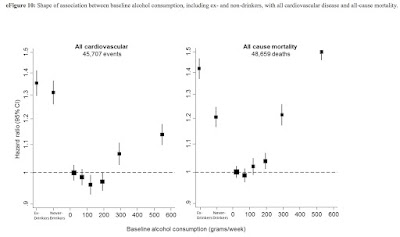
The main reason that moderate alcohol consumption reduces overall mortality is that it substantially reduces the risk of cardiovascular disease. The evidence for this is not just ‘good’. It is overwhelming. For example, this meta-analysis of 84 studies concluded that: ‘Light to moderate alcohol consumption is associated with a reduced risk of multiple cardiovascular outcomes.’ The risk of cardiovascular disease mortality was 25 per cent lower than among non-drinkers.

Since red wine is a form of alcohol, it would be very odd if drinking a moderate quantity of it wasn’t good for the heart. All the evidence shows that it is, and there are some reasons to think that it might be even better than other forms of alcohol in this respect.

Why are national drinking guidelines different from WHO recommendations?

Many countries have issued low-risk guidelines, usually recommending no more than 10 standard drinks per week. WHO does not set particular limits because the evidence shows that the ideal situation for health is not to drink alcohol at all.

Again, this is simply a lie.

Doesn’t most alcohol harm come from a minority group of heavy drinkers?

The common perception is that a small fraction of the population causes most of the harm linked to alcohol consumption. But alcohol-related cancers, accidents, injuries and violence are widely distributed across the population (8), including among those who drink moderately. Even though heavy drinkers are undoubtedly at high risk of alcohol-related harm, they contribute only a minority to the total alcohol casualties. In this “prevention paradox”, most alcohol-related harm occurs among low-to-moderate risk drinkers simply because they are more numerous in the population.

This is a reference to one of the ideas of Geoffrey Rose who argued that there are more deaths from a large number of people exposed to a low risk than from a small number of people exposed to a large risk. While this could be true of some risk factors in certain circumstances, it is not a general rule and it is particularly poorly suited to alcohol because the risk of low to moderate consumption is negative, i.e. it is beneficial.

‘Alcohol-related cancers’ are relatively rare and mostly affect heavy drinkers. It is reasonable to assume that most drink-related ‘accidents, injuries and violence’ also involve heavy/binge drinkers. The prevention paradox just doesn’t apply to alcohol and Rose never claimed it did. Some academics have tried to claim otherwise, but they have had to narrow their scope to a limited range of ‘harms’ and portray people who get drunk as moderate drinkers to do so.

The real reason why organisations like the WHO are so keen to pretend that everybody is at risk from alcohol harm and there is no safe level of drinking is that it can be used to justify population-wide policies such as minimum pricing (which the WHO’s new report wrongly describes as ‘effective’). They say this in so many words in the summary:

Takeaway

Alcohol consumption causes considerable harm to millions of people across the world, not just the heaviest users, which is why strong global action that protects the entire population is needed.

Why, you may ask, is the WHO taking such a hard line on this that it is prepared to lie to our faces? Preaching total abstinence is a departure for the WHO. It is not what most of its member states expect of it and it is out of line with its previous messaging.

Part of the reason is that some member states do support total abstinence. You have to remember that alcohol prohibition is still a reality in some countries. Several other countries, such as India and Turkey, allow the sale of alcohol but strongly discourage it. Russia and some of the Baltic states have been clamping down on alcohol in a big way in recent years. The WHO has to represent all these interests.

The bigger and more important reason is that anti-alcohol activists have weaseled their way into the WHO in growing numbers. A lot of WHO reports are written anonymously. This one isn’t, and its list of contributors is very revealing. They include:

  • Phil Cain, European Alcohol Policy Alliance (Eurocare)

  • Florence Berteletti, Eurocare

Phil Cain is a former BBC journalist who has been tweeting about alcohol for years and has become increasingly fanatical. I didn’t know he was now at Eurocare but it makes sense. Eurocare is an EU-funded temperance pressure group formed in 1990 by the Methodist teetotaller Derek Rutherford.

  • Maik Dünnbier, Movendi International

The International Order of Good Templars is a gospel temperance group formed in the mid-19th century. A few years ago they realised that their name sounded a bit too religious/masonic so they changed it to Movendi. Their agenda of total abstinence remains the same. It is now an official partner of the WHO.

  • Øystein Bakke, Global Alcohol Policy Alliance and FORUT

The Global Alcohol Policy Alliance is another temperance group set up by Derek Rutherford. Notice the trend of temperance groups giving themselves bland names so they can slot themselves into the field of ‘public health’. Formed in 2000, Derek Rutherford said its priority was to “make the most of the opportunities provided by the development of the WHO Global Alcohol Strategy and the focus on non-communicable diseases.” It is certainly doing that.

  • Adam Knobel, Foundation for Alcohol Research and Education (FARE)

FARE is a state-funded anti-alcohol organisation set up by the Australian government with a $115 million grant. It says that it spends 50 per cent of its income on ‘policy and advocacy’ and 15 per cent on ‘leading change’. In other words, it is a pressure group.

  • Nason Maani, London School of Hygiene and Tropical Medicine

Maani is an activist-academic who has co-authored many hilariously bad articles with Mark Petticrew about the alcohol industry.

  • David Jernigan, Boston University School of Public Health

Jernigan is also on the board of the Global Alcohol Policy Alliance and speaks at their mad conferences.

Finally, there is Juan Tello. Listed as co-editor of the guide for journalists, he is in charge of the WHO’s Less Alcohol Unit. He recently gave an interview in which he complained about the ‘normalisation’ of alcohol and wibbled on about the ‘commercial determinants of health’. He makes no secret of ‘pursuing a no alcohol environment’.

His interview did contain one bit of good news, however.

Juan Tello: We give countries five recommendations that are cost effective to implement, especially in middle-income countries: increase pricing, particularly through taxation; ban marketing and sponsorships advertising alcohol; decrease the physical availability of alcohol outlets; enforce checks and control of blood alcohol concentration; and treatment. We are well positioned to do this when countries are willing to move forward. 

Think Global Health: What’s the level of interest from countries?  

Juan Tello: The uptake is low. It’s truly low.

Excellent. Let’s hope it stays that way. In the meantime, if journalists are looking for a story about alcohol, may I suggest an article about WHO reports being written by anti-alcohol activists?


Friday, 3 March 2023

Martin McKee: still wrong about vaping after all these years

When a man points at the stars, McKee stares at his finger

 
The heavily overweight Zero Covid crank Martin McKee had a letter published in The Times yesterday in response to an op-ed from the paper's resident puritan Alice Thomson (whom we have come across before). Thomson has spotted a real problem - the sharp rise in vaping among teenagers, especially those using Elf bars - but characteristically comes up with the wrong solutions: banning flavours, banning colours and getting Public Health England (which she thinks still exists) to "treat vaping in the same way as cigarettes".
 
This is music to the ears of Fatty McKee who is claiming that his ignorant and dishonest campaign against e-cigarettes has been vindicated.
 

Sir, Sadly, the massive growth in e-cigarette use among adolescents comes as no surprise to those of us who warned that this would happen (“ ‘Harmless’ vapes are creating teenage addicts”, Mar 1). Unlike public health organisations worldwide, Public Health England (now the Office for Health Improvement and Disparities) has been promoting these products heavily, arguing that restricting the features that make them most attractive to young people, especially flavouring, would deter the adults they wanted to switch from cigarettes. Although no longer using the discredited “95 per cent safer than cigarettes” claim, it at least accepts that e-cigarettes are not risk-free but seem oblivious to the evidence linking their use to heart disease. We always knew that it would be a struggle to counter the efforts of the tobacco industry to get a new generation addicted to nicotine but, sadly, in England, those who should have been protecting these young people did not even try.
Professor Martin McKee

London School of Hygiene & Tropical Medicine

 
What is this "evidence linking their use to heart disease" to which McKee refers? Presumably he isn't referring to this study from last year which said...
 
We did not find a significant difference in the cardiovascular risk of exclusive e-cigarette use compared with nonuse of cigarettes and e-cigarettes

Nor can he have been referring to this study which found a "positive cardiovascular impact" among vapers who had quit smoking, with e-cigarettes being no worse for the heart than nicotine patches.
 
I can only assume that he is talking about cross-sectional studies which find that people who have been smoking for many years have a higher risk of heart disease even after they've switched to vaping. Disingenuous activist-academics present such findings as evidence that vaping, rather than prior smoking, increases the risk. Control for past smoking, however, and the association disappears. 
 
McKee's anti-vaping wingman Stanton Glantz had a paper retracted after it turned out that the heart attacks among vapers occurred before they started vaping. Perhaps that's the study he's thinking of?
 
As for the Office for Health Improvement and Disparities no longer using the '95% safer than cigarettes' claim, let's see what they have to say about that: 
 
We are aware that summarising the relative risks of vaping versus smoking across a range of different products and behaviours and assessed across multiple biomarkers can be simplistic and misinterpreted. Based on the reviewed evidence, we believe that the “at least 95% less harmful” estimate remains broadly accurate, at least over short term and medium term periods. However, it might now be more appropriate and unifying to summarise our findings using our other firm statement: that vaping poses only a small fraction of the risks of smoking. 
 
This is arguably a better way of putting it, since it is vanishingly unlikely that vaping carries five per cent of the risk of smoking.
 
John Britton replied today...

Sir, Martin McKee (letter, Mar 2) is right that the recent increase in vaping by young people is a cause for concern but I disagree that this represents a failure of public health policy. Between 2011, when vaping entered the mainstream, and 2021 (the most recent available national data), UK smoking prevalence has fallen from 20.2 per cent to 13.3 per cent — a fall roughly 50 per cent larger than in either of the preceding two decades, and equivalent to about three million smokers. While many of these former smokers are still vaping, the facts that smoking kills half of all long-term smokers and that vaping is unquestionably far less harmful than smoking make this a massive public health gain. We need to ensure that existing laws protecting children from e-cigarette promotion and under-age sale are observed and enforced, but ought not lose sight of the reality that vaping has contributed to a record reduction in the UK’s biggest avoidable cause of premature death and disability.
John Britton

Emeritus professor of epidemiology, Nottingham University

 
Britton is right about the solution. The law needs to be enforced. Notwithstanding the black market, which is the consequence of nanny state policies, it is generally very difficult for people under the age of 18 to buy cigarettes (and alcohol) these days. There is no reason why it should be any easier for them to buy e-cigarettes. 
 
There will be more media hysteria about Elf bars this year, I'm sure, but we already have the laws needed to limit underage vaping.


Wednesday, 16 March 2022

The further decline of Aseem Malhotra

"I'm with stupid"

This blog is proud to be the first place where the dubious claims of Aseem Malhotra were picked apart. It is nearly a decade since I wrote a post with the prescient title Dr Aseem Malhotra doesn't know what he's talking about. Back then the Croydon cardiologist was all about 'demonising' junk food (his word) and he was already displaying a relaxed attitude towards facts.

He then transformed into an anti-sugar campaigner before being kicked out of Action on Sugar (where a former colleague described him as "completely mad"). His next move was to jump aboard the low carb gravy train where he was involved in a hostile takeover of the National Obesity Forum which soon led to the organisation's destruction. 

Meanwhile, he became a regular at Retraction Watch after filing a series of dodgy articles to academic journals. Editors had their hands full retrospectively correcting his errors and slurs. 
 
He has written several books, including the execrable Pioppi Diet and the hastily written 21 Day Immunity Plan to cash in on COVID-19 in 2020 ("a cheap, shoddily produced work, written by a cheap, shoddy man" - Anthony Warner). In 2017, the British Dietetic Association named his Pioppi Diet as one of the 'Top 5 Celeb Diets to Avoid in 2018'.
 
Malhotra does not take criticism well. He denounced the British Dietetic Association as Big Food puppets after they dissed his diet book. He then added the British Heart Foundation and the American Heart Association to his list. He claimed that Public Health England was in the pocket of the food industry.
 
As far I can tell, he no longer practises in the NHS, although he seems to do a bit of work for private healthcare companies and, inevitably, he now has a Patreon. Frankly, it's a wonder he's allowed to practise anywhere. His main contribution to the field of cardiology has been to tell people that exercise won't help them lose weight, they shouldn't take statins and they should eat more saturated fat (he was described as "irresponsible" by Public Health England for the latter advice.)
 
I have often asked what it would take for Malhotra to get struck off. That question has become more urgent in the last six months as he has become the Pied Piper of the anti-vaxxers. In November he went on GB News to misrepresent the findings of unpublished study abstract, pandering to those who think the Covid vaccines have created an epidemic of heart attacks. 
 
 
It is at this point that Malhotra stopped being a grifting buffoon and became a dangerous grifting buffoon. His Twitter account has become a sewer of anti-vax dogwhistles and yesterday he appeared on GB News to give his worthless opinion about the death of the great Shane Warne.
 
 
Being an arrogant sociopath, he couldn't resist starting his answer with a reference to what a great cricketer he was in his youth and how he could have played at the same level as Warne if he hadn't been attracted by the glamour of being a cardiologist in Croydon hospital. He goes on say, with zero evidence, that "the [Covid] vaccine may well have played a part" in Warne's death.

Shane Warne died in Thailand of a heart attack at the age of 52. His love of junk food and his yo-yo dieting were legendary. His obituary in the Economist begins as follows... 

If someone invited him to a fancy restaurant, Shane Warne could tell them there wasn’t much point. A white-bread cheese sandwich or a bag of chips was just as good for him. Spaghetti bolognese was as far as he went in the gourmet department. And there wasn’t much to beat those warm pies you could buy at stalls, the ones he could demolish in about 30 seconds, with that sauce that inevitably ran down his chin and dribbled all over his jacket.

He drank, too. Not only Castlemaine, Foster’s and other patriotic brews, but the pints he downed in England in his winter seasons, when he discovered pubs. Those really put the weight on. He smoked like a chimney, lighting up a fag as soon as the dawn broke. His credo was “Eat. Go. Party!”, and there were plenty of high jinks to keep the tabloids happy. “Two drinks and two girls later,” began a sentence in his autobiography, and it could have started dozens.

 
Warne was a prolific smoker and had suffered from COVID-19 twice, being seriously ill on the first occasion. At the time of his death, he was on an extreme two week liquid diet.

I'm not going to speculate on what, exactly, caused his heart attack, but there is no doubt that if Malhotra had been talking about this two years ago, he would have blamed his diet. Malhotra even blamed his own mother's death on "her regular consumption of starchy carbohydrates and ultra-processed snack foods of biscuits, crisps and chocolate" (everything is a media opportunity for him).

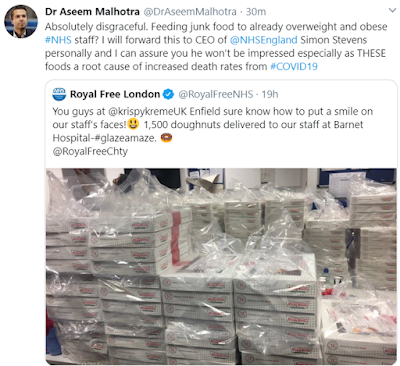
This is a guy who, in that article which first grabbed my attention ten years ago, claimed (falsely) that "diet-related diseases are responsible for 35 million deaths worldwide". A guy who made himself a laughing stock early in the pandemic with his infamous attack on doughnuts.


But when it comes to Shane Warne, all the lifestyle factors go out the window because he's found a new grift. "He had no risk factors," he says. And so - wink, wink - it may have been the vaccine.

Despicable.
 

UPDATE
 
Some details on Malhotra's school cricketing career.


Monday, 31 January 2022

A desperate attempt to deny the benefits of moderate drinking

There is mounting desperation in 'public health' to debunk the benefits of moderate drinking - or, at least, to make the public think the benefits have been debunked. Various academics are offering their services. It's as if there is a reward on offer to whoever can make the best case against the J-Curve. In a sense there is, because whoever manages it will be set for life in the neo-prohibitionist 'public health' industry.

In recent years, we have seen the J-Curve challenged by ridiculous modelling, lying by omission and the inappropriate use of Mendelian Randomisation. None of this casts serious doubt on the existence of health benefits of moderate alcohol consumption, although the drip-drip effect no doubt leaves the public confused about what the science shows (which is presumably the intention). 

Two weeks ago, the gloriously named Beatriz Champagne from the World Heart Federation falsely claimed that any amount of alcohol harms the heart. She said that any claims to the contrary are "at best misinformed and at worst an attempt by the alcohol industry to mislead the public about the danger of their product." I didn't write about this at the time because it was just an assertion with no evidence to back it up.

But then on Friday, a new study was published which claimed to disprove the J-Curve. The study was grossly misrepresented by its own author and was (unsurprisingly) misunderstood by the media.

The study should have set off warning bells to any decent health journalist. For a start, it was accompanied by some hyperbolic, media-baiting quotes from the lead author, who is a physiologist at Anglia Ruskin University...
 

“The so-called J-shaped curve of the cardiovascular disease-alcohol consumption relationship suggesting health benefit from low to moderate alcohol consumption is the biggest myth since we were told smoking was good for us."

 
The title of the study reads more like a headline than a piece of academic research...
 

Alcohol - The myth of cardiovascular protection

 
And the study ends with a dog whistle call-to-action for the government that is not justified by the findings...
 

Our results do not support the current alcohol consumption guidelines for the United Kingdom of up to 14 units per week in relation to CV risk in the general population.

 
As informed readers know, there is 50 years of evidence showing that moderate drinkers live longer than teetotallers, an effect that is mostly due to their lower heart disease risk. The authors of the new study used UK Biobank data to monitor the health outcomes of drinkers and people who have never drunk, but things start badly for them when they find that teetotallers have higher rates of heart disease and have more heart attacks than drinkers. 
 

Never drinkers were older (P < 0.0001), had a higher body mass index (P < 0.0001), higher systolic and diastolic blood pressure (both P < 0.0001), were less physically active (P < 0.0001), had a higher prevalence of diabetes (P < 0.0001) and higher incidence of overall CV events (P < 0.0001), ischaemic heart disease (P < 0.0001) and cerebrovascular disease events (P < 0.0001). The incidence of overall CV events, ischaemic heart disease and cerebrovascular disease were comparable between never drinkers and drinkers consuming more than 14 units per week.

 
This suggests, a priori, that teetotalism is not particularly healthy, although it could be the result of confounding variables. However, when the results are adjusted for confounders, the picture remains the same. (Note that former drinkers are already excluded to rule out a “sick quitter” effect).

Compared to current drinkers in adjusted models, never drinkers were at higher risk for overall CV events (hazard ratio, 1.31; 95% confidence interval, 1.20-1.42; P < 0.0001), ischaemic heart disease (hazard ratio, 1.51; 95% confidence interval, 1.29-1.76; P < 0.0001) and cerebrovascular disease (hazard ratio, 1.46; 95% confidence interval, 1.14-1.87; P < 0.0001). Consequently, using never drinkers as reference resulted in alcohol from all drink types combined exhibiting protection in relation to all outcome measures...

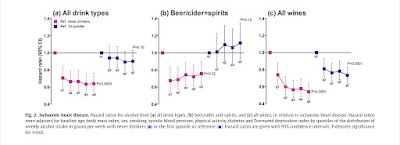
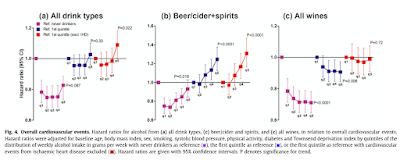
This is rather awkward for the authors. To deal with this inconvenient finding, they have a simple solution. They exclude ALL the non-drinkers from their analysis and compare light, moderate and heavy drinkers instead! They split the drinkers into five quintiles based on their alcohol consumption and show the results in the figures below. The pink data points are what you get when you compare them to non-drinkers. The blue data points show how the drinkers compare to each other. (Click to enlarge.)

As you can see, the drinkers have a lower risk of ischaemic heart disease at every level of consumption. For wine, the risk drops as people drink more, but for beer, cider and spirits (which are grouped together for some reason) the benefits decline somewhat as people drink more (although none of the changes are statistically significant). 

It's a similar story when you look at the relationship with all types of cardiovascular disease, although the authors exclude ischaemic heart disease from one of these plots (red) for reasons that are never properly explained. Here we see a reduction in risk for all wine drinkers and for moderate drinkers of other alcoholic drinks.


In short, the authors are making some pretty extreme claims about moderate drinking without looking at the only reference group that matters (non-drinkers - or never-drinkers). They effectively use light drinkers as the control. And even then, they barely achieve their desired result. 

We’ve seen this trick performed before in a study from 2018 which made similar claims by comparing light drinkers to moderate and heavy drinkers - and generated similar headlines. The graph used in the main body of that study appeared to show no evidence of a J-Curve...


This was sleight of hand designed to catch readers out at a glance. The authors simply ignored the non-drinkers and used light drinkers as their reference point. But if you digged deep into the appendix, there were graphs that showed that the J-Curve was alive and well. Never-drinkers had a 30 per cent increased risk of heart disease and a 20 per cent increased risk of premature death.

Everything about Friday's study seemed designed to mislead. The press release for it said... 
 
 
New study: 14 units a week still harmful to health


Compared to what? Not compared to zero units, that's for sure. It's difficult to find any interpretation of that headline that isn't trivial or wrong.

I see no academic merit in the methodology used in this study. It certainly can't be used to say anything about the relative risks of drinking versus not drinking because it deliberately excludes the non-drinkers. 

It should never have been published.


Monday, 19 July 2021

The Pioppi Diet is a superficial lifestyle guide based on distorted evidence

First published by Spectator Health in July 2017

Pioppi is a very small village in southern Italy. It is one of those places where people are reputed to live much longer than average (the authors claim life expectancy is 89 years but do not provide a citation for this claim). The gimmick behind this book is that the authors have travelled to the village, bottled its secrets and are prepared to sell them to you for a small fee.

Since the authors are both advocates of the low carb, high fat (LCHF) regime, everything is seen through the prism of the Atkins diet. They are Aseem Malhotra (a cardiologist, as he never tires of reminding you) and Donal O’Neill (director of internet-only, anti-carbohydrate movies such as Cereal Killers and Run on Fat).

In some respects, Pioppi is a surprising place to find this low carb duo as it was the home of the scientist Ancel Keys who died in 2004 at the age of 100. It was Keys who drew the world’s attention to the villagers’ longevity when he was conducting research into nutrition in the mid-twentieth century. That research helped to create the evidence that linked saturated fat to heart disease, and low carb activists have spent years portraying him as a crackpot and a bully who was probably in the pay of Big Sugar and who definitely blackmailed the scientific community into unfairly ‘demonising’ saturated fat. As a result of his junk science, they say, governments around the world changed their dietary guidelines to encourage the consumption of carbohydrates at the expense of life-saving lard. The general public, slavishly following government advice as always, took this as a green light to stuff their faces with sugar and soon became obese.

It’s a bizarre and ahistorical conspiracy theory which, as Anthony Warner says in The Angry Chef would require ‘paying off the medical establishment, the World Health Organisation, numerous charities, public health bodies and nutrition researchers around the world, and keep producing systematic reviews that show links between consumption of saturated fats and increased risk of heart disease.’ The idea that millions of people have been killed by guidelines which (a) were never followed, and (b) clearly discouraged sugar consumption, is one of the strangest memes in the world of nutritional woo.

Pioppi is at the very centre of the nutritional orthodoxy. Not only did Ancel Keys live there for many years, but it is recognised by UNESCO as the home of the Mediterranean Diet. In a sense, The Pioppi Diet is an attempt to erase the legacy of Keys and reclaim the village for the one true faith of LCHF. Keys attributed the Pioppi residents’ low rates of heart disease to the relative scarcity of saturated fat in the Mediterranean diet, but as far as Malhotra and O’Neill are concerned, saturated fat has been exonerated and their job is to discover what is really going on there.

Reading between the lines of The Pioppi Diet, it’s reasonably obvious what’s going on. It’s a rural farming and fishing community of 200 people who are engaged in manual labour from a young age and remain physically active throughout their lives. The air is clean and the local diet is dominated by fruit, vegetables, fish, pasta, olive oil and wine. The villagers have traditionally been too poor to eat a lot of red meat. Indeed, they have been too poor to eat a lot of anything, hence the low rate of obesity and its associated diseases.

The longevity of the Pioppi people is therefore entirely consistent with mainstream science and yet it forms the backdrop to a book which tells the reader to be ‘prepared for everything you know and believe to be true to be turned on its head’. But it is only a backdrop, a blank screen onto which they project whatever thoughts come to mind. They visit the village but do not conduct any research there. Instead, they stroll around drinking coffee, admiring the noble peasants and making sagelike comments such as ‘There’s not much sign of stress around here, Aseem.’

The first half of the book sees them take it in turns to crowbar in all the LCHF articles of faith: physical activity won’t help you lose weight, saturated fat is good for you, cholesterol is nothing to worry about, sugar is a poison, a calorie is not a calorie, etc. I have neither the time nor inclination to fact-check all of their claims so I will allow for the possibility that they might be right from time to time. I am quite prepared to believe that the dangers of saturated fat have been overstated; better qualified people than Malhotra and O’Neill have been critical of the evidence for years. But whenever they touch on a topic with which I am familiar, I noticed that their discussion of evidence was partial and one-sided, and sometimes totally incorrect. On the occasions when I felt moved to follow up their (rather patchy) references, I nearly always found that there was less to them than meets the eye.

For example, Malhotra cites the PREDIMED study, a well-regarded piece of research which appeared to show significant benefits from the consumption of nuts and olive oil. But it did not, as Malhotra claims, show the superiority of a high-fat diet over a low-fat diet; such a hypothesis was never raised nor tested. He also cites the Lyon Diet Heart Study as evidence that ‘the standard American Heart Association recommended “low-fat diet”‘ causes more heart attacks than the Mediterranean Diet. The study does indeed show benefits from the Mediterranean Diet, but it is only by reading the study that you would see that the Mediterranean Diet was lower in both total fats and saturated fats than the ‘standard’ diet.

Some of the errors in the book are risible, such as when they claim that in ‘industrialised countries between 5 and 10 per cent of GDP is spent treating dental disease’ (the entire NHS budget takes up 9 per cent of GDP). Others are just sloppy, such as when they use a graphic from a newspaper to prove that poor diets cause 35 per cent of deaths (they don’t). Nearly all of them are consistent with a systematic bias towards a desired conclusion.

The reader should not have to look up the references in a book to find out what is being concealed. The nutritional epidemiology literature is enormous. Thousands of studies have been conducted and they do not all agree with one another. If one ignores the totality of the evidence and cherry-picks a handful of studies, it is possible to argue almost anything. If the reader cannot trust the author to play with a straight bat, he might as well save his money and go on a Google binge.

Take the chapter on sugar, for instance. The scientific consensus says that obesity is a risk factor for diabetes. Insofar as there is a link between sugar and diabetes, it is the same as the link between cheese and diabetes, ie. if you eat to much of it, you will become obese and therefore be at greater risk of diabetes. It is indirect.

A handful of dissenters claim that there is a direct link and that sugar can cause diabetes even in the absence of obesity. The most famous of them is Robert Lustig, a Californian endocrinologist who has views on sugar that are extreme by any standard. He has made various wild claims about sugar being ‘toxic’ and ‘addictive’. He calls it ‘the alcohol of the child’. Amongst other strange assertions, he has said that breast milk is not sweet and that pasta was invented in America. His published research on sugar is, in my view, third rate and I don’t think anybody should take him too seriously. But he is on the low carb bandwagon and is one of Malhotra’s chums. Consequently, while the chapter on sugar only references five studies, four of them are by Lustig and his colleagues, although this is not obvious from the text.

Even if the scientific consensus is wrong and Lustig turns out to be a sort of Galileo, shouldn’t Malhotra at least acknowledge the totality of the evidence, even if only to argue against it? And if there is an independent association between sugar and diabetes, why do organisations that want people to eat less sugar – such as SACN and Diabetes UK – continue to deny it? Is everybody in the pay of Big Sugar?

Malhotra’s credentials as a cardiologist are not sufficient to persuade me to ignore so many scientists. He says himself that ‘the majority of doctors are not equipped with even basic training to give specific, evidence-based lifestyle advice’ and admits that he doesn’t recall receiving ‘a single lecture at medical school on the impact of nutrition and lifestyle on preventing and treating disease’. All of his conclusions, he says, are based on ‘my own research’. But there are experts in this field who have received ample training and have been given many lectures on nutrition. They are called dieticians, and I have yet to meet one who endorses Malhotra’s message.

It soon becomes clear that The Pioppi Diet is not a serious review of the evidence. It provides a distorted and superficial account of a tiny fraction of the evidence. It does not really attempt to overturn the scientific consensus, it simply ignores it. Meanwhile, it devotes page after page to a handful of low carb activists who are portrayed as world-leading authorities, such as Zoe Harcombe, Tim Noakes, Nina Teicholz, Jason Fung and Robert Lustig. While all these people have books to sell, Malhotra and O’Neill accuse ‘many scientists and doctors’, as well as the media, of being ‘under the financial influence of the food and pharmaceutical industry’. This, we are told, is why they ‘disseminate selected, biased and outdated information’. When your best evidence is a single study from 1956 which has never been replicated, this is a bit rich.

So what is this Pioppi Diet that promises a ‘life-changing journey taking just 21 days’? The first thing to understand is that it is not a diet, it is a lifestyle. From wandering around Pioppi, Malhotra and O’Neill come to the profound conclusion that it is important to socialise with friends, take plenty of exercise, be relaxed and get some sleep. They can’t help you with socialising or stress relief, but they suggest you get at least seven hours sleep (which is also what the National Sleep Foundation recommends). With regards to exercise, O’Neill spends several pages waxing lyrical about high intensity interval training, but is forced to admit that they don’t do that kind of thing in Pioppi and so recommends getting up from your desk every 45 minutes to stretch your legs.

So much for the lifestyle. What about the food? Malhotra and O’Neill recommend that you avoid desserts, all sugars (including fruit juice and honey) and many of the most common sources of calories, including bread, rice, pasta, cereals, potatoes, noodles, couscous and ‘anything flour based’. You should also fast for 24 hours once a week and think about skipping breakfast every day (because the authors were told that Pioppi people used to be so poor that they sometimes went to work hungry). If you do all this, plus lots of walking and go to the gym five times a week (as Malhotra does) or engage in regular high intensity training (as O’Neill does), they reckon you will lose weight. And do you know what? I think they might be right. Behold the miracle of the Pioppi Diet!

The trouble with this whole concept is that Malhotra and O’Neill’s interpretation of the Pioppi Diet does not reflect what the people of Pioppi eat. It is basically an ultra-low carb version of the Mediterranean Diet with a few trendy ingredients, such as coconut oil, thrown in. Coconuts have never been part of the Italian diet and nor have ‘full-fat fermented dairy products’ but the authors include the latter anyway because – as they say – ‘the Greek cohort in Ancel Keys’s original studies enjoyed [them] … so there is no reason we shouldn’t be doing likewise!’

Do you know what the people of Pioppi actually eat? Processed carbohydrates. Farm workers in rural Italy do not – could not – survive on a diet of fish and seasonal vegetables. Pasta is as central to the Italian diet as potatoes are to Britain’s. So too is bread. This is the elephant in the room for anyone trying to pretend that Italians eat a low carb diet. As a 94 year old Pioppi resident said last year: ‘Pasta is my favourite food. I don’t understand why so many people try to cut that and bread out of their diets – it is like medicine for the heart and it is silly not to eat it.’

Once you accept that pasta and bread are important elements of Mediterranean cuisine, the actual Pioppi diet involves lots of fruit, vegetables, fish, starchy carbohydrates, mushrooms, nuts and eggs, but little or no cake, biscuits, processed meat, crisps and red meat. In other words, it is the UK government’s Eatwell Guide with extra virgin olive oil. Maybe those official dietary guidelines are not so deadly after all?


Monday, 21 June 2021

The hounding of Katherine Flegal

Way back in 2013, I wrote about a meta-analysis published in the Journal of the American Medical Association which assessed 97 individual studies encompassing a total sample group of 2.88 million people. It found that people who are overweight have a slightly reduced risk of mortality compared to people of 'healthy' weight (RR = 0.94 (0.91-0.96)).

I first wrote about it when it was published because the BBC was using the old trick of putting criticism of the study front and centre. 

There are two ways to report news that divides opinion.
The first is to report what has happened and then include comments from those who have a view on it, including critics. 
The second is to lead off with disparaging comments from the critics so that the news itself becomes incidental. 
This latter approach amounts to poisoning the well and is mainly favoured by propagandists and media outlets which have a blatant editorial bias. So, with that in mind...

From the BBC:

'Weight is healthy' study criticised

A study which suggests being overweight can lead to a longer life has caused controversy among obesity experts.

One labelled the findings a "pile of rubbish" while another said it was a "horrific message" to put out.

The criticism from certain people was fierce. So fierce as to suggest a religious schism rather than a scientific debate. Tam Fry, from the National Obesity Forum, said: 
 
"It's a horrific message to put out at this particular time. We shouldn't take it for granted that we can cancel the gym, that we can eat ourselves to death with black forest gateaux." 
 
That was a bit of a straw man, but it was constructive and courteous compared to the quote from veteran anti-obesity crusader Walter Willett of Harvard School of Public Health:

"This study is really a pile of rubbish and no one should waste their time reading it."
 
As I wrote at the time...

How heartening it is to see the spirit of intellectual enquiry thriving at the Harvard School of Public Health. Perhaps Dr Willett and his friends will make a bonfire out of copies of the Journal of the American Medical Association and dance around it.

And that is pretty much what he did. As Nature subsequently reported, Willett "organized the Harvard symposium—where speakers lined up to critique Flegal's study—to counteract that coverage and highlight what he and his colleagues saw as problems with the paper."
 
The study's lead author, Katherine Flegal, has now written a full account of what happened and it really shows what you leave yourself open to when you get on the wrong side of 'public health' activists. The data she had was fine and her findings have been replicated many times. Her critics' problem was not really with the data but with 'the message' her findings supposedly sent out. This was obvious from Tam Fry's comment above as well as subsequent comments made by Walter Willet, such as...

Studies such as Flegal's are dangerous, Willett says, because they could confuse the public and doctors, and undermine public policies to curb rising obesity rates.

“There is going to be some percentage of physicians who will not counsel an overweight patient because of this,” he says. Worse, he says, these findings can be hijacked by powerful special-interest groups, such as the soft-drink and food lobbies, to influence policy-makers.
 
... Willett says that he is also concerned that obesity-paradox studies could undermine people's trust in science. “You hear it so often, people say: 'I read something one month and then a couple of months later I hear the opposite. Scientists just can't get it right',” he says.
 
“We see that time and time again being exploited, by the soda industry, in the case of obesity, or by the oil industry, in the case of global warming.”

And so she was attacked and hounded. It turns out that this process had been going on since 2005 when, as a scientist at the CDC, she published a study which...
 
...found that overweight was associated with slightly but significantly fewer deaths than normal weight. A quick glance at the literature suggested that our findings about overweight were not particularly unusual. We were unprepared for the firestorm that followed.

You should read the whole article (no paywall), but here are a few lowlights from her experience:

I fielded dozens of press calls as soon as our article was published. To my surprise, after the first few hours, many of the journalists who called me had already spoken to a professor, Walter Willett, (let's call him Professor 1) from a prestigious school of public health (PSPH). He was not a statistician and had no expertise in estimating the number of deaths associated with obesity. Our article was not intended to have anything to do with his work. He had apparently begun pre-emptively contacting the press, inserting himself into the discussion, positioning himself as an expert, and providing negative and antagonistic comments on our article before reporters had spoken to me. He used strong language to disparage our article, describing it as “really naive, deeply flawed and seriously misleading”.

.. In the same year, a post-doc at PSPH posted the following on a blog: “Numbers from Flegal's paper had been subsequently RETRACTED [sic] by the CDC, and she has subsequently been demoted at the CDC for writing the erroneous paper.” Every single one of these statements was false. CDC had not retracted our findings, and I had not been demoted. In fact, our paper had received CDC's highest science award, the Shepard award, in 2006.

.. Around the same time, some unusual statements were anonymously inserted in the Wikipedia entry on “overweight.” These statements asserted with no references that our article had been “widely discredited and regarded as fatally flawed by researchers from the Harvard School of Public Health, Harvard Medical School, American Cancer Society, and even the CDC agency itself, which has backtracked on the findings from the Flegal report.” This was part of what appeared to be an ongoing campaign to present our article incorrectly as having been repudiated by reputable sources.

.. In 2007, I accepted an invitation to give a named lecture at the 2008 meeting of a scientific society. The invitation included no mention of a rebuttal. When I received the final program a month before the meeting, to my surprise Professor 2 from PSPH had been added as a rebuttal speaker. This is an unusual way to treat an invited lecturer. As part of Professor 2's rebuttal, he presented a slide supposedly “based on” our research that strangely showed precisely the opposite of what we had found. It turned out that Professor 2 and his group had misunderstood a table in our published article and misinterpreted the results. Although I wrote him an email to clarify the table, Professor 2 and his colleagues nonetheless submitted an article for publication with the same errone- ous analysis. Fortunately, their article was rejected. This led me to realize that if such an article were to get published with such an erroneous analysis, it would likely be quite difficult for me to ever correct the situation. This episode as well as others also led me to realize that some, perhaps many, of our critics had very little understanding of our article.

.. Another line of attack was something like “this is just one study.” According to the 2007 hit piece in Scientific American, “Decades of re- search and thousands of studies have suggested precisely the opposite ...”, adding “Flegal is not necessarily wrong, but the preponderance of evidence clearly points in the other direction.” In fact, many other studies had already shown no excess mortality associated with overweight. The 2013 obesity guidelines put out jointly by the American Heart Association, the American College of Cardiology and The Obesity Society, also reported the finding that overweight did not appear to be associated with excess mortality, rating the strength of the evidence as “moderate.” Professor 2 was a coauthor of these guidelines. 

The initial intent of these attacks seemed to be to discredit our work completely. They employed denigrating and insulting remarks (“rubbish,” “ludicrous,” “complete nonsense,” “fatally flawed and widely discredited”) implying that our work was not worthy of serious consideration. There were also suggestions that we were unqualified, and my integrity and competence were questioned. Some attacks were surprisingly petty. At one point, Professor 1 posted in a discussion group regarding salt intake that JAMA had shown a track record of poor editorial judgment by publishing “Kathy Flegal's terrible analyses” on overweight and mortality. Similarly, again using a diminutive form of my name, Professor 1 told one reporter: “Kathy Flegal just doesn't get it”. It became clear that one of the things that critics found disturbing was that what they called the “lay media” or the “popular press” (which apparently extended to the New York Times, Scientific American and even Nature, a leading scientific journal) had reported on our findings as though they were worthy of serious discussion. One of the effects of the public insults may also have been to deter or intimidate other investigators. An anonymous researcher was quoted elsewhere as saying if character assassination is the price for publishing data that contradicts established beliefs, fewer academics will be willing to stick out their necks and offer up fresh thinking.

This is the 'public health' playbook. When the evidence doesn't go your way, resort to appealing to authority (as Flegal says, Willett is a leading academic in nutrition but not in the kind of work she does). Resort to the media (the BBC was only too happy to slant its coverage in their direction). Resort to editing Wikipedia, to holding one-sided symposiums, to fiddling the figures and to personal abuse. 
 
We've seen it before with the Australian sugar 'paradox' and very recently with vaping. Even John Snow got this treatment when he contradicted miasma theory. As far I can tell, the only part of the playbook that was not employed in this instance was accusing Flegal of being funded by 'Big Food', but I bet they were tempted. 

It's an incredible amount of defensiveness for an issue that shouldn't really matter. It's not an 'obesity-paradox' because people who are overweight are not obese. It should be possible to accept that people who exceed the entirely arbitrary BMI threshold of 25 - but who are not obese - do not suffer significant health risks, while those who exceed the threshold of 30 do - and that the fatter they get thereafter, the greater the risk.

But 'public health' doesn't really do nuance, does it?